
 by
by Air Travel With Ear Problems: Proven Equalization and Safety Tips for Flying Comfortably
21 Dec, 2025Feeling that painful pressure in your ears during takeoff or landing? You’re not alone. Millions of people experience airplane ear every year - a condition caused by pressure imbalance between your middle ear and the cabin. It’s not just annoying; it can be sharp, dizzying, and even temporarily deafening. But here’s the good news: you don’t have to suffer through it. With the right techniques and timing, you can fly without pain - even if you’ve got allergies, a cold, or kids who won’t stop crying.
Why Your Ears Hurt During Flights
Your ears aren’t broken. They’re just struggling to keep up. Inside your ear is a small tube called the Eustachian tube - about the length of a paperclip - that connects your middle ear to the back of your throat. Its job? To balance pressure. When the plane climbs, air pressure drops outside your body, and your eardrum bulges outward. When it descends, pressure pushes inward. Normally, swallowing or yawning opens the tube and lets air flow in or out. But when you’re congested, sick, or a child with smaller tubes, it doesn’t open fast enough. That’s when pain hits.Studies show 10% of adults and over 20% of kids feel significant discomfort. During allergy season, that number jumps to nearly one-third. The worst moments? The last 1,000 feet of descent. That’s when pressure changes fastest - up to 40 mmHg in under a minute. Without action, your eardrum gets pulled inward like a vacuum seal. In rare cases, it can even tear. But 78% of those cases are preventable with simple, timely moves.
What Works: The Proven Equalization Methods
Not all techniques are created equal. Some are safe for kids. Others carry risks. Here’s what actually works, backed by ENT specialists and clinical trials.- Swallowing and yawning - The safest option. Do it every 30 seconds during descent. It works for 65% of people. No side effects. Perfect for children.
- Toynbee maneuver - Pinch your nose shut and swallow. It’s safer than blowing, but only works for 68% of adults. Kids under 7 often can’t coordinate it.
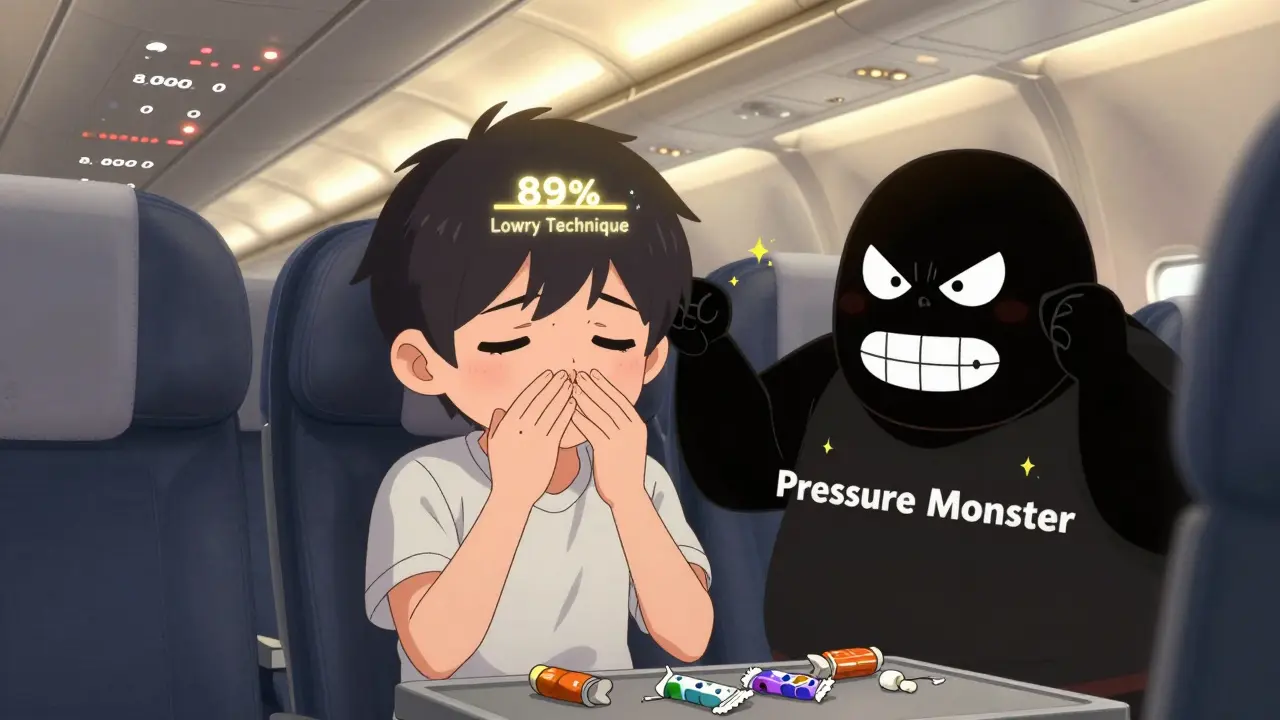
- Lowry technique - Combine swallowing and gentle blowing. Success rate: 89%. But it takes practice. Most people need three flights to get it right.
- Voluntary Tubal Opening - Tense your soft palate and push your jaw forward. It’s the most effective (92%) but requires weeks of daily training. Not for casual flyers.
- Valsalva maneuver - Pinch your nose and blow gently. Works for 82% of people. But blow too hard? You risk inner ear damage. Doctors say 27% of barotrauma cases come from overdoing this.
Here’s the real trick: don’t wait until it hurts. Start equalizing at 8,000 feet - that’s when the cabin pressure begins to rise noticeably. Keep doing it every 300 to 500 feet. That’s about every 30 seconds during descent. If you wait until your ears pop on their own, you’re already behind.
Special Tips for Kids
Children are more vulnerable. Their Eustachian tubes are shorter, narrower, and often blocked by mucus. They also can’t explain what they’re feeling - and they’ll often sleep through the worst part.- Feed them during descent - Bottle-feeding is 43% more effective than sipping from a cup. The stronger swallowing action helps open the tube. If they’re old enough, give them a snack or chewy candy.
- Jaw wiggles - Gently move their jaw side to side while swallowing. Studies show this boosts success by 22%.
- Don’t let them sleep - 73% of pediatric ear pain cases happen because kids are asleep during descent. Keep them awake and active.
- Avoid decongestants under age 6 - The FDA warns these can cause rapid heart rate in young children. Even a single dose isn’t worth the risk.
Earplugs, Sprays, and Pills - Do They Help?
There’s a whole industry built around fixing airplane ear. But not everything lives up to the hype.Filtered earplugs (like EarPlanes) - These aren’t noise-canceling. They’re designed to slow pressure changes. Clinical trials show they work for 76% of people. But if you have chronic Eustachian tube dysfunction? Their effectiveness drops to 42%. They cost about $5 a pair and are worth trying if you fly often.
Nasal decongestant sprays (like Afrin) - These shrink swollen tissues in minutes. FDA data shows they work for 85% of users. But don’t use them for more than three days in a row - they can cause rebound congestion. And if you’re over 40 or have high blood pressure? Talk to your doctor first. About 12% of adults face cardiovascular risks.
Oral decongestants (like Sudafed) - Pseudoephedrine helps for 8-12 hours. Take it 30-60 minutes before descent. Same warnings apply: avoid if you have heart issues or high blood pressure.
Nasal steroid sprays (like Fluticasone) - A newer option. University of Pennsylvania research shows daily use for a week before flying reduces inflammation by 61%. It’s not a quick fix, but if you fly monthly, it’s a game-changer.
Otovent device - This is a small balloon you blow up through your nose. It forces the Eustachian tube open. FDA-approved in 2022, it works in 88% of clinical trials. Great for kids and adults who can’t do the Valsalva.
What NOT to Do
Some habits make things worse. Avoid these common mistakes:- Waiting until it hurts - 68% of sufferers only try to equalize after pain starts. By then, it’s harder to fix.
- Blowing too hard - Force equals damage. The Valsalva should feel like blowing through a straw, not a bike tire.
- Sleeping during descent - Especially for kids. Your body doesn’t swallow in sleep.
- Using decongestants too often - Rebound congestion can leave you worse off after the flight.
- Assuming one method works for everyone - What works for you might not work for your child. Try multiple techniques.

What’s New in Air Travel and Ear Health
The industry is catching up. Newer planes like the Boeing 787 keep cabin pressure at 6,000 feet instead of the old standard of 8,000 feet. That’s a 25% reduction in pressure change. Delta Airlines now uses a gentler 3-degree descent angle instead of 3.5 degrees - slowing pressure shifts by 14%.Medical advances are even more promising. Mayo Clinic is testing tiny Eustachian tube stents - tiny tubes placed during a quick outpatient procedure. Phase 2 trials show 92% success. For people who get ear pain on every flight, this could be life-changing.
And in the near future? Smart earplugs from companies like Bose are in beta testing. They’ll light up or vibrate when you need to swallow - giving real-time feedback. The FAA is also considering a 2025 rule requiring all new aircraft to keep cabin pressure below 6,500 feet during descent.
When to See a Doctor
Most ear pain goes away within hours. But if you have:- Pain lasting more than 24 hours
- Hearing loss that doesn’t improve
- Dizziness or ringing in the ear
- Blood or fluid draining from the ear
See an ENT specialist. You might have a perforated eardrum or chronic Eustachian tube dysfunction. A simple procedure called balloon dilation - where a tiny balloon is inflated in the tube - has a 76% long-term success rate. It costs around $4,000 out-of-pocket in the U.S., but for frequent flyers, it’s often worth it.
And if you fly often? Start a daily habit: swallow 10 times before bed, 10 times in the morning. It keeps the tubes flexible. One study found people who did this for a week reduced their ear pain by 57%.
Final Checklist for a Pain-Free Flight
- Take a decongestant (if appropriate) 60 minutes before landing
- Use filtered earplugs if you fly often
- Start equalizing at 8,000 feet - don’t wait
- Swallow, yawn, chew gum - constantly during descent
- Keep kids awake and feeding/sucking during descent
- Avoid sleeping during landing
- Never force the Valsalva - gentle pressure only
- If pain lasts more than a day, see a doctor
Flying with ear problems isn’t a life sentence. It’s a solvable problem - if you act early, act often, and act smart. You don’t need expensive gear or a medical degree. Just awareness and a few simple habits. Next time you board a plane, don’t just hope for the best. Take control - your ears will thank you.
Julie Chavassieux
December 22, 2025 AT 12:52Wait so you’re telling me I’ve been doing this wrong my whole life?? I always just chew gum and hope for the best. Now I feel like a caveman who just discovered fire.
Jeremy Hendriks
December 22, 2025 AT 19:28Human biology is a glitch in the matrix. We evolved on solid ground, not in pressurized metal tubes hurtling through the stratosphere. The Eustachian tube? A Band-Aid on a bullet wound. The real solution isn’t swallowing harder-it’s redesigning the entire aviation pressure model. Why are we still flying like it’s 1972? The tech exists. The science is clear. We’re just too lazy to fix it.
jenny guachamboza
December 24, 2025 AT 02:49ok but have you heard about the secret government program that injects ear pressure sensors into airline passengers?? 🤫 I got this from a guy on Reddit who knows a guy who works for Boeing and he said they’re using it to track your ‘stress levels’ during flights… also the 787 isn’t better, it’s a trap. they lowered the pressure so you don’t notice the ear pain until you’re already addicted to the flight… 💀
Sai Keerthan Reddy Proddatoori
December 25, 2025 AT 04:20India has better ear health than US. We fly daily on cheap airlines, no earplugs, no sprays. Just swallow, eat jalebi, and pray to Hanuman. No science needed. Your ‘clinical trials’ are Western nonsense. We don’t need your fancy balloons or stents. Our ears are tougher than your coffee cups.
Tarun Sharma
December 26, 2025 AT 01:03Thank you for the detailed and well-researched post. The information is both practical and scientifically grounded. I appreciate the emphasis on timing and the distinction between safe and risky techniques.
Kiranjit Kaur
December 27, 2025 AT 02:52OMG I’m so glad I found this!! 🙌 I used to dread flying with my toddler-now I give her gummy bears and wiggle her jaw like a pro. She doesn’t even cry anymore. I’m telling all my mom friends!! 💕 You just saved my next flight!
Jim Brown
December 28, 2025 AT 22:10The human ear, in its exquisite vulnerability, serves as a silent metaphor for our collective dissonance with modernity. We ascend through the heavens in vessels of engineered steel, yet our physiology remains tethered to the primordial atmosphere of our ancestors. The pain we feel is not merely physical-it is existential. To swallow is to reconcile with impermanence. To yawn is to surrender to the rhythm of a world that refuses to accommodate us. The Valsalva maneuver? A desperate plea to the universe: ‘Let me be equal.’
Sam Black
December 29, 2025 AT 06:40As someone who flies for work every month, I’ve tried everything. The Otovent balloon is legit. It’s weird at first-like blowing up a balloon through your nose-but after a few tries, it’s way gentler than blowing hard. I keep one in my carry-on now. Also, hydration helps more than people think. Dry air + dry throat = worse pressure issues. Drink water like it’s your job.
Jamison Kissh
December 30, 2025 AT 14:25What if the real issue isn’t the pressure change, but our inability to adapt to it? We’re taught to fight discomfort instead of observing it. Maybe instead of forcing the tube open, we should learn to relax into the sensation. Breathwork before descent-slow inhales, long exhales-might be just as effective as swallowing. It’s not about mechanics. It’s about presence.
Tony Du bled
December 31, 2025 AT 23:00Man I just chew gum and stare out the window. If it pops, it pops. If not, I yawn. Done. No spray, no balloon, no science. Airplanes are loud, weird, and uncomfortable. We’re all just trying to get to the other side without crying.
Kathryn Weymouth
January 1, 2026 AT 20:14One thing missing from this guide: the importance of posture. Sitting upright during descent improves Eustachian tube function significantly. Slouching compresses the throat and makes equalization harder. I learned this the hard way after a 3-hour earache on a long-haul flight. Now I adjust my seat before descent every time. Small change, huge difference.
Nader Bsyouni
January 3, 2026 AT 12:50Of course you’re recommending decongestants and earplugs. That’s what the pharmaceutical-industrial complex wants you to believe. The real solution? Stop flying. Why are we still subjecting ourselves to this archaic, high-altitude torture chamber? The climate cost alone makes this absurd. Let’s build teleporters or at least train people to meditate through pressure changes instead of buying more plastic balloons and overpriced sprays. This entire post is a distraction from the real problem: our addiction to unnecessary travel.