
 by
by Antitrust Issues in Generic Substitution: Legal Concerns and Enforcement
22 Apr, 2026Imagine you’ve been taking a medication for years. Suddenly, your doctor tells you the original version is gone, and you must switch to a "new and improved" version. It sounds like progress, but in the pharmaceutical world, this is often a calculated move to keep cheaper generics off your pharmacy shelf. When brand-name drug companies use these tactics to bypass generic substitution laws, they aren't just innovating; they are potentially breaking antitrust laws. This creates a massive financial burden for patients and taxpayers, often costing billions in avoidable healthcare spending.
For this system to work, state substitution laws are critical. They allow pharmacists to automatically swap a brand-name drug for a bioequivalent generic. This is the "secret sauce" of generic success; when these laws work, generics often capture 80-90% of the market within months. But what happens when a company finds a way to make those laws irrelevant?
The "Hard Switch": How Product Hopping Works
One of the most controversial tactics is "product hopping"-specifically the "hard switch." This happens when a manufacturer introduces a slightly modified version of a drug (like changing a tablet to a capsule or an immediate-release version to an extended-release one) and then pulls the original version from the market right before the patent expires.
Why does this matter? Because state substitution laws only apply to the exact drug being prescribed. If the original drug is gone, the pharmacist can't substitute a generic version of it. Patients are forced to get a new prescription for the "new" version, which is still under patent. Because switching prescriptions involves high transaction costs-like booking a doctor's appointment-most patients just go along with it.
A prime example is the case of Namenda. The manufacturer, Actavis, introduced an extended-release (XR) version and withdrew the immediate-release (IR) version just 30 days before generics hit the market. The courts eventually stepped in, ruling that this wasn't about better medicine; it was about blocking competition.
Legal Battlegrounds: Actavis vs. Nexium
Not every product change is considered illegal. The courts have had to draw a fine line between legitimate innovation and anticompetitive behavior. The difference usually comes down to whether the old drug stayed available.
| Case Example | Action Taken | Court Verdict | Key Reason |
|---|---|---|---|
| New York v. Actavis | Withdrew original Namenda IR | Anticompetitive | Total withdrawal blocked generic substitution |
| In re Nexium Litigation | Switched users to Nexium but kept Prilosec | Procompetitive | Original drug remained available for substitution |
In the Nexium case, AstraZeneca encouraged people to move to Nexium, but they didn't kill off Prilosec. Because the original was still there, generic companies could still compete via substitution laws. This distinction is vital: removing the original product is often the "smoking gun" in antitrust lawsuits.

The REMS Trap: Blocking the Samples
Antitrust issues aren't just about the pharmacy counter; they start in the lab. To get a generic drug approved, a company needs samples of the brand-name drug to prove it's bioequivalent. Some companies use Risk Evaluation and Mitigation Strategies (REMS)-safety programs mandated by the FDA-as a shield to deny these samples.
By claiming that the drug is "too dangerous" to distribute freely, brand companies can effectively block generic competitors from ever starting their testing. This isn't just a minor delay; some estimates suggest that the inability to access samples for just 40 specific drugs costs the healthcare system over $5 billion a year. Legal experts argue this is a textbook case of monopolization because the behavior serves no purpose other than to harm the competitor.
The Staggering Cost of Delayed Competition
When these tactics work, the financial fallout is massive. Consider the impact of "patent thickets" and product hopping on high-cost medications. Data shows that for just three drugs-Humira, Keytruda, and Revlimid-the U.S. has wasted an estimated $167 billion compared to the European Union, simply because generic entry was delayed.
Look at Revlimid. Over 20 years, its price climbed from $6,000 to $24,000 per month. When a company can manipulate the market to prevent substitution, they have total control over the price. This isn't a free market; it's a captured one. Even minor changes, like Teva's switch with Copaxone, have resulted in costs to consumers estimated between $4.3 and $6.5 billion over a short period before the patents were invalidated.
Current Enforcement and Regulatory Trends
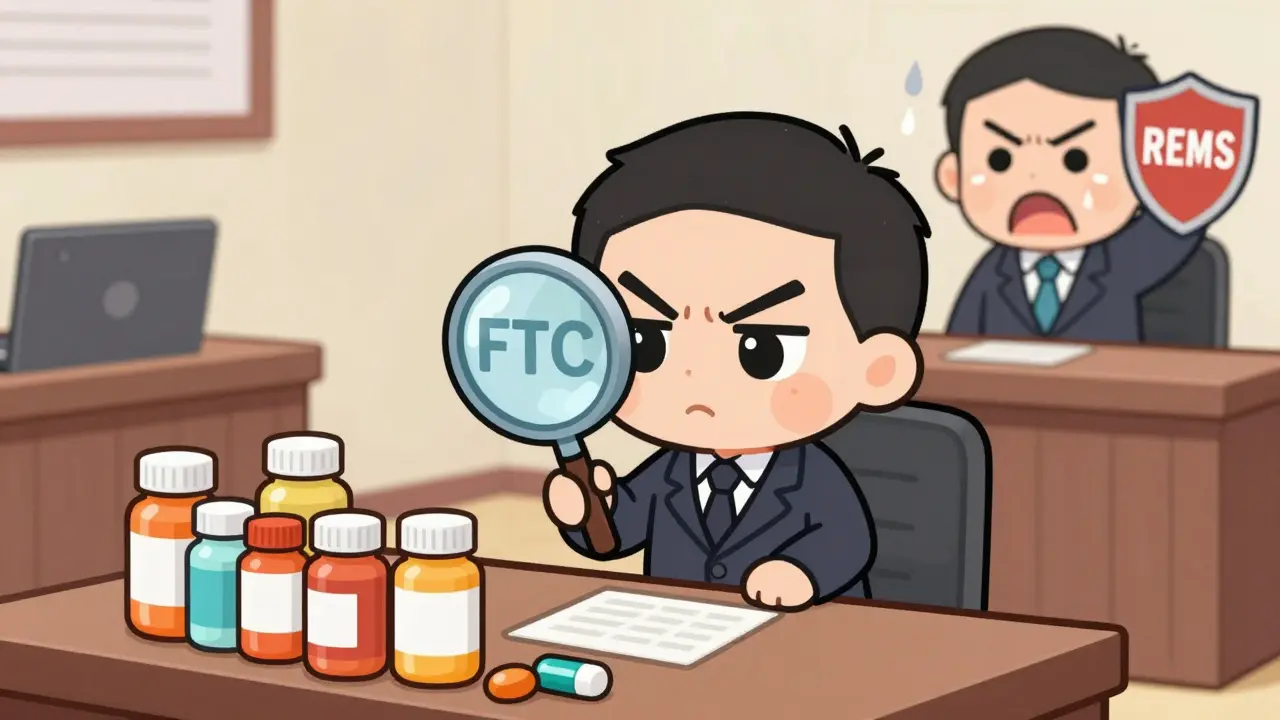
The Federal Trade Commission (FTC) has recently ramped up its scrutiny. In 2022, the FTC released a comprehensive report on product hopping, signaling that it will no longer ignore the role of state substitution laws when evaluating antitrust claims. This represents a shift toward a more "people-first" interpretation of the law, prioritizing patient access over corporate patent strategy.
The Department of Justice (DOJ) is also playing hardball. While the FTC focuses on product hopping, the DOJ has been tackling the other side of the coin: price-fixing among generic manufacturers. For instance, Teva recently paid a $225 million criminal penalty-the largest for a domestic antitrust cartel-to settle charges of price-fixing. This shows that regulators are cleaning up the entire supply chain, from the brand-name giants to the generic providers.
What to Watch for in the Future
We are likely heading toward a period of increased litigation and potential legislative reform. Many legal scholars believe that the current judicial inconsistency-where some courts care about substitution laws and others don't-needs to be fixed by Congress. We can expect more challenges against REMS abuse and a stricter definition of what constitutes a "meaningful therapeutic improvement" versus a superficial change meant to extend a patent.
For patients, the goal is simple: a world where the "cheaper version" is actually available. Until the law catches up with these sophisticated corporate strategies, the battle will continue between the FTC and the pharmaceutical industry's legal teams.
What is the difference between a generic and a brand-name drug?
A generic drug contains the same active ingredients and is bioequivalent to the brand-name version, meaning it works the same way in the body. Because generic companies don't have to repeat the initial clinical trials, they can sell the drug at a much lower price once the original patent expires.
How does "product hopping" actually stop me from getting a cheaper drug?
Product hopping happens when a company releases a new version of a drug and stops selling the old one. Since pharmacists can only substitute generics for the exact version prescribed, and the new version is still under patent, the pharmacist cannot legally give you the cheaper generic of the old version. You are forced to pay for the new, expensive version.
Is product hopping always illegal?
No. If a company introduces a new version but keeps the old one available on the market, courts generally view this as procompetitive innovation. It only becomes an antitrust issue (a "hard switch") when the original product is withdrawn specifically to block generic competition.
What are REMS and how are they misused?
Risk Evaluation and Mitigation Strategies (REMS) are FDA-mandated safety programs for high-risk drugs. Some brand-name companies misuse these rules to refuse to sell samples to generic manufacturers, claiming safety concerns. Without these samples, generic companies cannot perform the tests needed for FDA approval.
Who is responsible for enforcing these antitrust laws?
Enforcement is shared between the Federal Trade Commission (FTC), which often handles civil lawsuits and regulatory reports, and the Department of Justice (DOJ), which pursues criminal charges for things like price-fixing. State Attorneys General also frequently file lawsuits to protect their citizens from unfair pricing.