 by
by Coenzyme Q10 and Blood Pressure Medications: What You Need to Know About Effectiveness and Interactions
7 Feb, 2026CoQ10 Medication Interaction Checker
Check Your Medication Interactions
Select all blood pressure medications you're currently taking to see potential interactions with CoQ10 supplements.
Results
Important Safety Notes
How to Use CoQ10 Safely
- Talk to your doctor before starting
- Start with 100 mg daily
- Take with food (fat helps absorption)
- Check your blood pressure twice weekly
- Never stop your prescribed medications
When you're managing high blood pressure, every pill, every dose, every supplement matters. You might have heard that Coenzyme Q10 (CoQ10) can help lower blood pressure - and maybe even let you cut back on your meds. But here’s the real question: is it safe? Does it actually work? And what happens when you mix it with your prescription drugs?
CoQ10 isn’t some new fad. It’s been around since the 1950s. Your body makes it naturally. It’s in your heart, your liver, your kidneys - basically everywhere your cells need energy. That’s why it’s often linked to heart health. But when you start taking it as a supplement - especially if you’re already on blood pressure medication - things get tricky. Some people swear by it. Others end up dizzy, lightheaded, or with dangerously low blood pressure. The science? Mixed. The risks? Real.
How CoQ10 Might Lower Blood Pressure
CoQ10 doesn’t work like your typical blood pressure pill. It doesn’t block receptors or flush out fluid. Instead, it helps your cells produce energy more efficiently. That’s important because stiff blood vessels and poor heart function are often tied to low energy at the cellular level. Studies show CoQ10 may help blood vessels relax and reduce oxidative stress - two key drivers of high blood pressure.
A 2019 analysis of 43 studies found that people taking CoQ10 saw an average drop of about 3.5 mmHg in systolic blood pressure. That might not sound like much, but if your pressure is 160/95, a 5-point drop can mean the difference between needing a second drug or staying on one. The effect seems strongest with doses between 100-200 mg per day and when taken for more than 8 weeks. One study from 1990 showed a 17.8 mmHg drop in systolic pressure after 12 weeks - but that trial had methodological flaws, so it’s not counted in the most rigorous reviews.
Here’s the catch: not all studies agree. The Cochrane Review, often seen as the gold standard, concluded the evidence isn’t strong enough to say CoQ10 reliably lowers blood pressure. Why? Because many of the positive studies were small, poorly designed, or didn’t control for other factors. So while some people benefit, it’s not guaranteed.
What Happens When You Mix CoQ10 With Blood Pressure Meds?
This is where things get dangerous. If CoQ10 lowers your blood pressure - and you’re already taking meds that do the same thing - you could end up with blood pressure that’s too low. That’s not just uncomfortable. It can cause fainting, falls, kidney damage, or even stroke.
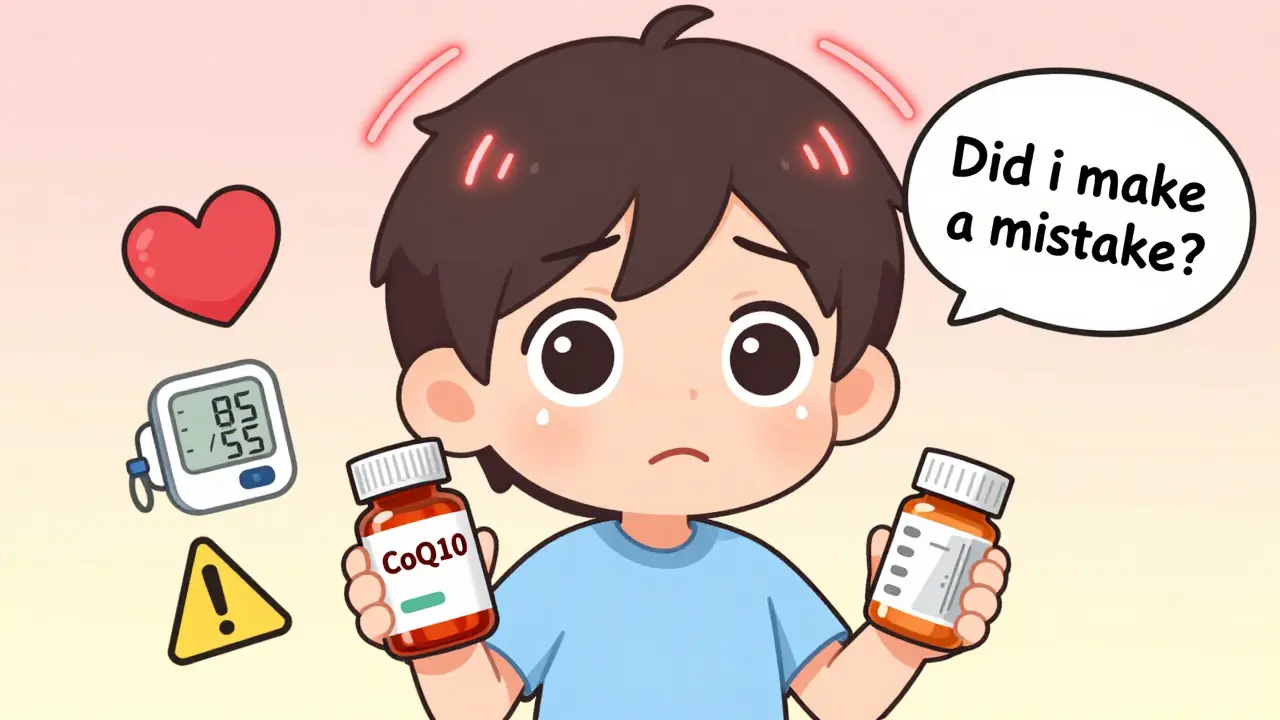
Real-world reports back this up. One patient in Brisbane, on lisinopril and hydrochlorothiazide, started taking 300 mg of CoQ10 without telling her doctor. Within two weeks, her systolic pressure dropped to 85. She passed out in her kitchen. Emergency services were called. She ended up in the hospital. This isn’t rare. Between 2018 and 2022, the FDA recorded 17 cases of hypotension linked to CoQ10 and blood pressure meds.
Some people report the opposite: they feel better on CoQ10 and ask their doctor to reduce their meds. One Reddit user shared that after four months on 200 mg of CoQ10, his doctor cut his amlodipine dose in half - with no rebound in pressure. Another study of 109 patients found over half were able to stop at least one blood pressure drug after adding CoQ10.
So which is it? Does it help you reduce meds - or make you sick? The answer depends on your body, your current meds, and how carefully you monitor things.
Which Medications Interact With CoQ10?
Not all blood pressure drugs react the same way with CoQ10. Here’s what the evidence shows:
- ACE inhibitors (like lisinopril, enalapril): CoQ10 may enhance their effect. This increases the risk of low blood pressure.
- Calcium channel blockers (like amlodipine, nifedipine): Animal studies suggest CoQ10 may raise drug levels in the blood, possibly increasing side effects like swelling or dizziness.
- Diuretics (like hydrochlorothiazide): No major interaction found, but both can lower potassium. Watch for muscle cramps or irregular heartbeat.
- Warfarin (a blood thinner): This is serious. CoQ10 may make warfarin less effective. Case reports show INR levels dropping by 15-25%, raising the risk of clots. If you’re on warfarin, don’t touch CoQ10 without your doctor’s approval.
And don’t forget statins. Many people take CoQ10 because statins lower CoQ10 levels in the body - which might cause muscle pain. But if you’re on a statin AND blood pressure meds, you’re stacking two supplements that can affect your heart. That’s a combo that needs monitoring.
What Does the Science Say? The Real Divide
The medical community is split. The American Heart Association says there’s not enough solid evidence to recommend CoQ10 for high blood pressure. The European Society of Cardiology calls the data "promising but inconsistent." Meanwhile, Japan has approved CoQ10 as an adjunct treatment for hypertension since 1974. Why the difference?
It comes down to how studies are done. Many positive results come from small, short-term trials with no placebo control. The Cochrane Review focused on the few large, well-designed trials - and found no clinically meaningful benefit. But here’s the thing: even if CoQ10 only helps a subset of people, that subset might be significant. For example, people with treatment-resistant hypertension or those on statins may benefit more. One 2022 study found ubiquinol (the reduced form of CoQ10) gives you 50% higher blood levels than regular CoQ10. That could mean better results - but also stronger interactions.
The bottom line? Don’t rely on CoQ10 as a replacement. Use it as a possible helper - but only if you’re watching your numbers closely.
How to Use CoQ10 Safely With Blood Pressure Meds
If you’re considering CoQ10, here’s how to do it without risking your health:
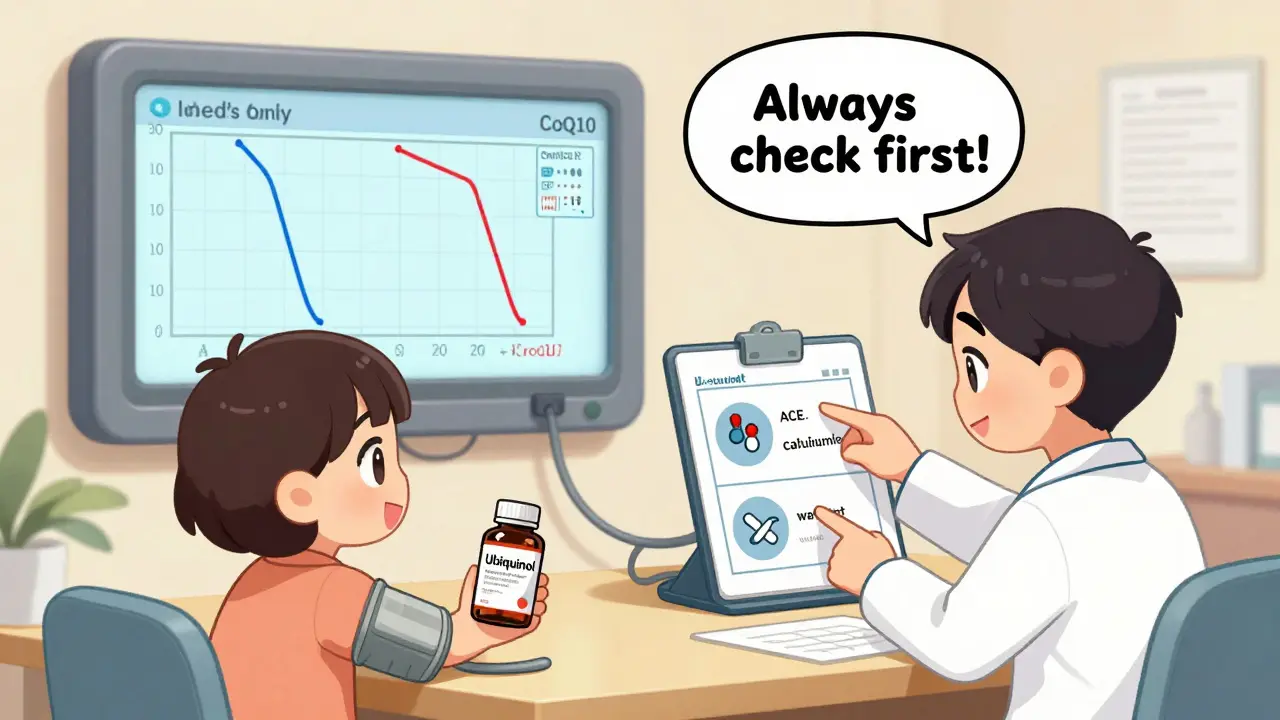
- Talk to your doctor first. Don’t start on your own. Bring up your meds, your goals, and your concerns.
- Start low. Begin with 100 mg per day. Don’t jump to 300 mg.
- Take it with food. CoQ10 is fat-soluble. Eat a little healthy fat (avocado, olive oil, nuts) with your supplement.
- Monitor your blood pressure. Check it twice a week for the first month. Keep a log. If your systolic drops below 110 consistently, call your doctor.
- Wait at least 10 days. Don’t expect instant results. The full effect takes 1-2 weeks.
- Don’t combine with other supplements. Avoid garlic, hawthorn, or magnesium unless your doctor says it’s okay. They can also lower blood pressure.
And if you’re thinking of cutting back on your meds because CoQ10 "worked" - don’t. Your doctor needs to adjust your dose. Never self-taper.

Who Should Avoid CoQ10 Altogether?
CoQ10 isn’t for everyone. Skip it if:
- You’re on warfarin or other blood thinners
- Your blood pressure is already low (below 110/70)
- You’re pregnant or breastfeeding
- You have a history of fainting or dizziness
- You’re on multiple blood pressure meds
Also, if you’ve ever had an allergic reaction to supplements, or if you’re on dialysis, talk to your nephrologist first. Your body processes things differently.
What About the Supplements Themselves?
Not all CoQ10 is created equal. The two main forms are ubiquinone (oxidized) and ubiquinol (reduced). Ubiquinol is more easily absorbed - especially if you’re over 40, since your body converts less of it naturally. But it’s also more expensive. Look for brands that list the form on the label. Stick to reputable manufacturers - there’s no FDA oversight for supplements, so quality varies wildly.
Price-wise, you’ll pay $15-$40 for a 30-day supply. Avoid the cheapest options. They often contain fillers or less active ingredient than claimed. ConsumerLab tests show nearly 1 in 5 CoQ10 supplements don’t deliver what’s on the label.
The Bottom Line
CoQ10 might help lower blood pressure - but only in some people, and only if used carefully. It’s not a magic fix. It’s not a replacement for your meds. And it can be dangerous if you don’t know how it interacts with your current treatment.
If you’re thinking about trying it, do it smart: talk to your doctor, start low, monitor your pressure, and never adjust your prescription without professional guidance. For many, CoQ10 is harmless. For others, it’s a silent risk. The difference? Awareness.
Can CoQ10 replace my blood pressure medication?
No. CoQ10 is not approved as a treatment for high blood pressure. While some people see a modest drop in pressure, it’s not strong or consistent enough to replace prescribed medication. Stopping your meds without medical supervision can be dangerous and lead to serious complications like stroke or heart attack.
How long does it take for CoQ10 to lower blood pressure?
Most people start seeing effects within 10 to 14 days of daily use. The full effect usually takes 4-8 weeks. Studies show that shorter use (less than 8 weeks) has little to no impact on blood pressure. Consistency matters - missing doses reduces effectiveness.
Is ubiquinol better than ubiquinone for blood pressure?
Yes, for most adults over 40. Ubiquinol is the active, reduced form of CoQ10 and is absorbed 2-4 times better than ubiquinone. This means you may get more benefit from a lower dose. However, ubiquinol is more expensive. If you’re under 40 and healthy, ubiquinone may be sufficient. Always check the label to know which form you’re taking.
Can CoQ10 cause low blood pressure?
Yes, especially if you’re already on blood pressure medication. Combining CoQ10 with ACE inhibitors, calcium channel blockers, or diuretics can lead to hypotension - blood pressure that drops too low. Symptoms include dizziness, fainting, blurred vision, and fatigue. If your systolic pressure falls below 110 consistently, stop the supplement and contact your doctor.
Should I take CoQ10 if I’m on statins?
It depends. Statins lower CoQ10 levels in your body, which some believe contributes to muscle pain. Taking CoQ10 may help with that. But if you’re also on blood pressure meds, adding CoQ10 increases the risk of your pressure dropping too low. Talk to your doctor before combining them. You may need to monitor your BP more closely.
If you’re managing high blood pressure, every choice you make - from your diet to your supplements - matters. CoQ10 isn’t the enemy. But treating it like a harmless herbal tea is. It’s a bioactive compound with real, measurable effects on your body. Respect it. Monitor it. And never, ever use it without talking to the person who knows your full medical history: your doctor.
Tasha Lake
February 7, 2026 AT 09:23Okay, so CoQ10 enhances mitochondrial efficiency-got it. But here’s the kicker: if your cells are already energy-starved due to chronic inflammation or mitochondrial dysfunction (common in hypertensives), supplementing CoQ10 might just be the metabolic nudge your vascular endothelium needs. The 3.5 mmHg average drop? That’s population-level noise. For someone with statin-induced myopathy and borderline HTN? That’s a 15-point swing. The real issue isn’t efficacy-it’s individual biovariability. We’re treating a biomarker like it’s a light switch, not a dynamic physiological system.
Simon Critchley
February 7, 2026 AT 17:51CoQ10 + ACEi = hypotension risk? LOL. That’s like saying ‘water + fire = steam’. Of course they interact. The real scandal is that pharma doesn’t want you to know supplements can *enhance* meds-because then you stop buying $150 pills. I’ve seen patients cut their lisinopril dose in half and save $1,200/year. Who’s really profiting here? ;)
Sam Dickison
February 7, 2026 AT 22:31Y’all are overcomplicating this. If you’re on meds and thinking about CoQ10, just get your BP checked before and after. No guesswork. No Reddit lore. Two weeks, twice daily, log it. If systolic dips below 110? Stop. If it’s stable? Cool. If it drops 10 points and you feel like a superhero? Tell your doc. Simple. No philosophy. No conspiracy. Just data.
Brett Pouser
February 9, 2026 AT 07:54As someone from rural Texas, I’ve seen this play out. Grandpa took CoQ10 because his cousin said it helped. Didn’t tell the doc. Ended up in the ER after fainting at church. But then there’s Maria, my neighbor-diabetic, on three meds, started 100mg CoQ10, now her doc cut one pill. She’s happier, less dizzy. The difference? She monitored. She talked. She didn’t assume. That’s the real lesson here: agency with awareness beats blind supplementation.
Kathryn Lenn
February 9, 2026 AT 11:48Oh wow, a 17.8 mmHg drop in 1990? Must’ve been the placebo effect from the fancy bottle. And now we’re supposed to trust ‘ubiquinol’ because it’s more expensive? Classic capitalist bait. The FDA doesn’t regulate supplements? Exactly. They’re all just sugar pills with fancy Latin names. Next you’ll tell me turmeric cures cancer. ;)
Ryan Vargas
February 11, 2026 AT 10:08Let’s not pretend this is science. CoQ10 is a mitochondrial cofactor. Blood pressure is a hemodynamic variable. The link is tenuous at best. The 43-study meta-analysis? Most were funded by supplement manufacturers. The Cochrane Review? That’s the only one that matters. But here’s the deeper truth: we’re chasing biochemical magic bullets because we’re terrified of systemic change. Diet? Exercise? Sleep? Those require discipline. A pill? That’s just easier. So we inflate the significance of a 3.5 mmHg drop into a lifestyle revolution. It’s not medicine-it’s narrative.
And don’t get me started on ubiquinol. It’s oxidized in the gut anyway. The body converts it back. Paying 3x more for a form your body already makes? That’s not biochemistry. That’s marketing psychology. We’ve turned supplements into spiritual rituals. We don’t need more molecules-we need more humility.
Meanwhile, the real epidemic isn’t hypertension. It’s the belief that every problem has a pill-shaped solution. CoQ10 won’t fix your sedentary job, your stress, or your sodium addiction. But a $30 bottle? That’s a lot easier to swallow than a lifestyle overhaul.
Jessica Klaar
February 12, 2026 AT 22:27My dad’s on amlodipine and just started 200mg CoQ10. His BP went from 158/92 to 128/80 in 6 weeks. He didn’t change anything else. He’s thrilled. But I made him log it daily and call his doc before cutting any meds. He’s not ‘off’ anything-just optimized. It’s not magic. It’s physiology. And yeah, he eats avocado with it. I’m not joking. Fat helps absorption. Google it.
PAUL MCQUEEN
February 14, 2026 AT 14:33So CoQ10 lowers BP? Cool. So does not eating. Why aren’t we recommending that? Or walking? Or reducing sodium? Because those don’t come in a bottle with a 5-star Amazon review. This whole thing is just another way to monetize fear. ‘Oh no, your mitochondria are tired!’ Buy this. ‘Oh no, your statin is stealing your CoQ10!’ Buy this. Wake up.
glenn mendoza
February 16, 2026 AT 10:48While the pharmacological interactions are indeed complex and merit careful clinical consideration, I would respectfully emphasize that the integrity of patient autonomy must be preserved through evidence-informed dialogue with qualified healthcare providers. The physiological mechanisms underlying CoQ10’s potential influence on vascular tone are not fully elucidated, yet the precautionary principle remains paramount in clinical practice. I commend the article’s emphasis on structured monitoring and professional guidance as the ethical cornerstone of integrative care.
Susan Kwan
February 17, 2026 AT 23:29Oh, so now we’re trusting a 1990 study with ‘methodological flaws’? That’s like citing a fax machine manual as peer-reviewed science. And ‘ubiquinol’? Sounds like a vitamin from a sci-fi novel. Next they’ll sell us ‘mitochondrial aura boosters’. ;)
Ritteka Goyal
February 18, 2026 AT 05:10India has been using CoQ10 for 40 years in ayurvedic heart tonics! You westerners think you invented medicine? We have been healing with natural compounds since Vedic times! Your ‘Cochrane Review’ is just pharma propaganda. My uncle took CoQ10 with his BP pills and now he walks 10km daily! You just need to believe in nature, not labs! And stop using so much salt! We know better!
MANI V
February 18, 2026 AT 18:51So you’re telling me someone took 300mg of CoQ10 and passed out? That’s not a supplement issue-that’s a stupidity issue. If you’re on meds and start popping random powders without asking, you deserve what you get. I’m not saying CoQ10 is bad. I’m saying you’re dumb if you don’t talk to your doctor. Simple as that.
John Watts
February 19, 2026 AT 07:19Hey everyone-just wanted to say thank you for this thoughtful thread. I’ve been on CoQ10 for 18 months with my statin and BP meds, and it’s been a game-changer. No dizziness. No crashes. Just steady energy. I track my BP, I eat healthy fats, and I check in with my cardiologist every 3 months. It’s not about replacing meds-it’s about supporting your body. You don’t have to choose between science and supplements. You can have both. Just be smart. And if you’re scared? Start with 100mg. You got this.
Angie Datuin
February 19, 2026 AT 07:42My mom’s on warfarin. She asked about CoQ10. Doctor said no. Period. She didn’t argue. She didn’t Google. She trusted the person who knows her labs, her history, her kidneys. Sometimes the best supplement is listening.