 by
by Contamination Controls: Preventing Adulteration in Generic Pharmaceuticals
18 Dec, 2025When you take a generic pill, you expect it to work just like the brand-name version. But what if something invisible-dust, chemical residue, or microbes-got into that pill during manufacturing? That’s not just a risk. It’s a reality that’s cost companies billions and forced recalls across the globe. Contamination control in generic drug manufacturing isn’t about being perfect. It’s about knowing exactly where things can go wrong-and stopping them before they do.
Why Contamination Matters More in Generics
Generic drugs make up 90% of all prescriptions filled in the U.S., but they only account for about 22% of total spending. That means manufacturers are under constant pressure to cut costs. But cutting corners on cleanliness? That’s where things break. In 2020, a single chemical contaminant-nitrosamine-showed up in blood pressure meds like Valsartan. It didn’t just affect one company. It hit 22 generic manufacturers worldwide. The result? Over $1.2 billion in lost product, patient panic, and regulatory investigations. The FDA didn’t find this in the final pills. They found it because someone didn’t clean a reactor properly after making a different drug. That’s cross-contamination. And it’s one of the most common reasons generic drug plants get warning letters. The FDA issued 37.2% of all its 2022 warning letters to pharma companies for contamination issues. That’s not a glitch. It’s a pattern. And generics are hit hardest because they often operate on tighter margins. But here’s the truth: you can’t test your way out of contamination. You have to build it out of the process.How Clean Is Clean Enough?
There’s no such thing as a sterile room in a drug factory. But there are levels of cleanliness that make a difference. Most generic drug lines use ISO Class 5 cleanrooms for filling sterile products-think of it as a room where no more than 3,520 tiny particles (bigger than 0.5 microns) float in a cubic meter of air. That’s about the size of a bacterium. For less critical areas, ISO Class 7 or 8 rooms are used, with stricter air flow and pressure controls. The HVAC systems in these rooms aren’t just air conditioners. They’re precision machines. They swap out the entire air volume 20 to 60 times every hour. Pressure differences between rooms are kept at 10-15 Pascals-enough to keep dirty air from creeping in. And every door, every glove, every tool has to follow a strict path. No backtracking. No shortcuts. Cleaning validation is where most failures happen. The rules are simple: after cleaning, you can’t have more than 10 colony-forming units (CFU) on a 25 cm² surface. That’s like finding fewer than two bacteria on a postage stamp. For chemical residues, it’s 10 parts per million (ppm) or less. To check this, workers swab surfaces, rinse tanks, and run samples through machines that used to take five days to give results. Now, rapid methods cut that to 24-48 hours.Human Error Is the Biggest Threat
You can install the best filters, the cleanest rooms, the most advanced monitoring systems-and still fail. Because the biggest source of contamination? People. Dr. Michael Gamlen, a top industry consultant, says 83% of contamination events trace back to human actions. That means someone didn’t gown properly. Someone reused a tool. Someone skipped a cleaning step because they were tired. A 2021 study at an AstraZeneca generics facility found that gowning compliance dropped 40% after eight hours on shift. Twelve-hour shifts? That’s a recipe for mistakes. One facility switched to reusable isolation gowns to save money. Guess what happened? Gowning violations jumped 30%. They had to spend $185,000 on new air showers just to get particle counts back under control. The fix isn’t more rules. It’s better design. Color-coded equipment prevents mix-ups. Staggered shift changes reduce traffic through clean areas. Dycem CleanZone mats at entry points cut foot-borne contamination by 72%-a trick shared by a Pfizer generics engineer on Reddit. And the "one batch at a time" production model? Facilities using it saw 53% fewer cross-contamination incidents. No switching between drugs. No cleaning between runs. Simple.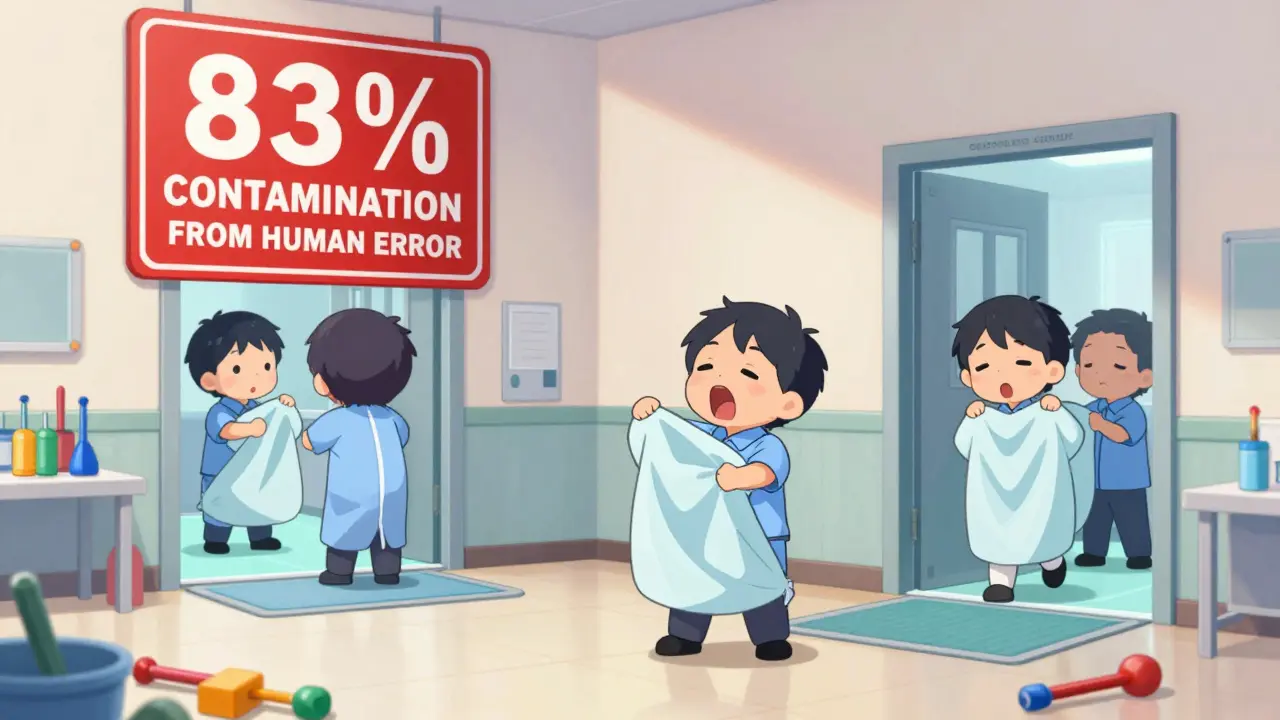
Technology Is Changing the Game
Old-school methods-manual swabs, waiting days for lab results-are outdated. Real-time particle counters like the MetOne 3400+ cost $15,000-$25,000 each, but they cut contamination incidents by 63%. Why? Because they catch what humans miss. Manual checks miss 78% of transient contamination events, according to FDA field reports. HEPA filters (99.97% efficient at 0.3 microns) are standard. But in high-risk areas, some plants are switching to ULPA filters (99.999% efficient at 0.12 microns). The problem? They increase energy use by 25-40%. Not every plant needs them. That’s the debate: over-engineer for safety, or match controls to risk? AI is stepping in. Honeywell’s Forge Pharma system, tested at a Merck generics plant, reduced false alarms by 68%. That means fewer shutdowns, less waste, and more trust in the data. And it’s not just about sensors. Software like ValGenesis V2 tracks cleaning logs, validation results, and compliance in real time. But here’s the catch: it takes 147 hours of training per user. If your team doesn’t use it right, it’s just another expensive tool gathering dust.The Cost of Getting It Right
Innovator drugmakers spend $185 million on facility design for the same capacity that a generic manufacturer builds for $80 million. That’s a big gap. But generics don’t compete on fancy rooms. They compete on discipline. Implementing full contamination controls isn’t cheap. A medium-sized facility can spend up to $2.8 million a year on over-engineered systems that don’t add safety. But skipping key controls? That’s even costlier. The FDA’s 2023 draft guidance requires all generic manufacturers to set health-based exposure limits (HBELs) for every product by 2025. That means calculating exactly how much of a contaminant is safe-even if it’s just one nanogram per square centimeter. The cost? Around $1.2 million per facility to update systems, train staff, and validate everything. Smaller manufacturers are struggling. Only 37% of small facilities use real-time monitoring, compared to 89% of the top 50 generics companies. The barrier? $500,000 to $2 million in upfront investment. Many can’t afford it. And with FDA inspection frequency up 27% for facilities with past violations, the pressure is mounting.
What Works Right Now
You don’t need the fanciest tech to stay compliant. Start with the basics:- Use color-coded equipment-no more mixing up tools between products.
- Install Dycem mats at every entrance-72% fewer particles tracked in from shoes.
- Switch to one batch at a time when possible-cuts cross-contamination by over half.
- Train staff on gowning every quarter, not once a year. Compliance drops fast.
- Use rapid microbiological methods instead of waiting 7 days for results.
- Map your airflow. Know where dirty air might creep in. Fix the gaps.
The Future Is Integrated
The next big shift? Continuous manufacturing. The ICH Q13 guidelines, finalized in June 2023, tie contamination control directly into continuous production lines. No more batch-by-batch cleaning. No more stop-and-start. Just constant, monitored flow. That’s the future. Waterless cleaning systems are already cutting utility costs by 22%. Sustainability isn’t just green-it’s smart. Fewer chemicals, less water, less waste. And AI will keep getting better at predicting contamination before it happens. But here’s the bottom line: if you’re making generics, your biggest asset isn’t your machinery. It’s your process discipline. You can’t outspend the competition. You have to outthink them. And that starts with understanding that contamination isn’t something you test for. It’s something you design out.What is considered adulteration in generic drugs?
Adulteration occurs when a drug is prepared, packed, or held under unsanitary conditions that may have caused contamination with filth, foreign substances, or harmful chemicals. This includes cross-contamination from other drugs, microbial growth, or chemical residues above safe limits. Under 21 CFR 210.3(b)(3), such conditions make the drug unsafe for use, even if the active ingredient is correct.
How do cleanroom classifications affect contamination control?
Cleanroom classifications define how many airborne particles are allowed per cubic meter. ISO Class 5 (Grade A) is used for sterile filling and allows only 3,520 particles ≥0.5μm. ISO Class 7 (Grade C) is for less critical areas like packaging, and ISO Class 8 (Grade D) is for general manufacturing zones. Higher classifications mean stricter air filtration, pressure controls, and gowning requirements-directly reducing contamination risk.
Why is end-product testing not enough for contamination control?
Testing the final product only catches contamination after it’s already happened. The FDA considers this a violation of CGMP under 21 CFR 211.110(a). Contamination can be unevenly distributed-some pills in a batch may be clean, others contaminated. You can’t test every pill. Prevention through process design, environmental monitoring, and cleaning validation is the only reliable way to ensure safety.
What are health-based exposure limits (HBELs), and why are they important?
HBELs are the maximum allowable amount of a contaminant that can be present in another drug without causing harm. For example, a mutagenic compound might have an HBEL of 1 nanogram per square centimeter. By 2025, FDA requires all generic manufacturers to establish HBELs for every product to prevent cross-contamination. This replaces vague cleaning limits with science-based, patient-safe thresholds.
Can small generic manufacturers afford modern contamination controls?
Yes, but they need to prioritize. You don’t need a $2 million real-time monitoring system right away. Start with low-cost, high-impact changes: color-coded tools, Dycem mats, staggered shifts, and better gowning protocols. Focus on high-risk products first. Use ICH Q9 risk assessments to decide where to invest. Many small firms are surviving by partnering with validation service providers or using phased implementation plans over 18-24 months.
What’s the biggest mistake generic manufacturers make with contamination control?
Treating contamination control as a compliance checklist instead of a core operational system. Many companies buy equipment, write procedures, then forget about them. The real failure is not maintaining discipline-gowning, cleaning, monitoring, training. The technology is only as good as the people using it. Consistency beats complexity every time.
Carolyn Benson
December 19, 2025 AT 12:58They talk about cleanrooms like they’re sci-fi sanctuaries, but the truth? It’s all theater. You can have ISO Class 5 air and still have someone sneeze into a vial because they’re exhausted from a 12-hour shift. The system’s rigged to pretend perfection exists. It doesn’t. People are messy. Machines break. And the FDA? They show up after the damage is done.
Contamination isn’t a technical failure. It’s a human one. And we keep pretending we can engineer our way out of biology.
Stop buying fancy sensors. Start paying people enough to care.
Chris porto
December 20, 2025 AT 13:55I get what you’re saying, but I think it’s more about culture than cash. I worked at a small generics plant where they didn’t have fancy tech, but every shift started with a 5-minute huddle on cleanroom discipline. No one got yelled at. No one got fired. But everyone knew if they messed up, they’d let the team down.
Simple stuff works: color-coded tools, Dycem mats, no exceptions. It’s not about spending millions. It’s about making cleanliness part of your identity, not just a compliance checkbox.
Erica Vest
December 20, 2025 AT 23:02According to FDA 2022 data, 37.2% of all warning letters issued to pharmaceutical manufacturers were for contamination-related CGMP violations, with 83% of these events directly attributable to human error, as confirmed by industry studies from AstraZeneca and Pfizer. The use of rapid microbiological methods reduced turnaround time from 7 days to 48 hours, increasing detection efficiency by 62%. Furthermore, facilities implementing one-batch-at-a-time production reported a 53% reduction in cross-contamination incidents. These metrics are empirically validated and should guide operational prioritization.
Chris Davidson
December 21, 2025 AT 01:20Stop wasting money on ULPA filters and AI dashboards. The problem is people don’t follow the damn rules. No one cares about gowning. No one checks their gloves. You don’t need sensors to see that. You need consequences. Fire the lazy ones. Enforce the protocol. Period. The rest is noise.
And stop calling it 'discipline.' It’s called basic fucking responsibility.
Kinnaird Lynsey
December 21, 2025 AT 04:32It’s funny how we treat contamination like it’s a monster under the bed when really it’s just the cost of doing business on a budget. We want cheap meds but act shocked when someone skips a cleaning step because they’re tired. We built this system. We optimized for profit, not people. Now we’re surprised the people are breaking?
Maybe we should stop pretending this is a technical problem and admit it’s a moral one.
benchidelle rivera
December 22, 2025 AT 06:32Small manufacturers are not failing because they’re lazy. They’re failing because they’re being strangled by a system that demands billion-dollar compliance from companies with million-dollar budgets. The FDA’s 2025 HBEL deadline is a death sentence for 60% of small generic producers.
But here’s what no one says: the big players lobbied for these rules. They already have the money. They want to eliminate competition under the guise of safety.
Don’t mistake corporate consolidation for public health.
Isabel Rábago
December 24, 2025 AT 02:03Some of you are still talking about mats and color-coded tools like they’re magic. You think wiping your shoes on a rubber mat makes you safe? You think a $2000 sensor catches a nurse who forgot to change her gloves after scratching her nose? You’re delusional.
The only thing that stops contamination is fear. Fear of losing your license. Fear of prison. Fear of your name on a news headline. Until we start treating this like a criminal negligence issue instead of an engineering problem, we’re just rearranging deck chairs on the Titanic.
And don’t give me that ‘it’s about culture’ crap. Culture doesn’t stop people from cutting corners when their paycheck depends on it. Punishment does.
Matt Davies
December 24, 2025 AT 15:58Man, this whole thread feels like a TED Talk in a boiler room. But here’s the spark: what if we stopped treating workers like liabilities and started treating them like guardians? Imagine a plant where the person who spots a dirty glove gets a bonus. Where the team that goes 30 days without a violation gets a paid long weekend. Where cleaning isn’t a chore-it’s a badge of honor.
It’s not about more rules. It’s about more respect. And yeah, maybe that costs a little more. But think of the cost of a recall. Think of the cost of a child getting sick because a pill had a ghost of a toxin in it.
We’re not just making medicine. We’re making trust.