
 by
by Exercise-Induced Bronchoconstriction: How to Prevent Symptoms and Use Inhalers Correctly
25 Jan, 2026What Is Exercise-Induced Bronchoconstriction?
Exercise-induced bronchoconstriction (EIB) happens when your airways narrow during or right after physical activity. You might feel short of breath, cough, have chest tightness, or hear wheezing. It’s not the same as asthma, though many people with asthma get EIB. The truth is, up to 90% of people with asthma experience it, but it also affects 9 to 30% of people without asthma - including elite athletes. You don’t need to have asthma to have EIB. It’s a physical reaction to breathing fast in dry or cold air.
When you run, swim, or ski hard, you breathe through your mouth, pulling in large amounts of cool, dry air. This causes your airways to lose heat and moisture. In response, your body releases chemicals that make the muscles around your airways tighten. That’s the bronchoconstriction. It usually peaks 5 to 15 minutes after you stop exercising and can last up to an hour. The good news? You can prevent it - and most people can exercise without limits once they know how.
How Do You Know If You Have EIB?
Symptoms like coughing after running or wheezing after soccer practice might seem normal. But if it happens consistently after exercise, it’s not just being out of shape. A drop of 10% or more in your forced expiratory volume in one second (FEV1) after exercise is the clinical sign doctors use to confirm EIB. That’s measured with a simple breathing test called an exercise challenge. You’ll run on a treadmill or ride a stationary bike at 80-90% of your max heart rate for 6-8 minutes, then breathe into a machine that tracks your lung function.
Another test, called eucapnic voluntary hyperpnea (EVH), mimics heavy breathing without exercise. It’s often used for athletes because it’s more sensitive. If your symptoms match the pattern - starting after exercise, improving within an hour, and recurring every time you push hard - and your breathing test confirms it, you have EIB. Don’t ignore it. Left untreated, 68% of people start avoiding exercise, which leads to weight gain, lower fitness, and even social isolation.
Non-Drug Ways to Prevent EIB
Before you reach for your inhaler, try these proven, drug-free strategies. First, warm up. A 10-15 minute moderate warm-up - like brisk walking or light jogging - triggers what’s called the “refractory period.” This means your airways become temporarily resistant to narrowing. After that warm-up, take a 5-10 minute rest before your main activity. That window can protect you for up to two hours.
Pay attention to your environment. Cold, dry air is the biggest trigger. If the temperature is below 10°C (50°F) or humidity is under 40%, EIB risk jumps by 73%. Try exercising indoors on those days. If you’re outside, cover your mouth with a scarf or mask. Heat exchange masks (like Nike E+ or Respro®) help a little - but they’re only 42% effective, compared to 89% for albuterol. Don’t rely on them alone.
Choose your sport wisely. Sports with short bursts of activity - like baseball, football, wrestling, or sprinting - trigger EIB in only 22% of people. Endurance sports like cross-country skiing, ice hockey, or long-distance running trigger it in up to 85%. That doesn’t mean you can’t do them. It just means you need better prevention.
Some diets show promise. A 2023 study found that taking 2-4 grams of omega-3 fatty acids daily for three weeks cut bronchodilator use by 31%. Taking 500 mg of vitamin C daily helped reduce symptoms by 48% in people with low baseline levels. But the Mayo Clinic says there’s not enough proof yet to recommend these for everyone. Still, if you eat more fish, flaxseeds, or citrus fruits, you’re not losing anything.
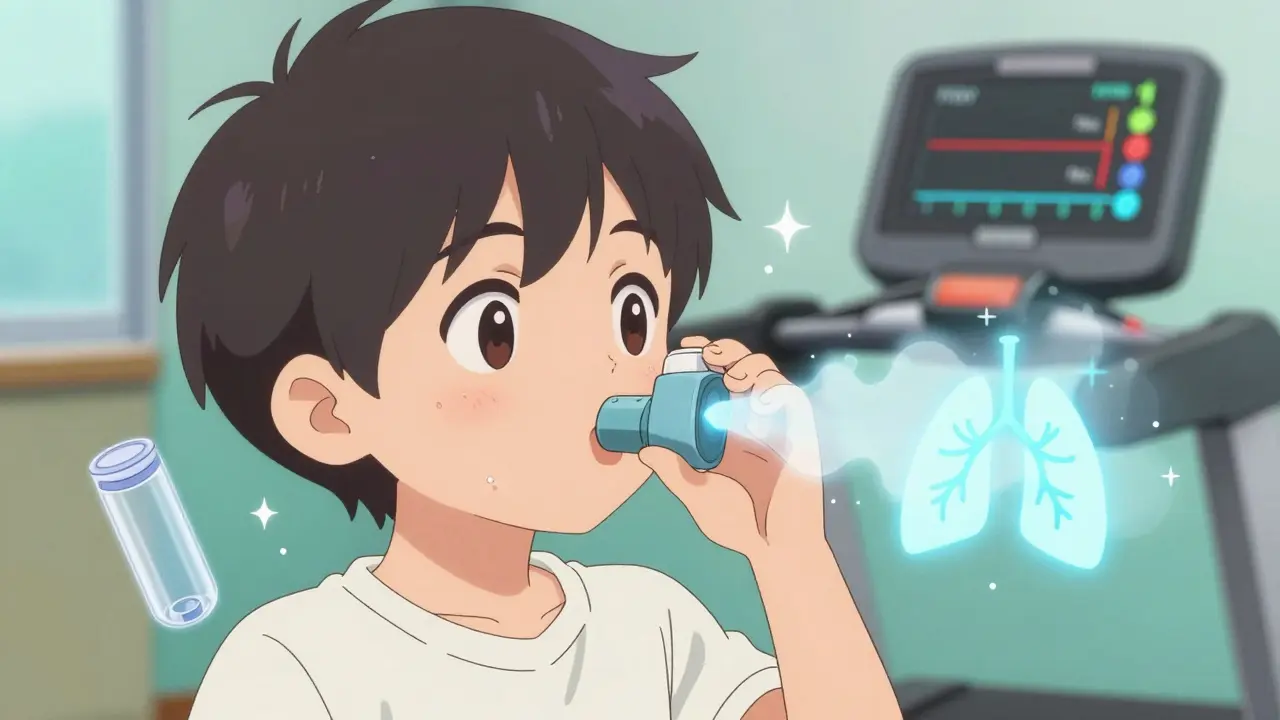
How to Use Your Inhaler Right
Short-acting beta-2 agonists (SABAs), like albuterol, are the gold standard. They work fast and prevent symptoms in 80-90% of cases. The key? Timing. Use your inhaler 5 to 20 minutes before you start exercising. Two puffs (90 mcg each) is the standard dose. If you use it too early - say, an hour before - it won’t work when you need it. Too late, and your airways are already tightening.
Technique matters more than you think. Sixty-three percent of EIB management failures happen because people don’t use their inhalers correctly. Here’s how to do it right: Shake the inhaler. Breathe out fully. Put the mouthpiece in your mouth. Press down and breathe in slowly and deeply at the same time. Hold your breath for 10 seconds. Wait 30 seconds. Repeat for the second puff. Use a spacer if you have one - it boosts lung delivery by 70%.
Store your inhaler at room temperature (20-25°C). If it’s below 10°C, the propellant weakens and only delivers 60% of the dose. Replace plastic spacers every 6 months. After a year, they lose 25% of their efficiency from wear and tear.
What If Your Inhaler Isn’t Enough?
One in three people still have symptoms even with albuterol. That doesn’t mean the drug isn’t working - it means your airways are inflamed underneath. That’s where daily controller meds come in.
Inhaled corticosteroids (ICS), like fluticasone (200-400 mcg daily), reduce inflammation and cut symptoms by 50-60%. They’re not for occasional use - you have to take them every day, even on rest days. Leukotriene receptor antagonists (LTRAs), like montelukast (10 mg daily), help too, with a 30-40% improvement. They’re taken once a day, usually at night, and don’t require inhaler technique.
Combining albuterol with a daily ICS reduces symptom frequency by 78% - way better than albuterol alone. For athletes, this is often the sweet spot: albuterol before exercise, plus a low-dose steroid daily. Some newer guidelines, like GINA 2022, now recommend as-needed ICS-formoterol combos for frequent EIB. But many sports doctors still prefer albuterol before activity because it’s fast, targeted, and doesn’t require daily dosing.
Cromolyn sodium (a mast cell stabilizer) used to be common. It’s safe and works in 60-70% of cases - but you have to use it 15-20 minutes before exercise, and it wears off quickly. Most people don’t stick with it.

What About Athletes and Competitive Sports?
You can compete at the highest level with EIB. The International Olympic Committee removed restrictions on long-acting beta-agonists in 2022. Now, all EIB medications are allowed without therapeutic use exemptions. Many Olympic athletes use albuterol before events. They don’t hide it - they plan for it.
Performance isn’t just about meds. Each 1-MET increase in your VO2 max (a measure of fitness) reduces EIB severity by 12%. The fitter you are, the less your airways react. That’s why endurance training over time helps - not just before a race.
Smart inhalers with Bluetooth (like Propeller Health) are starting to show up. They track when you use your inhaler and send reminders. In pilot studies, they improved adherence by 47%. That’s huge - because missing doses is the #1 reason EIB flares up.
Why Most People Fail at Managing EIB
It’s not the meds. It’s not the science. It’s the misunderstanding. Forty-one percent of teens with EIB are never diagnosed. They think they’re just “bad at sports.” Parents and coaches dismiss coughing as “just clearing the throat.”
Even when diagnosed, people skip warm-ups. They forget their inhaler. They use it wrong. They think “I don’t need it today.” And then they have a bad episode - and avoid exercise again.
The real cost? People with unmanaged EIB have 2.3 times higher obesity rates and 37% lower cardiovascular fitness than those who manage it well. That’s not just about lungs - it’s about your whole health.
The message is simple: EIB is not a barrier. It’s a solvable condition. With the right steps - warm-up, environment control, correct inhaler use, and sometimes daily medication - 95% of people can do any sport, any time, without limits.
When to See a Doctor
You don’t need to wait for a crisis. If you regularly have breathing trouble after exercise, talk to your doctor. Get a lung function test. Don’t assume it’s just asthma or allergies. EIB has its own rules.
If you’re using your rescue inhaler more than twice a week for exercise, it’s time to talk about daily control meds. If your symptoms wake you up at night or happen even when you’re not active, you might have underlying asthma that needs different treatment.
And if you’re an athlete - even a weekend warrior - don’t let EIB hold you back. With the right plan, you’ll breathe easier, move better, and stay active for life.
Ashley Karanja
January 26, 2026 AT 16:27Okay, but have we considered the neuroinflammatory cascade triggered by cold-air hyperventilation? The bronchoconstriction isn't just smooth muscle tightening-it's a mast cell degranulation event mediated by TRPV1 and P2X receptors, with downstream leukotriene release amplifying the response. The refractory period? That's your airway epithelium temporarily upregulating heat-shock proteins and suppressing inflammatory mediators. We're not just breathing air-we're triggering a whole-body stress response that's been evolutionarily conserved since our ancestors hunted in glacial winds. This isn't a sports medicine issue. It's a human physiology epic.
Neil Thorogood
January 28, 2026 AT 02:11Bro. You warm up. You use your inhaler. You don’t act like you’re about to run a marathon in Antarctica. 🤦♂️ I’ve seen people skip the warm-up, then blame the inhaler. Nah. It’s not broken. You are.
Angie Thompson
January 28, 2026 AT 23:59I used to think I was just out of shape until I started coughing after every yoga class. Then I tried the 10-min warm-up + inhaler trick-and suddenly I could do lunges without sounding like a dying teakettle. 🙌 Also, omega-3s? I started eating salmon 3x a week and my morning wheeze vanished. No magic, just biology.
Josh josh
January 29, 2026 AT 01:56George Rahn
January 29, 2026 AT 21:37Let us not mistake the symptom for the disease. EIB is not a medical condition-it is a cultural surrender to environmental fragility. The modern athlete, cocooned in climate-controlled gyms and medicated against nature’s rigor, has forgotten that the human body was forged in the crucible of wind, frost, and exertion. To treat EIB as a pathology is to pathologize vitality itself. The athlete who endures the cold, who breathes the dry air without flinching, does not need an inhaler-he needs a spine. The real epidemic is not bronchoconstriction. It is cowardice.
Jessica Knuteson
January 30, 2026 AT 05:02Joanna Domżalska
January 30, 2026 AT 09:46Ashley Porter
January 31, 2026 AT 10:28Interesting that the paper cites GINA 2022 but doesn't mention the 2023 meta-analysis on ICS-formoterol vs. SABA-only in endurance athletes. The effect size for symptom reduction was 0.81 (95% CI 0.67–0.95) in favor of combination therapy. Also, spacer efficiency drops off sharply after 6 months-did they control for device degradation in the 70% delivery claim? I’m not saying the data’s wrong. I’m just saying… the methodological rigor feels… performative.
Simran Kaur
February 1, 2026 AT 20:43In India, we don’t have fancy masks or spacers. We wrap our scarves tighter. We breathe through our noses when it’s cold. We run in the morning when the air is still warm from the sun. My uncle, a marathoner from Kerala, never used an inhaler-he just trained his breath like he trained his body. Maybe the real solution isn’t in the pharmacy… but in the wisdom of the old ways.
Napoleon Huere
February 3, 2026 AT 09:21Here’s the thing nobody wants to admit: EIB is the body’s way of saying, ‘You’re pushing too hard, too fast, too often.’ We’ve turned exercise into a performance metric, not a ritual of presence. The inhaler becomes a crutch for our addiction to intensity. What if the answer isn’t more drugs or better technique… but less? Less speed. Less competition. Less obsession with breaking records. What if we just… breathed? Slowly. Deliberately. Without fear?
bella nash
February 4, 2026 AT 10:45It is imperative to underscore that the pharmacokinetic profile of albuterol is subject to significant inter-individual variability, particularly with regard to CYP2D6 polymorphism. Furthermore, the propellant efficacy degradation under suboptimal thermal conditions constitutes a critical confounder in clinical adherence studies. One must also consider the epistemological limitations of self-reported symptom diaries as primary outcome measures. The current paradigm, while pragmatic, lacks sufficient epistemic rigor.
Geoff Miskinis
February 5, 2026 AT 17:28How quaint. A 2023 study on omega-3s? How delightfully underpowered. The real issue is that these ‘solutions’ are designed for the middle-class American who can afford a $120 inhaler and a $40 heat-exchange mask. Meanwhile, in the Global South, people run through smog and dust with no access to spacers or fluticasone. This isn’t medicine. It’s consumerist wellness theater. The real breakthrough? Learn to breathe without a prescription.
Aishah Bango
February 6, 2026 AT 06:10People who use inhalers before exercise are not weak. They’re smart. They’re not ignoring their bodies-they’re respecting them. If you think coughing and wheezing is ‘just part of being fit,’ you’re not tough. You’re reckless. And if you think someone with EIB is less of an athlete because they use medication, you don’t understand what athleticism even means. It’s not about suffering. It’s about showing up. Every. Single. Day. Even when your lungs are screaming.