 by
by Federal Food, Drug, and Cosmetic Act: How It Built the Legal Foundation for Generic Drugs
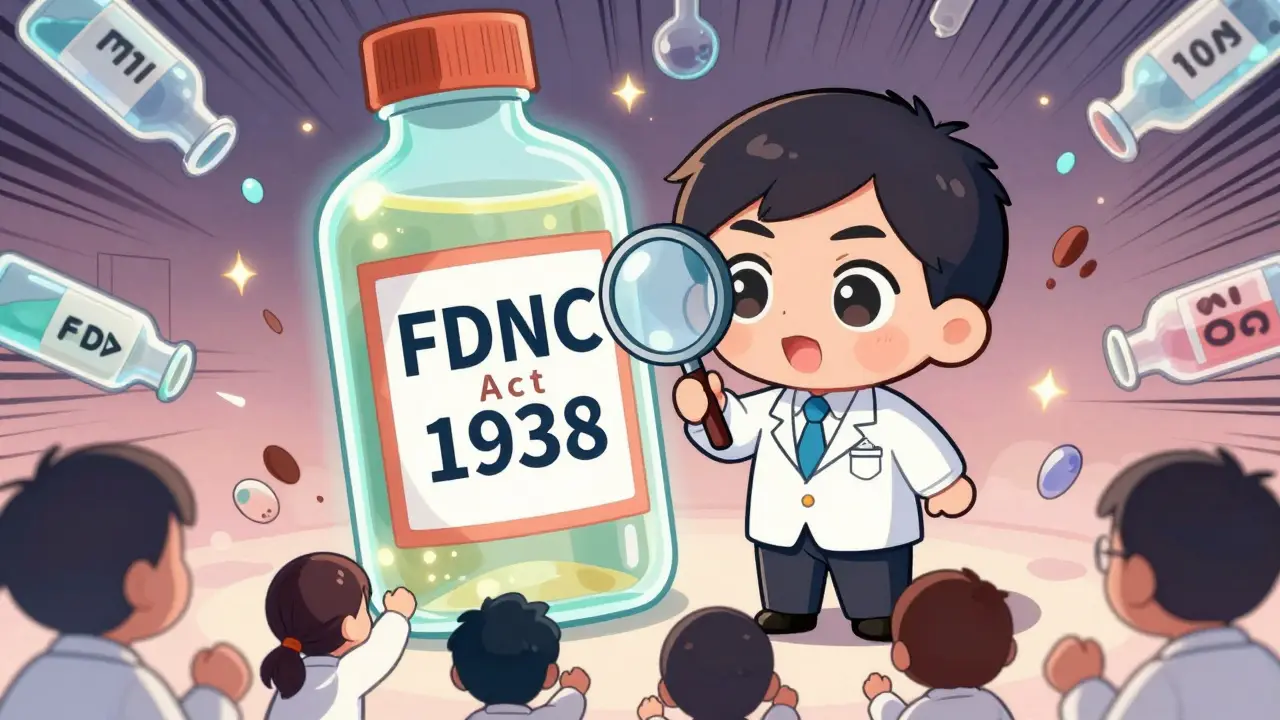
9 Jan, 2026The FD&C Act didn’t start out as a law for generic drugs. In 1938, it was created after more than 100 people died from a toxic medicine called elixir sulfanilamide. The drug had no safety testing. No labels. No oversight. That tragedy forced Congress to act. The result? The Federal Food, Drug, and Cosmetic Act gave the FDA real power to stop dangerous drugs before they reached consumers. But for decades, it only covered safety - not effectiveness. And it didn’t even mention generics.
How Generic Drugs Got Left Behind
For nearly 50 years after the FD&C Act passed, if you wanted to make a copy of a brand-name drug, you had to prove it was safe and effective - all over again. That meant running expensive clinical trials with hundreds of patients. Why? Because the law didn’t recognize that if Drug A works, Drug B with the same ingredients should work the same way. So generic manufacturers were stuck. They couldn’t compete. The brand-name companies held all the cards.
By the early 1980s, only about 19% of prescriptions filled in the U.S. were for generic drugs. But those generics made up just 3% of total drug spending. Why? Because they barely existed. The system was broken. Patients paid more. Insurance paid more. The government paid more. And no one could fix it - until Congress did.
The Hatch-Waxman Breakthrough
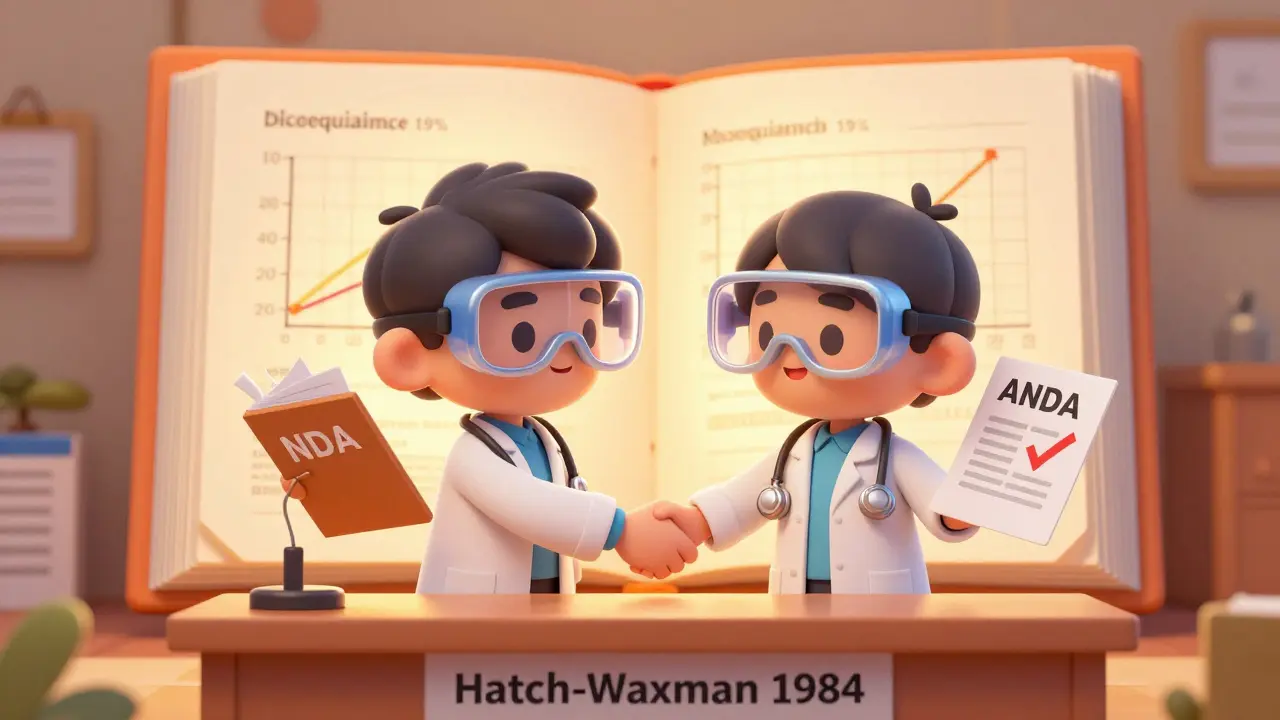
In 1984, Senators Orrin Hatch and Representative Henry Waxman came up with a deal. It wasn’t perfect. But it was smart. They amended the FD&C Act to create Section 505(j). That’s the part that changed everything. It gave us the Abbreviated New Drug Application - or ANDA.
Here’s how it worked: Generic companies no longer had to run new clinical trials. Instead, they just had to prove their drug was pharmaceutically equivalent and bioequivalent to the brand-name version. Same active ingredient. Same dose. Same way it’s taken - pill, injection, cream. And the body had to absorb it the same way. The FDA set a clear standard: the generic’s blood levels had to fall within 80% to 125% of the brand drug’s. That’s it. No retesting safety. No retesting effectiveness. Just science.
This wasn’t just a paperwork shortcut. It was a revolution. The ANDA pathway slashed approval time from years to months. Costs dropped by 90%. Suddenly, generic drug makers could enter the market without bankrupting themselves. And the FDA? They got a clear, repeatable system to approve copies safely and quickly.
The Balance: Patents, Exclusivity, and Fair Play
Hatch-Waxman didn’t just help generics. It protected innovators too. Brand-name companies still got 20 years of patent protection. But the law also gave them a bonus: if their drug took years to get FDA approval, they could get up to five extra years of patent life to make up for lost time. Total patent term? No more than 14 years after approval.
And here’s the kicker: the first generic company to challenge a patent got 180 days of exclusive rights to sell their version. No other generic could enter the market during that time. That created a huge incentive. Generic makers started digging into patents, looking for weaknesses. If they won, they got the market to themselves - and made serious money before others joined.
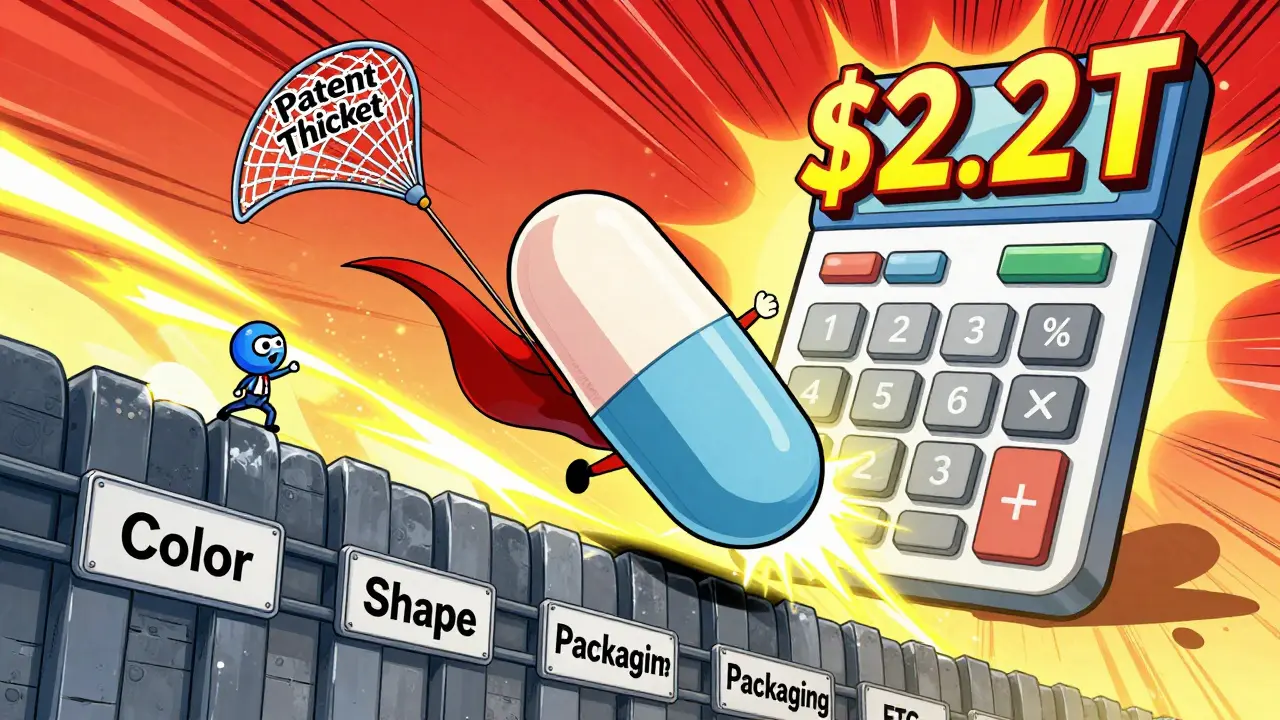
But that system also created loopholes. Some brand companies started filing dozens of weak patents - just to block generics. They’d file a patent on the pill’s color, the shape, the packaging. Courts called it “evergreening.” The FDA and FTC have been fighting this for years. In 2021, the FTC found that these tactics delayed generic entry in nearly half of complex drugs like inhalers and injectables.
How the System Works Today
Today, the FDA’s Orange Book is the bible for generic drug makers. It lists every approved drug, its patent status, and its therapeutic equivalence rating. If a generic wants to copy a drug, they check the Orange Book first. Then they file an ANDA with one of four patent certifications:
- There’s no patent listed (Certification I)
- The patent has expired (Certification II)
- The patent will expire on a certain date (Certification III)
- The patent is invalid or won’t be infringed (Certification IV - the one that triggers the 180-day exclusivity)
When a generic files a Certification IV, the brand company has 45 days to sue. If they do, the FDA can’t approve the generic for 30 months - unless the court rules in the generic’s favor sooner. This legal chess game is why some generics take years to hit the market, even after the patent expires.
Still, the results are undeniable. In 2024, 90% of prescriptions filled in the U.S. were for generic drugs. But they made up only 17% of total drug spending. That’s a $2.2 trillion savings for American patients over the last decade. And it’s all because of the FD&C Act - not as it was written in 1938, but as it was rebuilt in 1984.
What’s Still Broken
Not everything works smoothly. The FDA still struggles with quality control. In 2022, 47 generic manufacturers got warning letters for violating current Good Manufacturing Practices (cGMP). Common problems? Poor lab records, contaminated equipment, fake data. One company in India was caught altering test results for years. Another in Pennsylvania shipped pills with the wrong dosage because their equipment wasn’t calibrated.
And then there’s the rise of “authorized generics.” These are brand-name drugs sold under a generic label - usually by the same company. They’re legal, but they kill the 180-day exclusivity period. Why? Because the first generic doesn’t get a monopoly. The brand just copies their own product and sells it cheaper. The FTC says this undermines the whole point of the Hatch-Waxman incentives.
Complex drugs - like inhalers, injectables, and biologics - are still too hard for generics to copy. The science is tougher. The testing is more expensive. And brand companies have used that to delay competition. In 2023, generic entry for complex drugs was 42% slower than for simple pills.
The Future of Generic Drugs
The FDA is trying to fix this. The Generic Drug User Fee Amendments (GDUFA), updated in 2022, now require faster reviews. In 2022, 98% of priority ANDAs were approved in under 10 months - up from over 30 months in the 1990s. The 21st Century Cures Act and the CREATES Act are pushing brands to share samples so generics can test properly. And the FDA has 147 active guidance documents just for generic developers.
But the real win? Cost savings. The Congressional Budget Office estimates that by 2032, the current system will save the federal government $158 billion on drug spending. That’s money for Medicare, Medicaid, veterans’ care, and more. All because a 1938 law was updated in 1984 to let science - not lawsuits - decide who can make a copy of a drug.
The FD&C Act didn’t create generics. But it gave them a legal home. Without it, we’d still be paying $1,000 for a pill that costs $2 to make. And millions of people would still be skipping doses because they couldn’t afford them.
What is the FD&C Act and why does it matter for generic drugs?
The Federal Food, Drug, and Cosmetic Act (FD&C Act) is the 1938 law that gave the FDA authority to regulate drugs in the U.S. It didn’t originally cover generics, but the 1984 Hatch-Waxman Amendments added Section 505(j), creating the ANDA pathway. This lets generic manufacturers prove their drugs are equivalent to brand-name versions without repeating expensive clinical trials. Without this legal framework, generic drugs wouldn’t exist at their current scale.
What’s the difference between an NDA and an ANDA?
An NDA (New Drug Application) is what brand-name companies file to get approval for a new drug. It requires full clinical trial data proving safety and effectiveness. An ANDA (Abbreviated New Drug Application) is what generic companies file. It doesn’t need new clinical data. Instead, it proves bioequivalence - that the generic delivers the same amount of active ingredient into the bloodstream at the same rate as the brand drug. That’s why ANDAs cost less and get approved faster.
How does the FDA determine if a generic is safe and effective?
The FDA doesn’t retest safety or effectiveness for generics. Instead, they require proof of pharmaceutical equivalence (same ingredients, strength, dosage form) and bioequivalence. Bioequivalence is measured through blood tests in healthy volunteers. The generic’s peak concentration (Cmax) and total exposure (AUC) must fall within 80-125% of the brand drug’s. This range is scientifically proven to ensure the same therapeutic effect. The FDA also inspects manufacturing facilities and reviews labeling to ensure no misleading claims.
Why do some generics take years to launch after a patent expires?
It’s often due to patent litigation. When a generic company files a Certification IV (claiming a patent is invalid or won’t be infringed), the brand company has 45 days to sue. If they do, the FDA can delay approval for up to 30 months - unless the court rules earlier. Some brands also file multiple weak patents to create a “patent thicket,” making it harder for generics to navigate. Even when the patent expires, legal battles can delay entry by years.
What’s the Orange Book and why is it important?
The Orange Book, officially called Approved Drug Products with Therapeutic Equivalence Evaluations, is the FDA’s public database of approved drugs. It lists every brand and generic drug, their patents, exclusivity periods, and therapeutic equivalence ratings (like AB1, AB2). Generic manufacturers use it to identify which drugs they can copy and what patents they need to challenge. It’s the roadmap for entering the generic market legally.
Are generic drugs really as good as brand-name drugs?
Yes. The FDA requires generics to meet the same strict standards as brand-name drugs. They contain the same active ingredient, work the same way in the body, and must be manufactured in FDA-approved facilities. Studies show no meaningful difference in effectiveness or safety between most generics and their brand-name counterparts. The only differences are in inactive ingredients - like fillers or dyes - which don’t affect how the drug works. Millions of people rely on generics every day, and they’re used in hospitals, VA clinics, and Medicare plans nationwide.
chandra tan
January 11, 2026 AT 03:51Man, in India we know this stuff first-hand. My uncle’s blood pressure med? Used to cost 3000 rupees. Now it’s 120. Same pill. Same results. Hatch-Waxman saved lives here too.
Ted Conerly
January 13, 2026 AT 00:31Let’s be real - the ANDA pathway is one of the few times government actually got out of the way and let science win. No more reinventing the wheel just because a company owns a trademark. Brilliant.
Lisa Cozad
January 13, 2026 AT 09:29I work in a rural pharmacy. Patients cry when they find out their $500 brand drug is now $8 generic. That’s not just savings - that’s dignity restored.
Saumya Roy Chaudhuri
January 15, 2026 AT 06:03Everyone forgets that the FDA doesn’t even test generics anymore - they just verify the manufacturer’s data. And guess what? Sometimes that data’s cooked. I’ve seen the reports. It’s not all sunshine.
Aurora Memo
January 15, 2026 AT 14:34I appreciate how this explains the balance - innovators aren’t punished, but generics aren’t blocked either. It’s not perfect, but it’s the closest we’ve gotten to fair.
Ian Cheung
January 17, 2026 AT 00:42Evergreening is just corporate greed dressed up as IP law and honestly it’s disgusting
anthony martinez
January 18, 2026 AT 07:27Oh so now the FTC is surprised that pharma companies use patents like a moat? Newsflash: they’ve been doing this since the 80s. The system’s rigged.
Kunal Majumder
January 19, 2026 AT 20:54My cousin works at a generic plant in Gujarat. They got an FDA warning last year for sloppy records. They fixed it. They’re still making pills for half the price. That’s the real story.
lisa Bajram
January 21, 2026 AT 16:50Authorized generics? That’s the ultimate middle finger to the 180-day exclusivity rule. Brand companies literally copy their own product and undercut the first generic - then act like they’re heroes for lowering prices. No. Just no.
Mario Bros
January 22, 2026 AT 19:34My dad’s on 7 meds. 6 are generic. He’d be choosing between insulin and groceries without this system. Seriously - thank you, Hatch-Waxman.
Dwayne Dickson
January 23, 2026 AT 08:09It is imperative to note that the bioequivalence threshold of 80–125% AUC and Cmax is not arbitrary; it is grounded in pharmacokinetic principles validated through decades of clinical observation. The statistical tolerance window, while seemingly expansive, is empirically sufficient to ensure therapeutic interchangeability across the vast majority of pharmacodynamic profiles. To dismiss this as insufficient is to misunderstand the foundational tenets of pharmacological equivalence.
Faith Edwards
January 25, 2026 AT 03:39How can anyone with a shred of integrity not be appalled by the fact that we allow pharmaceutical monopolies to dictate access to life-saving medication? This isn’t innovation - it’s legalized extortion. And we celebrate it as ‘progress’? Shameful.
Jaqueline santos bau
January 26, 2026 AT 05:25Wait - so you’re telling me the FDA approves pills made in factories with rats running through the labs? And people just swallow them? I’m not taking anything generic anymore. I’m switching to IV drips at a private clinic. My insurance will pay. I deserve better.
Jay Amparo
January 28, 2026 AT 02:52When I was a kid, my mom skipped her diabetes meds because the brand cost $200 a month. Now? $5. I still get emotional thinking about it. This law didn’t just change policy - it changed lives.