 by
by Fever Medication for Kids: Acetaminophen vs. Ibuprofen Safety Guide for Parents
17 Nov, 2025When your child has a fever, the last thing you want is to guess which medicine is safe-or worse, give too much. Acetaminophen and ibuprofen are the two most common fever reducers for kids, but they’re not the same. One might work faster. One might last longer. And one might carry risks you didn’t know about. This isn’t about brand names or price tags. It’s about what actually works, what’s safest, and how to use them without making things worse.
What You Need to Know Before Giving Any Fever Medicine
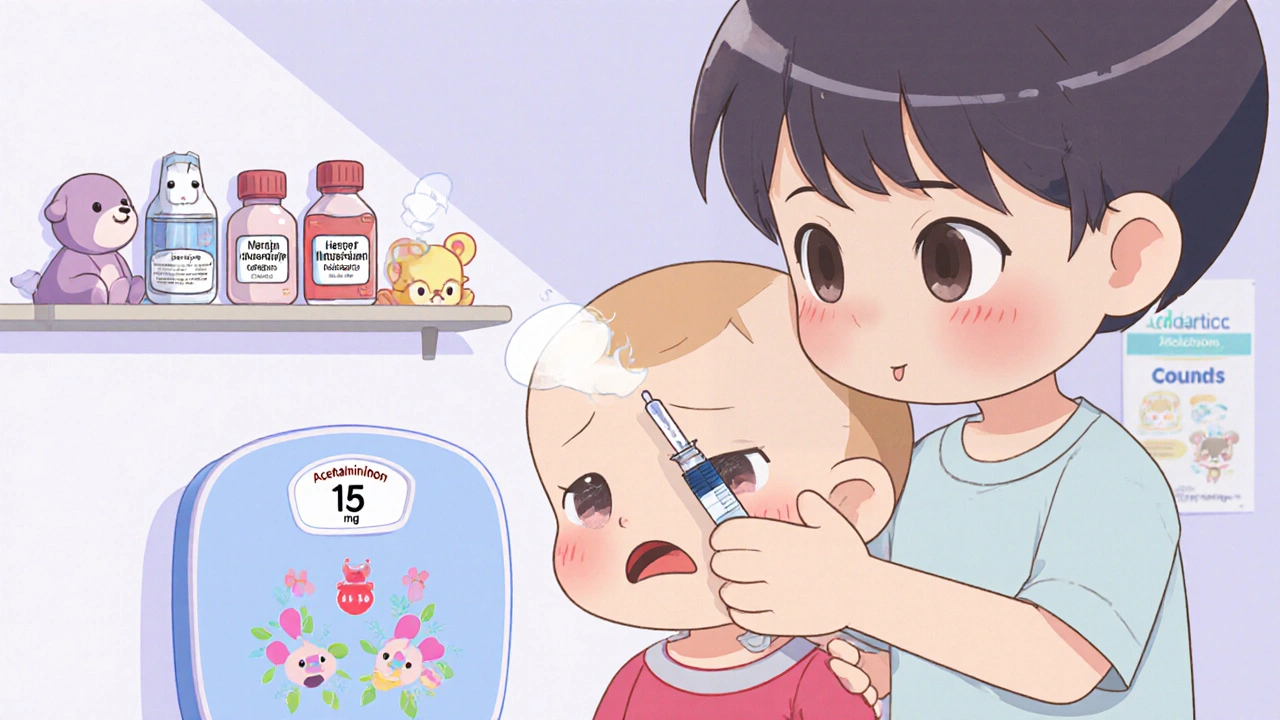
Never give fever medicine based on age alone. That’s the biggest mistake parents make. A 6-month-old weighing 12 pounds needs a completely different dose than a 6-month-old weighing 18 pounds. The acetaminophen dose for kids is 7-15 mg per kilogram of body weight, given every 4-6 hours. The maximum daily dose is 75 mg/kg. For ibuprofen, it’s 4-10 mg/kg every 6-8 hours, with a max of 40 mg/kg per day. If you don’t know your child’s exact weight, don’t guess. Weigh them on a baby scale or ask your pediatrician.
Both medicines are approved for children over 6 months, but the American Academy of Pediatrics says to avoid ibuprofen in babies under 6 months unless a doctor says it’s okay. Acetaminophen isn’t recommended for infants under 3 months without medical advice. Why? Because their livers and kidneys are still developing. A small dosing error can cause serious harm.
And never, ever use adult medicine. A single teaspoon of adult Tylenol can overdose a toddler. The FDA cracked down on this in 2011 by forcing manufacturers to standardize infant acetaminophen to 160 mg per 5 mL. But many older bottles still exist in cabinets. Check the label. If it says 80 mg per 0.8 mL, throw it out. Use only the new, clearly marked bottles with the correct dosing syringe.
Which One Works Better for Fever?
If your goal is to bring down a high fever fast, ibuprofen usually wins. Multiple studies show it reduces fever more effectively than acetaminophen, especially after 4 hours. One major review of 85 studies found that children given ibuprofen were 1.86 times more likely to be fever-free at the 4-hour mark than those given acetaminophen. At 6 hours, the difference was even clearer. Ibuprofen’s effect lasts longer-up to 8 hours-while acetaminophen wears off after 4-6.
Why? It comes down to how the body processes each drug. Ibuprofen reaches peak levels in the blood in 1-2 hours and stays active longer. Acetaminophen hits peak levels faster-within 30-60 minutes-but clears out quicker. That’s why some parents notice acetaminophen works fast but doesn’t last. Ibuprofen might take a little longer to kick in, but it holds the line.
That doesn’t mean acetaminophen is useless. For mild fevers or teething pain, it works fine. But if your child’s temperature is above 102°F and they’re uncomfortable, ibuprofen is often the better choice.
What About Pain Relief?
For pain-like ear infections, sore throats, or teething-the two are much closer. Studies show they’re about equally effective at reducing pain in the first 2-4 hours. But over longer periods-say, 4 to 24 hours-ibuprofen tends to do slightly better. One 2020 review found children reported less pain with ibuprofen after several hours, likely because of its stronger anti-inflammatory action. Acetaminophen doesn’t reduce inflammation. It just blocks pain signals in the brain.
So if your child has swollen gums, a red ear, or a sore throat with swelling, ibuprofen may offer more complete relief. For a simple headache or mild discomfort, acetaminophen is still a solid pick.

Safety: What Are the Real Risks?
Both medicines are safe when used correctly. But each has hidden dangers if misused.
Acetaminophen is hard on the liver. Too much-even a little over the daily limit-can cause liver damage. In children under 6, 29% of acetaminophen-related liver injuries come from accidental overdose due to combination cold medicines. Parents don’t realize they’re giving two products with the same active ingredient. Always check the active ingredients. If it says “acetaminophen” or “APAP,” don’t give another one.
Ibuprofen can irritate the stomach and, in rare cases, affect kidney function, especially if the child is dehydrated. That’s why you shouldn’t give it if your child hasn’t had fluids in hours. Also, it’s not recommended for kids with chickenpox or certain infections because it may increase the risk of rare skin complications.
There’s also new research linking early acetaminophen use to a higher chance of childhood asthma. A 2022 meta-analysis found kids exposed to acetaminophen in their first year had a 1.6 times higher risk of developing asthma by age 6. That doesn’t mean you can’t use it-but it does mean you should use it only when necessary, not as a routine.
On the flip side, ibuprofen has been wrongly blamed for kidney damage in young infants. Older studies suggested this, but more recent data from the American Academy of Family Physicians in 2021 found no increased risk of serious side effects compared to acetaminophen. The fear was based on outdated assumptions. Today, both are considered equally safe when dosed properly.
Alternating Medications? Don’t Do It Without a Doctor
You’ve probably heard it: “Alternate acetaminophen and ibuprofen every 3 hours to keep the fever down.” It sounds smart. But it’s risky.
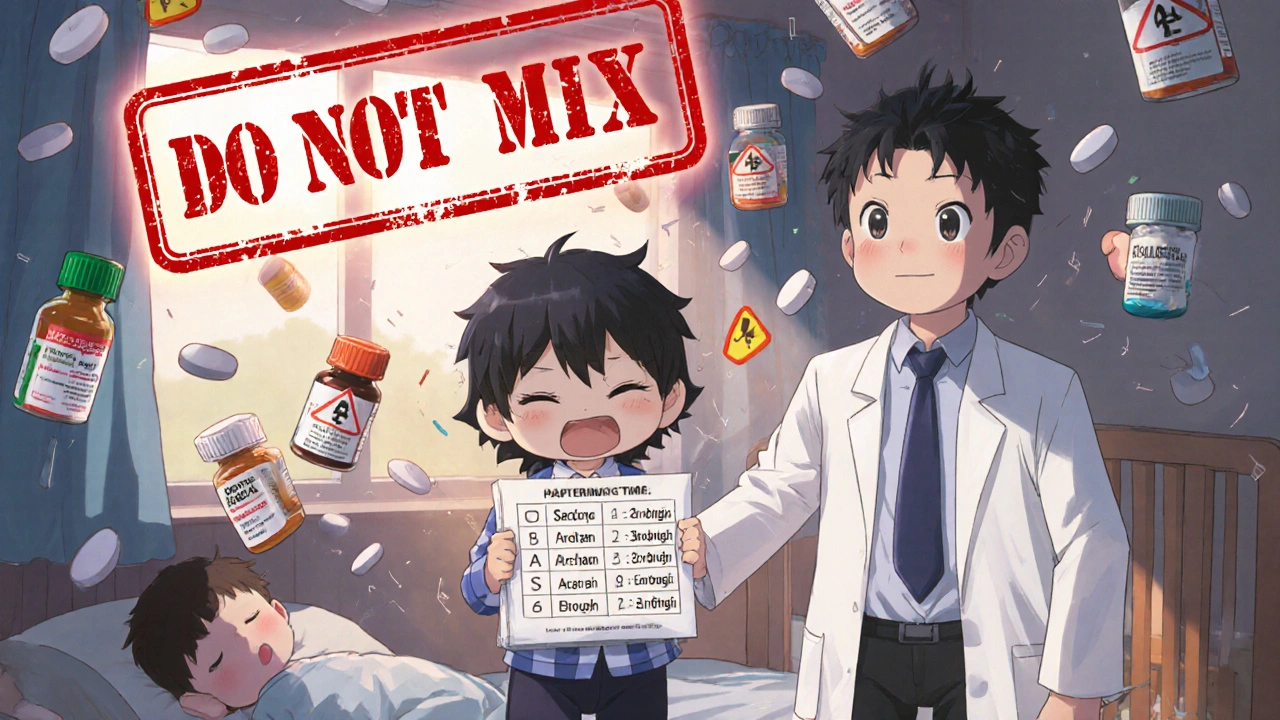
Parents who alternate often lose track of which medicine they gave last, when, and how much. A 2022 survey of 4,852 parents showed 63% did this-but 71% couldn’t correctly explain the schedule. That’s how overdoses happen.
The American Academy of Pediatrics doesn’t recommend alternating unless a child isn’t responding to one medicine and a doctor advises it. Even then, it should be tracked on a written chart. No one should be guessing doses every few hours. It’s too easy to mess up.
If your child’s fever won’t break with one medicine, call your pediatrician. Don’t try to outsmart the system.
How to Give Medicine Safely
Using the right tool matters as much as the right dose. Never use a kitchen spoon. They’re not accurate. Always use the syringe or cup that came with the bottle. If it’s missing, ask your pharmacy for a new one-they’ll give it to you free.
Hold your child upright. Never lay them flat when giving liquid medicine. That’s how choking happens. Tilt their head slightly back, insert the syringe between the cheek and gum, and slowly push the plunger. Let them swallow between small pushes.
Wipe the syringe after each use. Buildup can change the dose. Store medicines out of reach-preferably in a locked cabinet. The American Association of Poison Control Centers reports that 17% of pediatric poisonings from fever meds come from kids getting into unlocked bottles.
When to Call the Doctor
Medicine helps with symptoms, not the cause. If your child is under 3 months and has a fever of 100.4°F or higher, call your doctor immediately. No waiting. No giving medicine first. This is a medical emergency.
For older kids, call if:
- The fever lasts more than 72 hours
- Your child won’t drink, hasn’t peed in 8 hours, or has dry lips
- They’re lethargic, hard to wake, or won’t make eye contact
- They have a rash, stiff neck, or trouble breathing
- The fever goes away but comes back after 24 hours
Also, if you’re ever unsure about the dose, call your pediatrician. Better safe than sorry.
What’s Changing in 2025?
The American Academy of Pediatrics is updating its fever guidelines in January 2025. They’ll likely give clearer advice on using ibuprofen in babies under 6 months, based on new safety data. The FDA is also reviewing the link between early acetaminophen use and asthma risk.
Meanwhile, Boston Children’s Hospital is running a major study called PAIN-RELIEF, tracking 1,200 children under 2 to compare precise weight-based dosing. Early results suggest most parents still overdose by using age charts instead of weight. That’s why your pediatrician keeps asking for your child’s weight-it’s not just for growth charts. It’s for survival.
Bottom Line: What Should You Do?
For babies under 6 months: Use acetaminophen only if your doctor says so. Otherwise, treat fever with fluids, light clothing, and a lukewarm sponge bath. Don’t rush to medicine.
For kids over 6 months: Ibuprofen is usually the better choice for fever and inflammation. It lasts longer and works more reliably. Acetaminophen is fine for mild pain or if your child has stomach sensitivity.
Always dose by weight. Always use the right tool. Never mix medicines. And never ignore signs that something’s more serious than a fever.
Both medicines save lives when used right. But they can hurt when used wrong. Knowledge isn’t just helpful-it’s the difference between comfort and crisis.
Katelyn Sykes
November 17, 2025 AT 08:22I used to alternate meds like it was a science experiment until my kid threw up twice in one night. Now I stick to one at a time and just keep fluids flowing. Turns out the body knows how to fight fever better than I thought.
Gabriella Jayne Bosticco
November 17, 2025 AT 09:14This is the most practical guide I've read in years. No fluff, just clear dosing rules and real risks. I printed it out and taped it to the fridge next to the medicine cabinet. My partner finally stopped using the kitchen spoon.
Denny Sucipto
November 18, 2025 AT 04:24Man I remember when I gave my little guy adult Tylenol by accident. Thank god it was just a half teaspoon and we rushed to the ER. They laughed but said we got lucky. Now I keep the syringe in a labeled ziplock next to the meds. No more guessing. No more panic. Just calm, weight-based doses.
Iska Ede
November 18, 2025 AT 18:10Oh so now we’re supposed to weigh our kids before every fever? Next you’ll tell me to time their sneezes and calculate the fever’s GDP.
Sarah Frey
November 20, 2025 AT 18:06While I appreciate the data-driven approach, I think we’re missing the bigger picture. Fever isn’t the enemy-it’s the body’s way of fighting. The real goal isn’t to crush the number on the thermometer, but to keep the child comfortable and hydrated. Sometimes that means waiting. Sometimes that means holding them while they shiver. Medicine helps, but presence helps more.
Gabe Solack
November 22, 2025 AT 10:04Love this. Just added it to my parenting bookmark folder 🙌 Also-please everyone, check your cabinets. I found a 2012 bottle of infant Tylenol that said 80mg/0.8mL. Threw it out. Bought the new one with the syringe. No regrets. 🚫💊
Shilpi Tiwari
November 22, 2025 AT 12:47From a pediatric pharmacology standpoint, the pharmacokinetic profiles are well-documented but the real-world adherence data is where the rubber meets the road. Most caregivers operate under cognitive load-sleep deprivation, stress, fragmented attention-so the margin for error in polypharmacy scenarios is non-trivial. The AAP’s stance against alternating regimens is not merely precautionary-it’s a harm-reduction imperative in the context of real-world executional failure rates exceeding 70% in non-clinical populations.
Yash Nair
November 22, 2025 AT 21:33USA always overcomplicating things. In India we just give paracetamol and wait. No weighing no syringes no stress. Kids are tougher here. You think your child is special? They arent. Just give the right dose and shut up. Why you need study for this? Common sense is dead in america