
 by
by H2 Blockers and Their Dangerous Interactions with Antivirals and Antifungals
15 Dec, 2025H2 Blocker & Antifungal/Antiviral Checker
Check Your Medication Interaction
Enter the antifungal or antiviral you're taking and the H2 blocker you're prescribed to see if they interact dangerously.
Enter medication details to see interaction information
Important Notes
Cimetidine is the most dangerous H2 blocker due to enzyme interactions. Famotidine is generally safer. Always consult your pharmacist before combining medications.
When you’re taking medication for a fungal infection or a virus, the last thing you want is for your stomach acid reducer to sabotage it. But that’s exactly what can happen when H2 blockers are mixed with certain antivirals and antifungals. These drugs - once seen as safe and simple - can quietly reduce the effectiveness of life-saving treatments, leading to treatment failure, longer illness, or even dangerous side effects.
What Are H2 Blockers, Really?
H2 blockers, or histamine H2-receptor antagonists, are drugs designed to cut down stomach acid. They work by blocking histamine from telling your stomach cells to produce acid. The result? Less heartburn, fewer ulcers, and relief from GERD.
There are three main ones still in use in the U.S. as of 2025: famotidine (Pepcid), cimetidine (Tagamet), and nizatidine (Axid). Ranitidine (Zantac) was pulled off shelves in 2020 after it was found to contain NDMA, a probable cancer-causing chemical. Famotidine is now the most common because it’s effective and has fewer drug problems than the others.
But here’s the catch: H2 blockers don’t just calm your stomach. They change the whole environment your other drugs have to travel through. When you take one, your stomach pH rises from about 1-3 (very acidic) to 4-6 (much less acidic). That sounds harmless - until it messes with how your antivirals or antifungals get absorbed.
Why Acid Matters for Antifungals
Not all antifungals are created equal. Some need a highly acidic stomach to dissolve and get into your bloodstream. Others don’t care at all. The difference can mean the difference between healing and worsening infection.
Itraconazole is one of the worst offenders. This antifungal, used for serious fungal infections like aspergillosis or nail fungus, absolutely requires acid to dissolve. Studies show that when you take itraconazole with an H2 blocker, its absorption drops by 40-60%. That’s not a small drop - it’s enough to let the infection grow unchecked.
But here’s the twist: the oral solution of itraconazole contains citric acid, which helps it dissolve even in a less acidic stomach. So if you’re on an H2 blocker and need itraconazole, your doctor might switch you to the liquid form. Tablets? Not so much.
On the flip side, fluconazole doesn’t care about stomach pH. It’s highly water-soluble and absorbs just fine whether your stomach is acidic or not. That’s why fluconazole is often the go-to choice when acid suppression is needed.
Voriconazole and posaconazole fall in the middle. They’re affected by pH, but not as badly as itraconazole. The FDA recommends spacing them out from H2 blockers by at least two hours. Isavuconazole is the new kid on the block - it’s designed to be less sensitive to pH and has fewer enzyme interactions, making it a safer option in complex cases.
Antivirals That Hate Low Acid
Antivirals aren’t off the hook either. Many of them, especially those used for HIV or certain cancers with antiviral properties, need acid to dissolve properly.
Atazanavir, an HIV protease inhibitor, is a textbook example. When taken with famotidine, its blood levels can drop by up to 77%. That’s not just a minor inconvenience - it’s a direct path to drug resistance. The FDA specifically says: take atazanavir at least two hours before your H2 blocker. No exceptions.
Other antivirals like dasatinib (used in leukemia but with antiviral effects) and erlotinib also suffer from reduced absorption with acid blockers. A 2022 FDA review found that 68% of antiviral labels now include warnings about acid-reducing drugs. That’s more than two-thirds of all antivirals - a huge red flag.
And here’s the scary part: 31% of those antivirals don’t even come with clear instructions on how to avoid the interaction. That means patients and even some doctors might not know they’re putting treatment at risk.
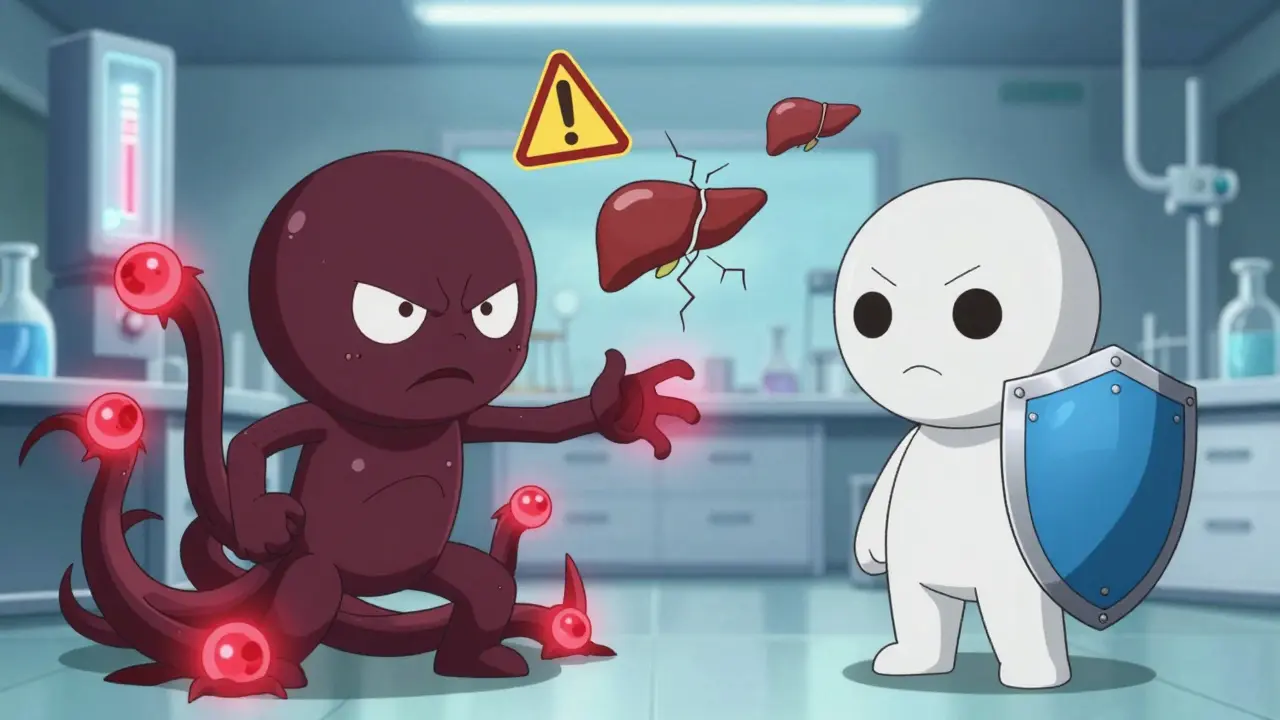
Cimetidine: The Worst Culprit
Not all H2 blockers are the same. Cimetidine is the old-school option - and it’s the most dangerous when mixed with other drugs.
Why? Because it doesn’t just raise stomach pH. It also blocks key liver enzymes - CYP1A2, CYP2C9, CYP2C19, and CYP2D6 - that break down hundreds of medications. This means drugs can build up to toxic levels in your blood.
Take voriconazole, for example. It’s broken down by CYP2C19. Cimetidine blocks that enzyme, causing voriconazole levels to spike by 40%. That can lead to hallucinations, liver damage, or skin reactions. In one study, patients on both drugs needed dose reductions just to stay safe.
Meanwhile, famotidine doesn’t touch those enzymes. It’s pH-only. That’s why experts now recommend famotidine over cimetidine whenever possible - especially if you’re on antifungals or antivirals.
According to the University of Liverpool’s drug interaction database, cimetidine is involved in 63% of all problematic interactions with antifungals and antivirals. Famotidine? Less than 10%. The numbers don’t lie.
What Should You Do?
If you’re on an antifungal or antiviral and your doctor prescribes an H2 blocker, don’t assume it’s safe. Ask these questions:
- Is my antifungal or antiviral sensitive to stomach pH?
- Which H2 blocker am I getting - cimetidine or famotidine?
- Can I take them at different times?
- Is there a better alternative?
Here’s what works in practice:
- For itraconazole tablets: Avoid H2 blockers entirely. Use the oral solution if you must use acid suppression.
- For voriconazole: Monitor blood levels. Target troughs should be 2-5 mcg/mL. Don’t guess - test.
- For atazanavir: Take it at least two hours before your H2 blocker. Always.
- For fluconazole or isavuconazole: You’re likely fine. These are the safest choices.
- Never take cimetidine with any azole antifungal or pH-dependent antiviral. It’s not worth the risk.
Timing matters. Taking your antifungal two hours before your H2 blocker gives your stomach time to be acidic enough for absorption. Waiting too long? You’re playing Russian roulette with your treatment.
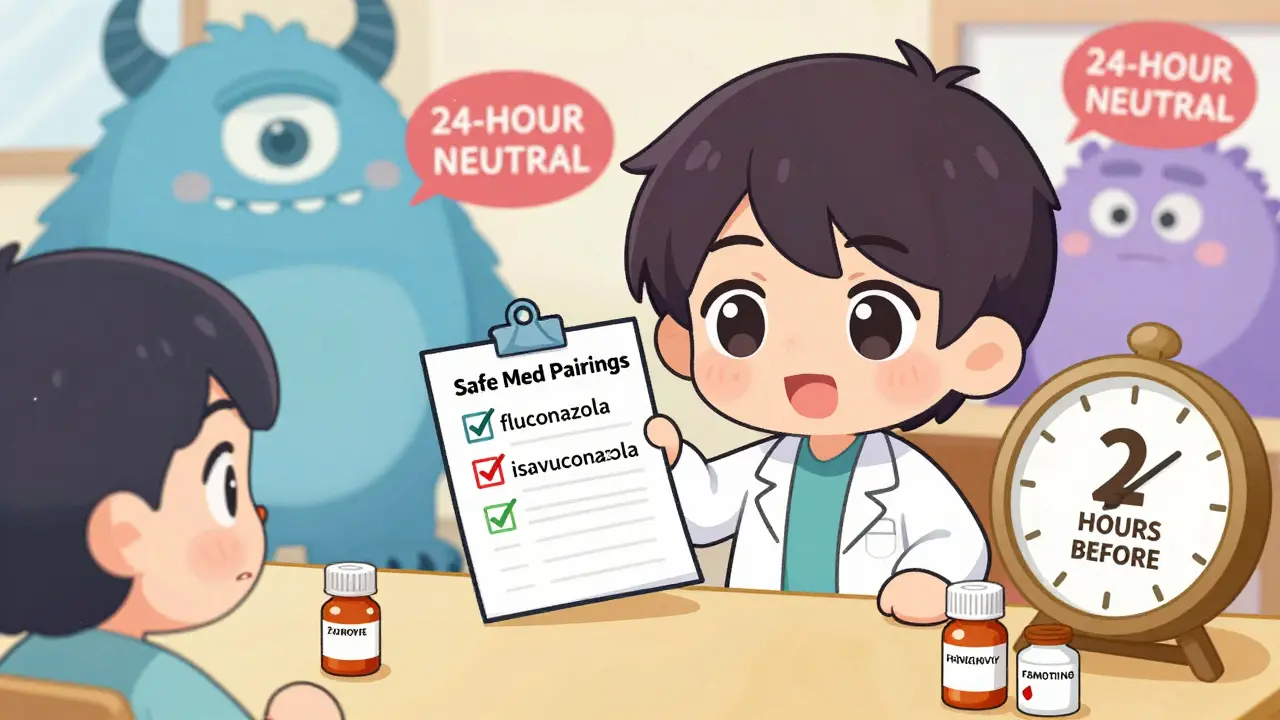
Why PPIs Are Even Worse
You might think, “Why not just use a proton pump inhibitor (PPI) like omeprazole instead?”
Bad idea.
PPIs suppress acid for 24+ hours. H2 blockers? Only 6-12 hours. That means with H2 blockers, you can time your antifungal to be taken when acid is naturally high - like right before bed or first thing in the morning. With PPIs, your stomach is neutral all day. No window. No safety net.
Also, PPIs interact with more drugs than H2 blockers. Omeprazole alone has 78 documented interactions. Cimetidine? 44. Famotidine? Just a handful.
So if you need acid suppression, H2 blockers - specifically famotidine - are still the better choice. Just use them smartly.
What’s Changing in 2025?
Things are getting better - slowly.
A 2023 IQVIA analysis showed that prescriptions for H2 blockers dropped by 18% in patients on azole antifungals between 2019 and 2022. Why? Because doctors are learning. And when they do prescribe one, 92% of the time it’s famotidine - not cimetidine.
The FDA is pushing for clearer labeling. A proposed rule in late 2023 would require all pH-sensitive drugs to include exact timing instructions on their labels. That could cut interaction-related failures by 35%.
And new drug formulations are coming. Early trials (NCT04821542) are testing lipid-based itraconazole that works even in neutral pH. If it pans out, we might soon have antifungals that don’t care about your stomach acid at all.
Bottom Line
H2 blockers aren’t evil. But they’re not harmless, either. When paired with antivirals or antifungals, they can quietly ruin your treatment - without you even knowing.
The key is knowing which drugs are affected, which H2 blocker you’re on, and how to time them right. Famotidine is your safest bet. Cimetidine? Avoid it like the plague if you’re on antifungals or antivirals.
And always, always talk to your pharmacist. They’re the ones who catch these interactions before they hurt you.
Can I take famotidine with fluconazole?
Yes. Fluconazole is not affected by stomach pH changes, so famotidine won’t reduce its effectiveness. There are no known significant interactions between the two. You can take them together without timing concerns.
Why is cimetidine dangerous with antifungals?
Cimetidine blocks liver enzymes (CYP450) that break down many antifungals like voriconazole and itraconazole. This causes those drugs to build up in your blood, raising the risk of serious side effects like liver damage, hallucinations, or skin reactions. It also raises stomach pH, which reduces absorption of pH-dependent antifungals. It’s a double threat.
How long should I wait between an antiviral and an H2 blocker?
For drugs like atazanavir, take the antiviral at least 2 hours before the H2 blocker. This gives your stomach time to be acidic enough for the antiviral to dissolve. Taking them together or the other way around can cut absorption by up to 77%.
Is it safe to use H2 blockers with isavuconazole?
Yes. Isavuconazole has minimal CYP enzyme inhibition and is less affected by stomach pH than other azoles like itraconazole or voriconazole. It’s one of the safest antifungals to use with H2 blockers, though spacing doses by 2 hours is still recommended as a precaution.
What’s the best H2 blocker to use with antivirals?
Famotidine is the best choice. It doesn’t block liver enzymes like cimetidine does, and its acid suppression is shorter (6-12 hours), making it easier to time around antivirals. Cimetidine should be avoided entirely if you’re on antivirals like atazanavir or dasatinib.
Do all antifungals interact with H2 blockers?
No. Fluconazole and isavuconazole are not significantly affected by stomach pH. Itraconazole, voriconazole, and posaconazole are. Always check the specific drug you’re taking - don’t assume all antifungals behave the same.
Dwayne hiers
December 16, 2025 AT 13:24Let’s cut through the noise: famotidine is the only H2 blocker you should ever consider if you’re on azole antifungals or pH-dependent antivirals. Cimetidine? Absolute poison in this context. It’s not just about pH - it’s the CYP450 inhibition that turns a simple interaction into a pharmacokinetic disaster. The FDA’s 2022 review nailed it: 68% of antiviral labels now warn about acid suppressants. That’s not a footnote - that’s a red alert.
And yes, fluconazole and isavuconazole are the outliers. They don’t care about gastric pH. That’s why they’re first-line in patients on chronic acid suppression. But if you’re on itraconazole tablets and your doc prescribes Pepcid? You’re setting yourself up for treatment failure. The oral solution exists for a reason - use it.
Timing isn’t optional. Two hours before the H2 blocker? Non-negotiable for atazanavir. One study showed a 77% drop in AUC when taken concurrently. That’s not ‘maybe it’ll work’ - that’s ‘your HIV is now resistant’ territory.
PPIs? Even worse. They obliterate acid for 24 hours. No window. No buffer. H2 blockers at least give you a circadian window - take your antifungal at 7 AM, your Pepcid at 10 PM. That’s strategy. PPIs? That’s surrender.
And don’t get me started on the 31% of antivirals with no clear dosing instructions. That’s malpractice by omission. Pharmacists are the unsung heroes here - they’re the ones catching these before patients end up in the ER with fungal meningitis or viral rebound.
Thomas Anderson
December 16, 2025 AT 17:10So if I’m on fluconazole for athlete’s foot and I take Pepcid for heartburn, I’m good? No need to space them out?
Just want to make sure I’m not overcomplicating this. My grandma takes both and she’s fine. Maybe I’m overthinking it?
Dwayne hiers
December 17, 2025 AT 03:05Exactly. Fluconazole doesn’t give a damn about your stomach pH. You can take it with Pepcid, with omeprazole, even with a shot of vinegar - it’ll still work. The drug doesn’t need acid to dissolve. It’s like a bullet that doesn’t need a ramp to fly. Simple as that.
But if you’re on itraconazole? That’s a different story. That thing’s like a key that only turns in a rusty lock - needs acid to fit. No acid? No cure. And your grandma? She’s probably fine because she’s not on something that actually requires gastric acidity to work. Don’t generalize.
Daniel Wevik
December 18, 2025 AT 13:44For real - why is this even a conversation? If you’re on antivirals or antifungals, you should already be under a pharmacist’s supervision. This isn’t ‘take aspirin for a headache.’ This is life-or-death pharmacokinetics. If your doctor doesn’t know this, find a new one. Or better yet, go to a clinic that specializes in infectious disease or antiretroviral management.
And stop trusting ‘online advice.’ This is why people die - because they think Google is a doctor. If you’re on azoles and H2 blockers, your pharmacist should be reviewing your med list weekly. Period.
Edward Stevens
December 18, 2025 AT 17:52So let me get this straight - we’ve got a drug that’s basically a ‘stomach acid dimmer switch,’ and it’s quietly sabotaging half the prescriptions people take for serious infections… and the FDA’s only now trying to fix the labeling?
Meanwhile, Big Pharma’s marketing teams are still pushing H2 blockers like they’re harmless Tums. Classic. The system’s designed to keep people sick so they keep buying stuff. But hey, at least we’ve got famotidine as the ‘lesser evil.’ What a world.
Rulich Pretorius
December 20, 2025 AT 12:35Interesting how this mirrors the broader issue in modern medicine - we treat symptoms without understanding the system. Acid suppression is a bandaid for GERD, but we ignore root causes: diet, stress, gut dysbiosis. Meanwhile, we’re poisoning the absorption of life-saving drugs because we’re too lazy to fix the real problem.
I’ve seen patients on PPIs for 10 years, then come in with invasive aspergillosis because their itraconazole didn’t absorb. The irony? Their GERD was from eating processed food and lying down after meals. But no - let’s just turn off stomach acid and call it a day.
Maybe the real solution isn’t better timing, but better lifestyle medicine. But then again, that doesn’t sell pills.
Jonny Moran
December 21, 2025 AT 15:52Hey, I just want to say thank you for this post. I’m a nurse in oncology, and I’ve seen too many patients get crushed by these interactions - not because they were careless, but because no one told them. I’ve had to pull meds, re-educate docs, and explain why their ‘simple’ heartburn pill is messing with their chemo.
It’s not just about the science. It’s about communication. We need to stop assuming patients know what ‘pH-dependent’ means. We need to say: ‘Don’t take this pill with your Pepcid - it won’t work.’ Plain. Simple. No jargon.
And yes - famotidine is your friend. Cimetidine? Throw it in the trash. I keep a printed cheat sheet on my desk now. Every patient on azoles gets it. Small thing. Big difference.
Rich Robertson
December 21, 2025 AT 18:43As someone who’s lived with Crohn’s and been on antifungals for fungal overgrowth, this hits home. I was on itraconazole for months, and my GI doc threw me a Pepcid like it was candy. I didn’t know to ask. My infection got worse. I had to go back to square one.
It wasn’t until I started reading clinical guidelines myself that I realized what happened. I’m not a doctor. I’m not a pharmacist. But I learned enough to save my own life.
So if you’re on any of these meds - don’t wait for your doctor to bring it up. Ask: ‘Is this drug pH-dependent? Which H2 blocker are you giving me? Can we time them?’ If they look confused? That’s your cue to get a second opinion.
Knowledge isn’t power here - it’s survival.
Sinéad Griffin
December 23, 2025 AT 17:58OMG I just realized I’ve been taking Pepcid with my antifungal for 6 months 😱😭
Thank you for this post!! I’m literally running to my pharmacy right now!!
Also - why is no one talking about this on TV?! This should be on the news!!
jeremy carroll
December 24, 2025 AT 15:58Man I thought famotidine was just a chill acid reducer. Didn’t know it could be a game-changer or a landmine depending on what else you’re on. Thanks for breaking it down. I’ve got a buddy on itraconazole and he’s been taking it with his Zantac - I’m gonna send him this right now.
Also, cimetidine sounds like a villain from a Marvel movie. ‘I am Cimetidine… and I will block your enzymes.’
Natalie Koeber
December 24, 2025 AT 23:39Wait… what if this is all a lie? What if the FDA and Big Pharma are hiding the truth? I read that H2 blockers were originally developed by the CIA to control gut bacteria in mind control programs. Famotidine? It’s not a drug - it’s a behavioral modulator. They want you to think it’s safe so you keep taking it while your immune system gets wiped out by ‘unabsorbed’ antifungals.
And why is fluconazole ‘safe’? Because it’s synthetic and patented. Natural antifungals like garlic and oregano oil don’t need stomach acid - and they’re banned in 47 states. Coincidence? I think not.
Alexis Wright
December 26, 2025 AT 01:22Let’s be brutally honest: this isn’t a pharmacology issue. It’s a systemic failure of medical education. Doctors are trained to prescribe, not to understand pharmacokinetics. They memorize drug names, not mechanisms. And patients? They’re told to ‘take it with food’ and assume that’s enough.
We’ve turned healthcare into a transactional checklist. ‘Here’s your script. Have a nice day.’ No follow-up. No context. No accountability.
And now we’re surprised when people die from drug interactions that were documented in 1998? This isn’t negligence - it’s institutional arrogance. The system doesn’t care if you live or die. It cares if the billing code gets submitted.
So yes - famotidine over cimetidine. But the real answer? Stop trusting the system. Learn. Question. Demand details. Or die quietly like the rest of them.
Tim Bartik
December 27, 2025 AT 19:15Bro I just found out my cousin’s on itraconazole and takes Pepcid like it’s candy. I told him he’s gonna die of aspergillosis and he laughed. Said ‘I’m healthy, bro.’ Dude, you’re on antifungals because you’re NOT healthy. And now you’re sabotaging your own treatment because you think ‘Pepcid = harmless.’
Send him this post. Or I will. I ain’t playin’.
Sarthak Jain
December 28, 2025 AT 23:41As someone from India where antifungal resistance is rising fast, this is critical. We see so many cases of recurrent candidiasis because people just pop fluconazole and take antacids without knowing the difference. This post is gold.
Also, famotidine is way cheaper here than PPIs. If we can push it as the safe option, it could save so many lives - especially in rural areas where access to labs and specialists is limited.
Shoutout to the pharmacist who caught this for me last year. I thought my infection was stubborn. Turns out, I was taking it with ranitidine (before it got banned). Lesson learned.
Daniel Thompson
December 30, 2025 AT 20:59So… if I take my atazanavir at 7 AM and my famotidine at 10 PM, I’m fine? No need to wait two hours after? Or is that only if you take it before?
Just trying to be precise - this stuff keeps me up at night.