 by
by How to Check for Allergens and Inactive Ingredients on Prescription and Food Labels
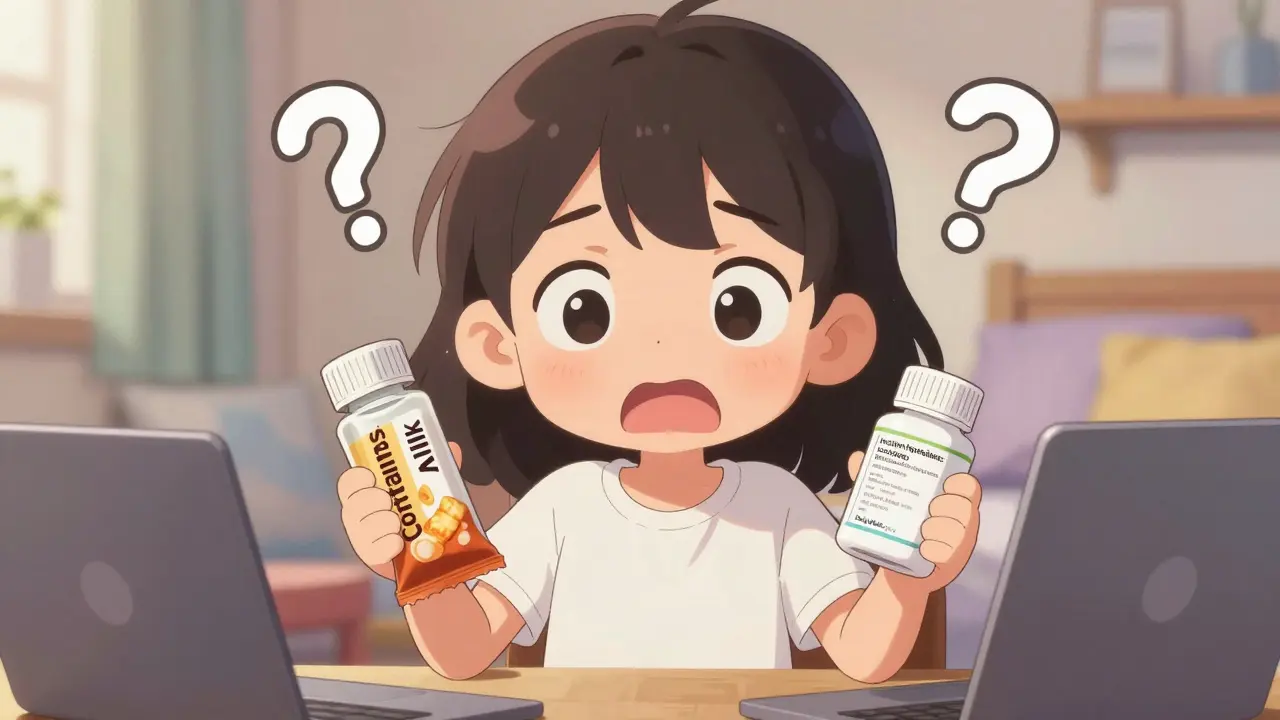
16 Dec, 2025Reading a prescription label isn’t just about knowing how much to take or when. For people with allergies, it’s a matter of avoiding a reaction that could land them in the emergency room. The truth is, allergens don’t just hide in your peanut butter or bread-they’re also hiding in your pills. And most people have no idea.
Why Food Labels Are Clearer Than Medicine Labels
In the U.S., food manufacturers must follow strict rules under the Food Allergen Labeling and Consumer Protection Act (FALCPA). That means if your snack bar contains milk, soy, or peanuts, it has to say so-clearly and plainly. The law requires allergens to be listed either right in the ingredient list (like “lecithin (soy)”) or in a separate “Contains:” statement at the end. Since 2023, sesame is also required to be labeled, making it the ninth major allergen covered by law.But here’s the problem: those rules don’t apply to medications.
Prescription drugs, over-the-counter pills, and even vitamins can contain the same allergens-lactose (from milk), peanut oil, soy lecithin, wheat starch-but they don’t have to say so on the bottle. There’s no federal law forcing drugmakers to list inactive ingredients as allergens. That’s not an oversight-it’s a gap in regulation. The FDA doesn’t require standardized allergen labeling for drugs, even though millions of Americans live with allergies to these substances.
What Inactive Ingredients to Watch For
Inactive ingredients are the fillers, binders, and coatings that help pills hold their shape or dissolve properly. They’re not meant to treat anything, but they can still trigger reactions. Here are the most common culprits:- Lactose - Found in nearly 20% of prescription pills. Made from milk. Can cause reactions in people with dairy allergies.
- Peanut oil - Rare, but still used in some injectables and topical medications. Even trace amounts can be dangerous.
- Soy lecithin - Used as an emulsifier in capsules and tablets. Often listed as “lecithin” without specifying the source.
- Wheat starch - Used as a binder. Not the same as gluten, but can still contain wheat proteins that trigger allergies.
- Shellfish-derived ingredients - Found in some anticoagulants and injectables, like heparin derived from pig intestines (not shellfish) but sometimes confused.
These aren’t just “maybe” ingredients. They’re common. A 2023 study in the Journal of Allergy and Clinical Immunology found that 4% of U.S. adults have documented allergies to at least one inactive ingredient in medications. That’s over 10 million people.
How to Read a Prescription Label Properly
You can’t rely on the bottle alone. Here’s how to do it right:- Check the patient information leaflet - This small paper inside the box has the full list of inactive ingredients. Look for the section titled “Inactive Ingredients” or “Other Ingredients.”
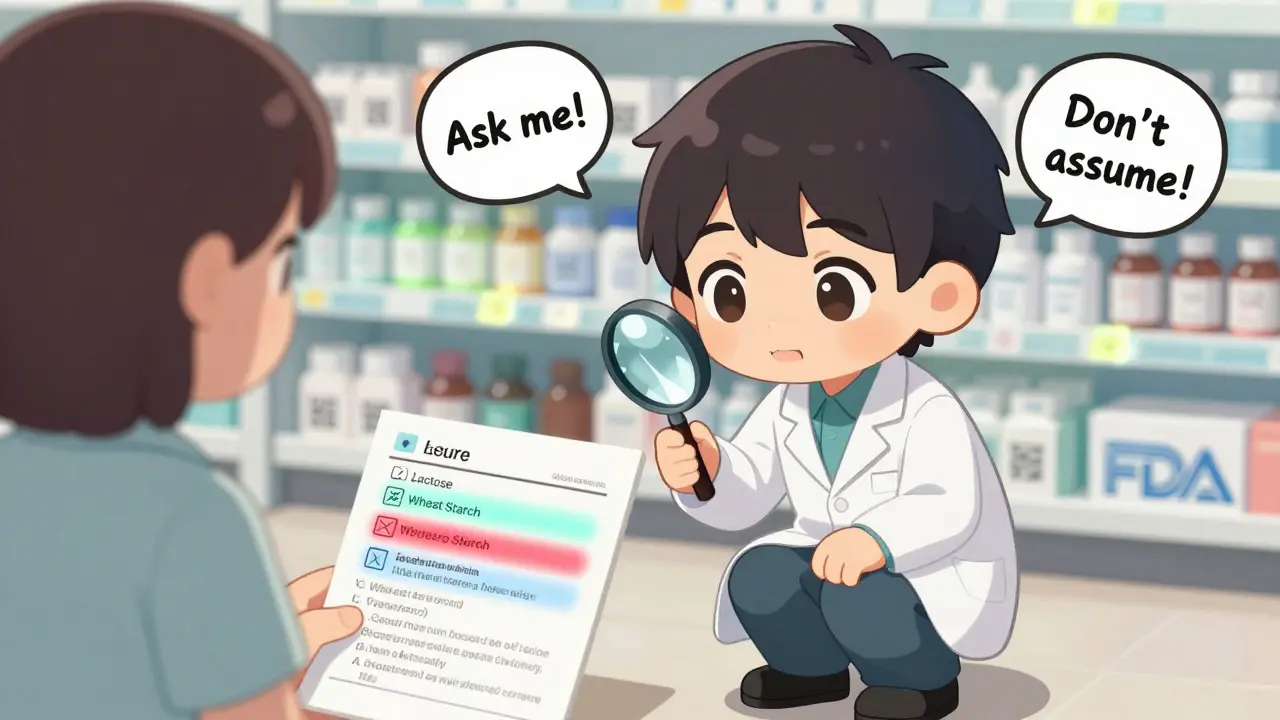
- Ask your pharmacist - Pharmacists have access to the full drug monograph. Don’t just say, “Does this have dairy?” Say, “Can you give me the complete list of inactive ingredients for this pill?”
- Compare generic versions - Two brands of the same generic drug can have different fillers. One might use lactose, another might use corn starch. Switching manufacturers without checking can be risky.
- Use the FDA’s DailyMed database - Go to dailymed.nlm.nih.gov and search your drug name. You’ll find the official prescribing information with the full ingredient list.
Don’t assume your pharmacist remembers every formulation. They’re busy. You need to be the one asking.
What to Do If You’ve Had a Reaction
If you’ve ever broken out in hives, felt your throat tighten, or had stomach cramps after taking a new pill-even if you’ve taken it before-you need to act.- Stop taking it - Even if the reaction seemed mild, it can get worse next time.
- Call your doctor - Tell them exactly what happened and what you took.
- Get the ingredient list - Request the full inactive ingredients from the pharmacy or manufacturer.
- Report it to the FDA - Use the MedWatch program at fda.gov/medwatch. Your report helps improve safety for others.
A 2022 FARE report found that 28% of accidental exposures to allergens in medications happened because the person had taken the same drug before-without realizing the manufacturer had changed the filler.
How Food Labeling Rules Can Help You With Medicine
Even though drug labels aren’t regulated the same way, you can still use the same habits you’ve learned from food shopping:- Know your allergens - Write them down. Keep a list of all ingredients you react to, including less obvious names like “casein” (milk), “arachis oil” (peanut), or “soy protein” (soy).
- Scan for hidden terms - “Natural flavors,” “starch,” “emulsifier,” and “glidant” can all hide allergens. Don’t assume they’re safe.
- Use apps - Apps like AllergyEats Scan (launched in early 2024) let you take a photo of an ingredient list and instantly flag allergens. It works for food and some drug labels.
- Stick to trusted brands - Some manufacturers consistently use the same fillers. Once you find one that works, stay with it.
What’s Changing in 2025
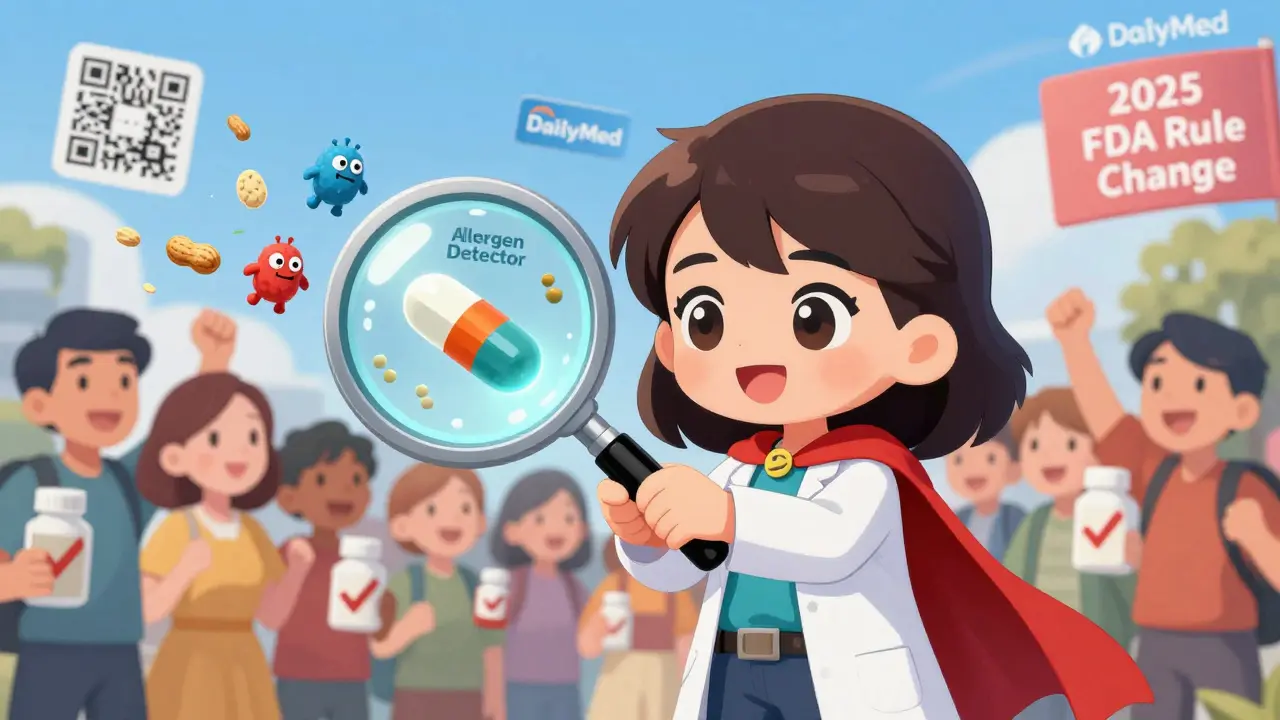
The FDA is working on new rules. In May 2024, they proposed requiring clearer formatting for allergen labeling on drugs, similar to food. They’re also considering expanding the list of required disclosures to include mustard and lupin-two allergens already required in the EU and Canada.Meanwhile, more pharmacies are starting to offer digital ingredient lists via QR codes on prescription bottles. If your pharmacy doesn’t offer this yet, ask them to. Consumer pressure is driving change.
Global supply chains are making this harder, not easier. A 2023 FDA report found that 43% of imported medications had incomplete or missing inactive ingredient lists. That means a pill made in India or China might have different fillers than the same drug made in the U.S.
Real-Life Example: What Happened to Sarah
Sarah, 34, from Brisbane, had been taking a generic version of her blood pressure medication for three years. One day, after switching to a new batch, she broke out in hives and felt dizzy. She assumed it was stress-until it happened again the next month.She called her pharmacist and asked for the inactive ingredients. The new version used lactose as a filler. She had a mild dairy allergy she’d never told anyone about. Her doctor switched her to a lactose-free version, and her symptoms stopped.
She didn’t know it was possible for a pill to cause that. Now she checks every new prescription.
Bottom Line: Don’t Trust the Bottle
You wouldn’t eat a snack without reading the label. Don’t swallow a pill without knowing what’s in it. Medications are not food, but they can still contain food allergens-and the risks are just as real.Here’s your simple checklist before taking any new medication:
- ✓ Did I read the patient leaflet?
- ✓ Did I ask the pharmacist for the full inactive ingredient list?
- ✓ Did I check if this is the same manufacturer as before?
- ✓ Did I look up the drug on DailyMed?
If you have a known allergy to milk, soy, peanuts, or wheat-treat every new prescription like it could be dangerous. Because it might be.
Are inactive ingredients the same as side effects?
No. Side effects are reactions caused by the active drug itself-like drowsiness or nausea. Inactive ingredients are fillers that don’t treat your condition but can cause allergic reactions. You can be allergic to an inactive ingredient without having any side effects from the active drug.
Can I trust “allergen-free” claims on drug packaging?
No. There’s no official standard for “allergen-free” on medications. A company can label something that way without testing or verification. Always check the full ingredient list or ask your pharmacist for confirmation.
Why don’t drug companies have to label allergens like food companies do?
Because there’s no federal law requiring it. Food labeling is regulated by the FDA under FALCPA, but drug labeling falls under different rules that don’t include allergen disclosure as a requirement. The FDA encourages voluntary disclosure, but doesn’t enforce it.
What should I do if my medication doesn’t list inactive ingredients?
Call the manufacturer’s customer service line-the contact info is usually on the box. Ask for the “Complete List of Ingredients” or “Inactive Ingredients.” If they can’t provide it, ask your pharmacist to switch you to a different brand or formulation.
Can I request a custom-made medication without allergens?
Yes. Compounding pharmacies can make medications without common allergens like lactose, soy, or gluten. Your doctor can write a prescription for a compounded version. It’s more expensive and may take longer, but it’s a safe option for people with severe allergies.
Victoria Rogers
December 17, 2025 AT 21:29Meghan O'Shaughnessy
December 18, 2025 AT 16:47Radhika M
December 20, 2025 AT 00:22Kent Peterson
December 21, 2025 AT 12:03Josh Potter
December 22, 2025 AT 18:36Evelyn Vélez Mejía
December 24, 2025 AT 16:01Nishant Desae
December 25, 2025 AT 22:29Kaylee Esdale
December 26, 2025 AT 13:43Jody Patrick
December 27, 2025 AT 17:13Philippa Skiadopoulou
December 28, 2025 AT 20:14Pawan Chaudhary
December 30, 2025 AT 10:18Jonathan Morris
December 31, 2025 AT 00:17Linda Caldwell
January 1, 2026 AT 12:50