 by
by How to Identify Counterfeit Medication Packaging and Seals
23 Jan, 2026Every year, millions of people around the world take medication they believe is real-only to find out later it was fake. Counterfeit drugs don’t just miss the active ingredient; they can contain toxic chemicals, crushed drywall, or nothing at all. And the packaging? Often, it looks identical to the real thing. That’s the danger. You can’t tell by just glancing at the bottle or the blister pack. But there are ways to spot the fakes-if you know what to look for.
Start with the basics: Visual inspection
The first step is simple: look closely. Don’t rush. Hold the package under good lighting-ideally 500 to 1,000 lux, like daylight near a window. Compare it to a known authentic package if you have one. Look for tiny mismatches.Font weight matters. On genuine Ozempic packaging, the lot number uses a consistent, slightly bold font. Counterfeit versions often have uneven letter thickness or misaligned numbers. The same goes for brand names and dosage instructions. If the text looks slightly blurry, smudged, or too sharp, that’s a red flag.
Check the color. A 2019 case involving counterfeit Lipitor revealed packaging that used a blue shade (Pantone 286C) that the manufacturer stopped using in 2002. The difference was invisible under normal light-but under UV light, it stood out. Even small shifts in color, like slightly yellowed packaging on Muro 128 eye drops, have been confirmed as fake by manufacturers.
Feel the material. Genuine blister packs use specific plastic thicknesses. Counterfeiters sometimes use cheaper, thicker plastic. One pharmacist reported counterfeit Adderall blister packs weighed 5% more than authentic ones-120gsm versus 114gsm. That’s not something you’d notice unless you were comparing side by side, but it’s measurable.
Look for hidden details: Microtext and alignment
Most legitimate medications include microtext-tiny letters or numbers printed so small they’re hard to read without magnification. On a genuine pill blister, you might find "Pfizer" or "5mg" printed in a line thinner than a human hair. Counterfeiters often skip this, or they print it too thickly, making it look blurry or uneven.Alignment is another giveaway. On authentic packaging, every element-text, logos, barcodes-is perfectly centered. Fake ones are often slightly off. One FDA alert in 2023 noted that counterfeit semaglutide packaging had holograms that were misaligned by just 1.5 millimeters. That’s less than the width of a pencil lead. But if you’re looking closely, it’s enough to raise suspicion.
Barcodes and QR codes should scan cleanly. If your phone camera struggles to read it, or the link leads to a strange website (not the manufacturer’s official domain), walk away. A 2022 Reddit thread from pharmacists described counterfeit pills where QR codes linked to a Chinese e-commerce site instead of the U.S. drug distributor. Real QR codes on prescription meds always point to verified manufacturer portals.
Security features: Holograms, UV ink, and anti-tamper seals
Holograms used to be a reliable sign of authenticity. But today, counterfeiters replicate them with digital printers. The same hologram you see on a real Xanax bottle might appear on a fake one too. So don’t rely on it alone.Instead, look at how the hologram behaves under light. Genuine holograms shift colors smoothly when tilted. Fakes often have flat, static images that don’t change with angle. Some counterfeits even use printed foil stickers glued on top-these peel slightly at the edges.
UV ink is harder to fake. Shine a UV light (like a cheap blacklight from a dollar store) on the packaging. Many authentic drugs use invisible ink that glows under UV-sometimes the company logo, sometimes a serial number. If nothing appears, or if the glow looks smeared or too bright, it’s suspect. A Johns Hopkins survey found 42% of counterfeit drugs had inconsistent UV fluorescence.
Anti-tamper seals should be intact. If the seal is broken, loose, or resealed with glue, don’t take the medication. Even if the pill looks right, tampering means someone could have replaced it. The European Falsified Medicines Directive requires all prescription medicines to have a tamper-evident seal-so if you’re buying from a pharmacy in the EU and there’s no seal, it’s illegal.
Use technology: Raman spectroscopy and mobile tools
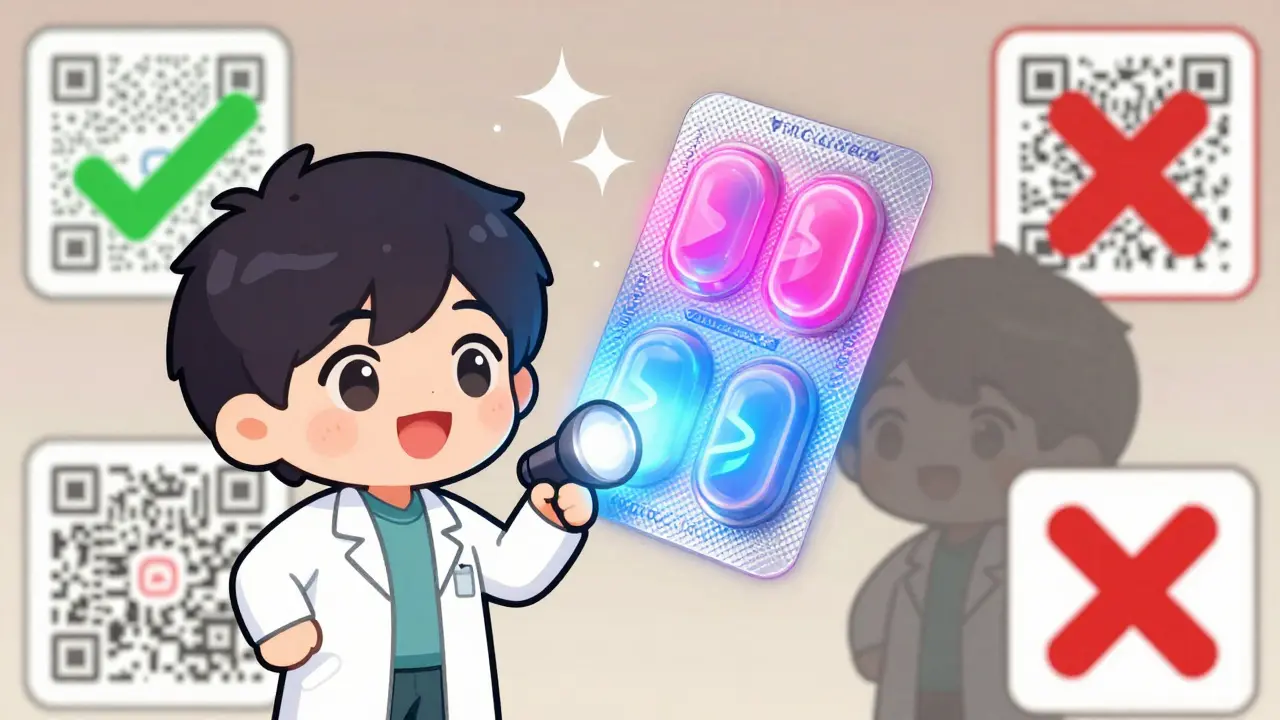
If you’re a pharmacist, clinic worker, or someone who handles medication regularly, consider investing in a handheld Raman spectrometer. These devices cost $15,000-$25,000, but they’re accurate up to 98.7%. Point it at the pill or the packaging, and it gives you a green checkmark or red X in seconds. Pfizer and other major manufacturers use them in distribution centers.For consumers, new tools are emerging. Purdue University developed ePUFs-edible physical unclonable functions. These are microscopic patterns on pills that can be scanned with a smartphone camera. MIT tested a similar system called CandyCodes, where each pill has a unique edible pattern that matches a database. Neither is widely available yet, but they’re coming.
Another option: the Videometer, a device nicknamed the "disco ball" at Pfizer’s lab. It scans the entire package in infrared and ultraviolet wavelengths, detecting color mismatches invisible to the human eye. While too expensive for individuals, some pharmacies in high-risk areas are starting to use them.
Know where to buy: Avoid online scams
The FDA reports that 68% of counterfeit drugs come from online pharmacies. Many of these sites look professional-they have SSL certificates, real-looking logos, and fake reviews. But they’re not licensed.Always buy from pharmacies that require a prescription and are licensed in your state or country. In the U.S., look for the VIPPS seal (Verified Internet Pharmacy Practice Sites). In the EU, check for the official EU common logo. If the website doesn’t display it, or if you can’t find its license number through your national pharmacy board, don’t buy.
Be wary of prices that seem too good to be true. A 30-day supply of Ozempic costs around $1,000 in the U.S. If you see it for $150 online, it’s fake. Counterfeiters make up to 9,000% profit on drugs like cancer treatments and diabetes medications. They’re not running a charity.
What to do if you suspect a fake
If you find something suspicious, don’t throw it away. Don’t take it. Don’t give it to someone else.Document everything. Take clear photos of the packaging, the pills, the lot number, and the barcode. Write down where you bought it and when.
Report it. In the U.S., contact the FDA’s MedWatch program at 1-800-FDA-1088. They processed nearly 5,000 counterfeit reports in 2022. In the EU, report to your national medicines agency. The WHO also accepts reports through its global surveillance network.
Pharmacies are required to report suspected counterfeits. If you bought it from a pharmacy, ask them to investigate. Most have protocols for this.
Why this matters: Real risks, real consequences
Counterfeit drugs aren’t just a scam-they’re a health emergency. In 2012, over 100 people in Nigeria died after taking fake antibiotics that contained rat poison. In 2021, a patient in Florida suffered organ failure after taking counterfeit metformin laced with diethylene glycol, a toxic antifreeze component.The WHO estimates 1 in 10 medicines in low- and middle-income countries is fake. Even in the U.S. and Europe, where systems are tighter, counterfeit drugs still slip through. The FDA found that 1.2% of non-serialized drugs in circulation were counterfeit in 2023. That’s 1 in 80 pills.
And it’s getting worse. Counterfeiters now use AI to generate fake packaging that mimics real designs. A 2023 SPIE study showed AI-generated fakes bypassed visual inspection 33% of the time. That means even trained professionals can miss them.
That’s why layered verification matters. No single check is foolproof. You need visual inspection, UV light, barcode scanning, and-if possible-spectroscopic confirmation. The WHO recommends at least three layers of verification for high-risk drugs like insulin, cancer treatments, and heart medications.
What’s being done to stop it
The U.S. Drug Supply Chain Security Act (DSCSA), fully enforced in 2023, requires every prescription drug package to have a unique identifier and be traceable through blockchain. This has cut counterfeit infiltration in serialized supply chains to 0.001%-down from 1.2% before.The European Union’s Falsified Medicines Directive, active since 2019, requires anti-tamper seals and unique identifiers on every prescription package. The result? Counterfeit rates dropped to 0.0005% in EU markets.
Pharmaceutical companies are also investing in new tech. Pfizer, Merck, and Novartis are testing blockchain verification, molecular DNA tags, and augmented reality apps that let you scan a pill and instantly verify its authenticity. The FDA has allocated $47.8 million through 2028 to develop low-cost, field-deployable verification tools for clinics and pharmacies in rural areas.
But technology alone won’t fix this. It takes awareness. It takes vigilance. It takes you asking questions.
Final checklist: 5 quick checks before you take any pill
- Look for font inconsistencies, blurry text, or misaligned logos.
- Check the hologram-does it change color when you tilt it?
- Scan the QR code-does it go to the official manufacturer site?
- Shine a UV light on the packaging-does anything glow?
- Verify the pharmacy-do they require a prescription? Do they have a license?
If even one thing feels off, stop. Report it. Your life could depend on it.
Can I tell if a pill is fake just by looking at it?
Sometimes, but not always. Many counterfeit pills look identical to the real thing. Subtle signs include uneven font, misaligned text, or color shifts. But 78% of advanced fakes pass visual inspection. Always use multiple checks-UV light, barcode scanning, and packaging texture-to be sure.
Are all online pharmacies dangerous?
No, but most fake drugs come from unlicensed online sellers. Legitimate online pharmacies require a prescription and display a VIPPS seal (in the U.S.) or the EU common logo. Always verify the website’s license through your national pharmacy board before purchasing.
What should I do if I accidentally take a counterfeit drug?
Stop taking it immediately. Contact your doctor or poison control. Save the packaging and pills as evidence. Report the incident to your country’s health authority-like the FDA’s MedWatch program. Even if you feel fine, some fake drugs cause delayed harm, like organ damage from toxic fillers.
Do pharmacies test for counterfeit drugs?
Most pharmacies rely on supplier verification and packaging checks. Larger chains and hospitals may use handheld Raman spectrometers or barcode scanners. But routine chemical testing is rare due to cost. Your best protection is checking the packaging yourself before taking the medication.
Is it safe to buy medication from international pharmacies?
It’s risky. Medications from countries without strict regulations may be counterfeit, expired, or improperly stored. Even if the packaging looks real, the contents could be dangerous. The FDA warns against importing prescription drugs from outside the U.S. unless it’s through a licensed, verified channel.
Why do counterfeiters target certain drugs?
They target high-demand, high-cost medications with no generic alternatives-like Ozempic, insulin, cancer drugs, and erectile dysfunction pills. These drugs have profit margins of up to 9,000%. People are desperate to afford them, so they’re more likely to buy from untrusted sources.
Alexandra Enns
January 25, 2026 AT 01:48Wow, this is the most pathetic excuse for a guide I’ve ever seen. You think people are gonna check UV ink with a dollar store blacklight? In rural India? In Venezuela? In my damn apartment with no windows? This isn’t safety-it’s a luxury for people who can afford $25k spectrometers. Real people buy meds off Facebook Marketplace because they’re choosing between insulin and rent. Your ‘5-point checklist’ is a joke.
Marie-Pier D.
January 25, 2026 AT 04:55Thank you for writing this with so much care 🙏 I’ve been a pharmacist for 18 years and I’ve seen too many people get hurt because they trusted a ‘too good to be true’ deal. I always tell my patients: if your gut says no, it’s probably no. Keep the packaging. Take photos. Report it. You’re not being paranoid-you’re being smart. And if you’re scared to speak up? I’ve got your back. You’re not alone.
Marlon Mentolaroc
January 25, 2026 AT 23:53Let’s be real-90% of this is common sense. But the 10% that’s not? Like the 120gsm vs 114gsm blister pack weight difference? That’s gold. I’ve got a buddy who works at a Walmart pharmacy in Ohio and he started weighing blister packs with a digital kitchen scale. He caught three fakes in two weeks. Who knew your grandma’s scale could be a lifesaver? Also, QR codes linking to .cn domains? That’s not a red flag-it’s a neon sign screaming ‘I’M A SCAM’.
Karen Conlin
January 27, 2026 AT 12:07Look-I’ve worked in ERs in three states. I’ve seen the aftermath. Diethylene glycol doesn’t just ‘make you sick’-it melts your kidneys like butter on a hot pan. And yes, AI-generated fakes are getting scary good. But here’s what matters: YOU are the last line of defense. If you don’t check the hologram, the UV glow, the barcode, the seal-you’re playing Russian roulette with your life. This isn’t about being ‘paranoid.’ It’s about being alive. And if you’re buying Ozempic for $150? Honey, you’re not saving money-you’re buying a death sentence. Stop. Just stop.
Viola Li
January 28, 2026 AT 14:08Wow, so now we’re supposed to trust the FDA? After they approved Vioxx? After they let opioid manufacturers lie for decades? This whole thing feels like corporate propaganda wrapped in a ‘safety checklist.’ If you really cared about counterfeit drugs, you’d fix the pricing system that makes people buy from shady websites. But no-you want us to scan QR codes while ignoring the root cause. Classic.
venkatesh karumanchi
January 28, 2026 AT 18:23I live in a village in India where people buy medicines from roadside stalls. No UV light. No barcode scanner. No pharmacy license. But we have one thing: trust. We buy from the same guy for 15 years. He never sold us bad stuff. Maybe the real problem isn’t the fake medicine-it’s that the system abandoned us. We don’t need gadgets. We need dignity.
Vatsal Patel
January 29, 2026 AT 10:09Ah yes, the holy trinity of modern delusion: UV lights, QR codes, and holograms. You think counterfeiters don’t have access to Amazon and Alibaba? They’ve been using 3D printers since 2017. The real counterfeit isn’t the pill-it’s the belief that technology can fix a system built on greed. You’re trying to outsmart a criminal with a flashlight. The only real solution? Make meds affordable. Everything else is theater.
Kevin Waters
January 29, 2026 AT 15:39Just wanted to add something practical-my cousin works at a community clinic in Kentucky. They got a grant for a $3k handheld spectrometer (not the $25k ones). They scan every new batch of insulin and metformin. It’s not perfect, but it’s cut their fake reports by 70%. If your local clinic doesn’t have one, ask them to apply for FDA’s $47.8M funding program. It’s real. And they need help. You don’t need to be a pharmacist to push for this.
Kat Peterson
January 31, 2026 AT 11:01OMG I’m literally shaking rn 😭 I just checked my Ozempic bottle and the font on the lot number? IT’S SLIGHTLY OFF. I thought it was just my eyes! I’m calling the pharmacy RIGHT NOW and reporting it. Also, I just bought a $12 UV light on Amazon and I’m scanning EVERYTHING now. This post saved my life. I’m telling all my friends. WE NEED TO TALK ABOUT THIS. 🙏💖
Elizabeth Cannon
February 1, 2026 AT 18:15ugh i just realized my metformin bottle looks kinda blurry? like the text is smudged? i thought it was just the lighting. im gonna go check the barcode right now. also i bought it from cvs but they never asked for my rx? weird? anyway im gonna take pics and call them. thanks for the heads up lol
Gina Beard
February 3, 2026 AT 14:31It’s not about the tech. It’s about the trust.
Don Foster
February 4, 2026 AT 18:20Did you even read the DSCSA? The blockchain thing? No? Then why are you writing this? Most of this is common knowledge if you work in pharma. The rest is overcomplicated. People don’t need UV lights. They need lower prices. And you’re wasting their time with gimmicks
siva lingam
February 6, 2026 AT 16:55Check the seal. If it's broken don't take it. Done.