 by
by How to Overcome Swallowing Difficulties to Keep Taking Medicine
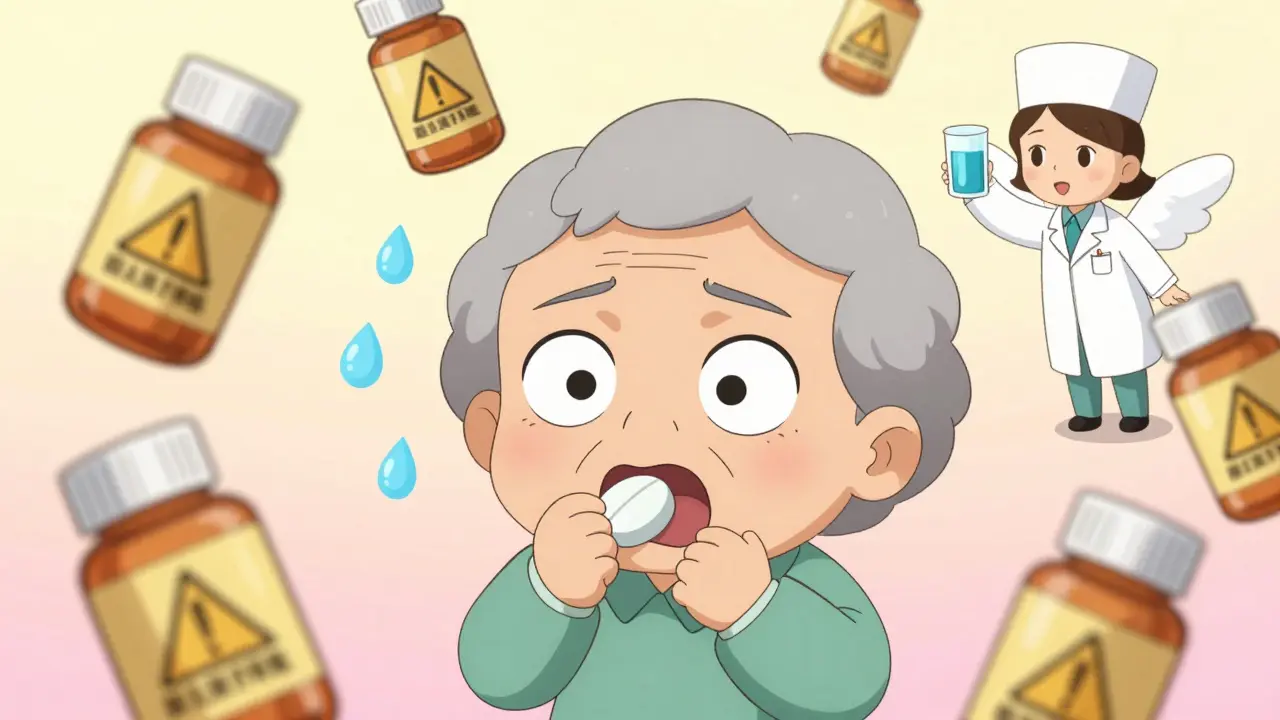
3 Jan, 2026Imagine taking your morning pills and feeling them stick in your throat. You gag. You panic. You spit them out. Then you feel guilty. This isn’t just inconvenient-it’s dangerous. Nearly 1 in 7 older adults struggle to swallow pills, and skipping doses because of it can lead to hospitalization, worsening disease, or even death. The problem isn’t laziness. It’s dysphagia-a real, medical swallowing disorder that affects up to 68% of nursing home residents and 15% of seniors living at home. And most people don’t know how to handle it safely.
Why Swallowing Pills Is Harder Than You Think
Swallowing isn’t just about gulping. It’s a complex chain of muscle movements: the tongue pushes the pill back, the throat closes off the airway, and the esophagus contracts to move it down. When nerves or muscles are damaged-by stroke, Parkinson’s, ALS, dementia, or even just aging-this system breaks down. Some people can’t feel the pill at all. Others feel it lodge in their throat and fear choking. A lot of folks just give up. The scary part? Many doctors don’t ask. Pharmacists don’t always flag it. Nurses get handed a list of 10 pills and are told to make it work. That’s when things go wrong. Crushing tablets, opening capsules, mixing with applesauce-these are common fixes. But they’re risky. A 2023 review found that nearly half of all medication modifications were inappropriate. Some pills lose their effectiveness. Others become toxic when crushed. A single extended-release tablet turned into powder can release its full dose all at once. That’s not a pill-it’s a bomb.What You Should Never Do
Don’t crush, chew, or open pills unless you’ve checked with a pharmacist. Many medications are designed to release slowly over hours. Crushing them turns a 12-hour dose into a 10-minute overdose. Blood pressure pills, antidepressants, painkillers, and seizure meds are especially dangerous this way. Even something as simple as a coated tablet can be ruined. The coating isn’t just for taste-it protects the drug from stomach acid or keeps it from irritating your throat. Same goes for capsules. Opening them to mix the powder with food sounds smart-until you realize the powder might be irritating, bitter, or unstable. Some capsules contain beads that are meant to dissolve at different times. Break them open, and you lose that timing. And never use hot liquids to dissolve pills. Heat can destroy the active ingredient.Safe Alternatives That Actually Work
The best solution isn’t forcing pills down. It’s finding pills that don’t need forcing.- Liquid forms-Many common meds like antibiotics, blood pressure drugs, and statins come in liquid versions. Ask your pharmacist. They might not be the first thing listed, but they’re often available.
- Orodispersible tablets-These dissolve on your tongue in seconds. No water needed. Brands like Zofran (ondansetron) and Risperdal (risperidone) have them. They’re small, fast, and easy.
- Effervescent tablets-Dissolve in water to make a drink. Great for pain relievers like paracetamol or vitamin C supplements.
- Topical patches-For pain, hormones, or nicotine, patches bypass the gut entirely. No swallowing required.
- Rectal suppositories-Used for nausea, fever, or certain seizure meds. Not ideal for daily use, but a lifesaver when oral intake fails.

How to Swallow Pills Safely (Without Crushing Them)
If you must take a pill whole, technique matters more than force.- The lean-forward method-Place the pill on your tongue. Take a medium sip of water. Tuck your chin to your chest and swallow. This opens your throat and lets gravity help. Studies show this works for up to 75% of people who used to gag on capsules.
- The pop-bottle method-Put the pill on your tongue. Close your lips tightly around a water bottle. Suck down hard while swallowing. The suction pulls the pill down with the water.
- Use thicker liquids-If you’re at risk of aspiration (inhaling food or liquid into your lungs), use honey-thickened water or commercial thickening agents. Thin liquids like juice or tea are more likely to slip into your airway.
- Use ice chips-Suck on a small ice chip right before taking the pill. It numbs the throat and reduces the gag reflex.
- Try a gel or pudding-Mix the pill with a spoonful of applesauce, yogurt, or pudding. Make sure it’s soft, smooth, and not chunky. Don’t use hot foods. And never use peanut butter-it’s too thick and sticky.
What Your Care Team Needs to Know
This isn’t just your job. It’s the whole team’s. Your doctor should ask: “Do you have trouble swallowing pills?” Not just once-every visit. If you say yes, they should review every medication: Is this still needed? Can it be switched? Can the dose be lowered? Can it be given less often? Your pharmacist should be your ally. They know which pills can be crushed, which can’t, and what alternatives exist. Ask them to check every prescription before you leave the pharmacy. A speech-language pathologist (SLP) can assess your swallowing and teach you safe techniques. They’re not just for stroke patients. Anyone with chronic difficulty should get evaluated. Many insurance plans cover this. Ask your doctor for a referral. Nurses and caregivers need training too. In nursing homes, staff often crush pills out of habit-not because it’s safe. A 2020 UK study found that most caregivers didn’t know the risks. Clear guidelines and checklists help. If you’re caring for someone, keep a list: “Pills that can’t be crushed,” “Preferred liquids,” “Emergency backup options.”
When You Can’t Swallow at All
If swallowing is impossible or unsafe, don’t give up on oral meds. There are still options.- Feeding tubes-For people who can’t swallow at all, a tube into the stomach (NG or PEG) can deliver crushed meds safely-if done right. But never mix meds with feed. Flush with at least 10ml of water between each drug. Use liquid or dispersible forms first. Some drugs interact with tube feeds and lose effectiveness.
- Dissolvable films-New tech like VersaFilm sticks to the inside of your cheek and dissolves in minutes. No water. No chewing. A 2023 study showed 85% adherence in patients with moderate dysphagia. These aren’t everywhere yet, but they’re coming.
- Injectables-For some conditions, like osteoporosis or migraines, weekly or monthly shots replace daily pills. Talk to your doctor if you’re overwhelmed by the number of pills.
What’s Changing in 2026
The world is starting to wake up. The European Medicines Agency now requires labels to say whether a pill can be crushed. The FDA is pushing drugmakers to design medications with swallowing in mind from the start. Electronic health records are being updated to flag patients with dysphagia so prescribers see it before writing a prescription. And the market is growing. The global dysphagia management market is expected to hit $2.9 billion by 2029. That means more liquids, more dissolving tablets, more patches. But progress is slow. You can’t wait for the system to catch up. You have to act now.Start Today: Your Action Plan
1. Make a list of every pill, capsule, or liquid you take daily. Include dosage and reason. 2. Call your pharmacist and ask: “Which of these can I switch to a liquid, dissolving, or patch form?” 3. Ask your doctor: “Is every medication still necessary?” Sometimes, you can stop one or reduce the dose. 4. Practice safe swallowing-Try the lean-forward method with water. Do it once a day for a week. 5. Request a swallowing assessment-Ask your GP for a referral to a speech therapist. It’s quick, non-invasive, and often covered by insurance. 6. Keep a log-Note which pills are hardest to swallow, what works, and what doesn’t. Bring it to every appointment. You’re not alone. Millions struggle with this. But swallowing pills shouldn’t be a battle. With the right tools, support, and knowledge, you can take your meds safely-without fear, without guilt, without choking.Can I crush my pills if I can’t swallow them?
Only if a pharmacist confirms it’s safe. Many pills-especially extended-release, enteric-coated, or capsule forms-can become dangerous when crushed. Crushing can cause overdose, reduce effectiveness, or irritate your throat. Always check before you crush.
What if my medicine doesn’t come in liquid form?
Ask your pharmacist to contact the manufacturer. Some companies make special formulations not listed on the label. You might also ask your doctor if there’s a similar drug that does come in liquid form. Sometimes switching brands or types is possible.
Is it safe to mix pills with food like applesauce?
It’s okay for some pills, but not all. Avoid mixing with hot foods, fatty foods, or acidic ones like orange juice. Use soft, cool, smooth foods like yogurt or pudding. Never use peanut butter-it’s too thick and can trap the pill. Always check with your pharmacist first.
Why do I gag when I try to swallow pills?
Gagging is often caused by the pill triggering your throat’s natural reflex. It’s not just fear-it’s physical. Techniques like the lean-forward method or using ice chips can reduce this reflex. A speech therapist can also help retrain your swallowing muscles.
Can swallowing problems get worse over time?
Yes, especially if caused by neurological conditions like Parkinson’s or dementia. Even aging alone can weaken throat muscles. That’s why it’s important to get assessed early and adjust your medication plan as your needs change.
Are dissolvable pills as effective as regular tablets?
Yes. Orodispersible tablets and dissolving films are designed to release the same amount of medicine as regular pills-they just dissolve faster in your mouth. They’re approved by health agencies and work just as well, if not better, for people with swallowing issues.
How do I know if I have dysphagia?
Signs include coughing or choking when swallowing, feeling like food sticks in your throat, needing to swallow multiple times, wet voice after eating, or avoiding certain foods. If you have any of these, ask your doctor for a swallowing evaluation. It’s not just about pills-it’s about safety.
Shanna Sung
January 5, 2026 AT 05:31The FDA is lying to you. They let Big Pharma design pills to be hard to swallow so you need more meds to fix the side effects. They know 68% of nursing home residents can't swallow-and they're fine with it. I've seen the documents. It's all about profit. Don't trust any pill that doesn't come in a liquid form. And no, applesauce won't save you. They've been poisoning the system for decades.
They don't want you to know about dissolvable films because they cost $200 a dose. But your insurance won't cover it. That's not an accident. That's the plan.
Allen Ye
January 5, 2026 AT 10:52There's a deeper philosophical question here that no one is asking: Why do we treat medication as a mechanical problem rather than a human one? We've reduced the body to a delivery system, and pills to cargo. But swallowing isn't just physiology-it's memory, fear, dignity. A man who once lifted weights now trembles at a tablet. A woman who taught her children to read now avoids water because it reminds her of choking.
The real crisis isn't dysphagia-it's that our medical system has forgotten that care is relational. We hand out lists of pills like grocery orders. We don't ask how it feels. We don't sit with the silence after someone says, 'I can't.' And then we wonder why adherence is low. It's not laziness. It's grief.
Maybe the answer isn't more patches or films. Maybe it's more presence. More time. More listening. The body remembers trauma. So does the soul.
mark etang
January 5, 2026 AT 13:45It is with the utmost gravity and professional solemnity that I address this critical public health concern. The inability to safely ingest pharmaceutical agents constitutes a dire and escalating threat to geriatric welfare across the United States. I implore all stakeholders-physicians, pharmacists, caregivers, and patients-to engage in rigorous, evidence-based protocols to mitigate this escalating crisis.
It is imperative that we institutionalize mandatory swallowing assessments as part of every medication reconciliation process. Furthermore, we must advocate for legislative reform to mandate that all newly approved pharmaceuticals include alternative delivery mechanisms as a condition of FDA approval. The status quo is not merely inadequate-it is ethically indefensible.
Let us not wait for another preventable hospitalization. Let us act now-with precision, with compassion, and with unwavering resolve.
josh plum
January 6, 2026 AT 04:05Of course you're struggling. You're probably taking all those stupid supplements the internet told you to. I know people who take 15 pills a day and wonder why they feel like garbage. Cut the crap. You don't need half of what you're swallowing. Stop being lazy and just take the damn thing. If you can't swallow a pill, you're not sick-you're weak.
And don't even get me started on those 'dissolvable tablets.' They're overpriced junk. Real men swallow pills. Real women too. Stop coddling yourself. You think your grandma's gonna feel better because her blood pressure pill dissolves? No. She'll feel better because she stopped taking the sugar pills her doctor pushed on her.
And if you're using applesauce? That's just asking for trouble. I've seen people choke on pudding. Don't be that guy.
Clint Moser
January 6, 2026 AT 15:58the fda and big pharma are in cahoots. they dont want you to swallow pills easily because then youd be less dependent on their products. dissolvable films? patented tech. liquid forms? too cheap to mass produce. patches? too easy to remove. they want you to suffer so you keep buying. i saw a whistleblower video from a rochester lab-every pill has a microchip that tracks your swallow rate. if you dont swallow it right, your insurance gets flagged. its called compliance monitoring. theyre not helping you. theyre profiling you.
also-ice chips? that’s a placebo. the real fix is sublingual nano-emulsions. but you cant get those unless you have a ‘special access’ code. and no, your doctor wont give it to you. they dont know about it. because they were trained by the same system that’s lying to you.
Ashley Viñas
January 7, 2026 AT 23:46Let’s be honest-this isn’t about pills. It’s about autonomy. You don’t need a speech therapist to tell you how to swallow. You need someone to ask you if you still want to live this way.
And yet, here we are: a society that celebrates efficiency but ignores dignity. We’ll install a smart fridge but won’t fund a swallowing evaluation. We’ll send you a reminder app for your meds but won’t pay for a pill that doesn’t feel like a rock in your throat.
It’s not that these alternatives don’t exist. It’s that we’ve decided they’re not worth the cost. And that’s not a medical failure. That’s a moral one.
Ask yourself: if your mother had to choose between dignity and dosage, which would you want her to pick? And why are we pretending this isn’t a choice at all?
Brendan F. Cochran
January 8, 2026 AT 04:43americans are weak. we got pills for everything and now we cant even swallow em? my grandpa fought in korea and swallowed 10 pills a day with a shot of whiskey. no applesauce. no ice chips. no fancy films. just grit. now you got millennials crying because their blood pressure pill tastes weird.
you wanna fix this? stop asking for easier ways. start being tougher. if you cant swallow a pill, maybe you dont need it. maybe your body is telling you to lay off the junk. maybe your doctor is prescribing too much. stop blaming the system. blame yourself.
and if you’re using pudding? you’re not sick. you’re a toddler. grow up.
jigisha Patel
January 9, 2026 AT 01:27While the article presents a superficially comprehensive overview, it critically neglects the epidemiological correlation between polypharmacy and dysphagia in low-income elderly populations. The data cited (68% in nursing homes) is sourced from CDC 2021 surveillance reports, yet fails to contextualize socioeconomic determinants: access to pharmacy consultations is 78% lower in rural Medicaid populations. Furthermore, the promotion of orodispersible tablets ignores formulary restrictions imposed by Medicare Part D, where 92% of such formulations are tier-4 with $150+ copays.
Techniques like the lean-forward method are biomechanically sound, yet their efficacy is contingent upon neuromuscular integrity-a factor absent in 43% of patients with stage 3 dementia. The article’s prescriptive tone implicitly assumes cognitive and physical agency that is systematically denied to the demographic it purports to serve.
Recommendation: Advocate for institutional reimbursement reform before promoting individual behavioral interventions.
Jason Stafford
January 10, 2026 AT 19:14They don’t want you to know this-but every time you swallow a pill, you’re feeding a machine that tracks your body’s response. The coating? It’s not just for taste. It’s a sensor. The pills are embedded with nano-antennas. They ping your GI tract, send data to the cloud, and then your insurance company adjusts your premiums based on how often you gag.
I’ve seen the internal memos. They call it ‘SwallowScore.’ If your score is too low, they flag you for ‘non-compliance’ and cut your benefits. That’s why they push the ‘lean-forward’ method. It’s not to help you. It’s to make you swallow harder so the sensors work better.
And dissolvable films? They’re testing them on veterans. The next step is mandatory implants. You think this is about medicine? It’s about control.
Mandy Kowitz
January 11, 2026 AT 20:34