 by
by How to Prevent Medication Degradation in Tropical Humidity: A Practical Guide for Travelers and Residents
11 Jan, 2026When you’re traveling to a tropical destination-whether it’s Bali, Costa Rica, or the Philippines-your medicine might be in more danger than you think. High heat and thick, wet air don’t just make you sweat. They can quietly destroy your pills, capsules, and inhalers before you even take them. You might not see it. You might not smell it. But your medication could be losing potency, clumping, or even growing mold. And that’s not just inconvenient-it’s dangerous.
Why Tropical Humidity Destroys Medication
Tropical humidity isn’t just "damp." It’s a chemical threat. Most medicines are designed to stay stable in dry, cool places-like your medicine cabinet at home. But in places where humidity hits 75-95% and temperatures stay above 28°C, water molecules start attacking the drugs at a molecular level. This process is called hydrolysis, and it breaks apart the active ingredients in your medicine.Take amoxicillin, for example. In high humidity, it can soak up 8-10% of its own weight in water. That’s enough to cut its effectiveness by half in just 30 days. Lamotrigine tablets lose up to 38% of their ability to release the drug properly after only four weeks in 75% humidity. Antibiotics like tetracycline degrade 3.5 times faster under these conditions. And it’s not just pills. Orally disintegrating tablets turn into sticky lumps. Dry powder inhalers clog. Even vaccines can fail if they get too moist.
Microbes don’t wait either. Once humidity climbs above 70%, fungi like Aspergillus and Penicillium start growing on medication surfaces within 72 hours. You might not see the mold, but your body will feel the consequences-treatment fails, infections return, or worse.
What Medications Are Most at Risk?
Not all medicines are equally vulnerable. Some are like sponges for moisture. Others crack, soften, or change color. Here’s what to watch out for:- Antibiotics (amoxicillin, tetracycline): Hydrolysis breaks down the active molecules fast. Color changes? That’s a red flag.
- Antifungals (fluconazole, clotrimazole): Moisture causes clumping and uneven dosing.
- Orally Disintegrating Tablets (ODTs): These dissolve on your tongue-until humidity makes them take 5 times longer to break down.
- Dry Powder Inhalers: Moisture makes particles stick together. Your lung dose drops by 15-25%.
- Freeze-dried vaccines: Require humidity below 20% RH. Even brief exposure can ruin them.
- Pediatric formulations: Often contain sugars or flavors that attract moisture and degrade faster.
According to WHO data, 30% of medications in tropical regions lose effectiveness before reaching patients. That’s not a small risk-it’s a public health crisis. And if you’re carrying your own meds, you’re part of that chain.
What’s the Safe Humidity Level?
The numbers matter. You don’t need to be a pharmacist to understand them.- 30-45% RH is the ideal range for most medications. This is what manufacturers test for in tropical stability studies.
- 60% RH and above starts causing problems. Capsule shells soften. Tablets crack.
- 70% RH and above = microbial growth zone. Mold grows. Potency drops.
- 80% RH (common in bathrooms and kitchens) = disaster for most drugs.
Temperature matters too. Every 10°C increase above 25°C doubles the rate of degradation. So 30°C at 80% RH is twice as bad as 20°C at 80% RH. That’s why storing medicine in your bathroom or near a window is a bad idea. Even if it’s cool at night, the daytime heat and steam from showers make it worse.
How to Protect Your Medication: Practical Steps
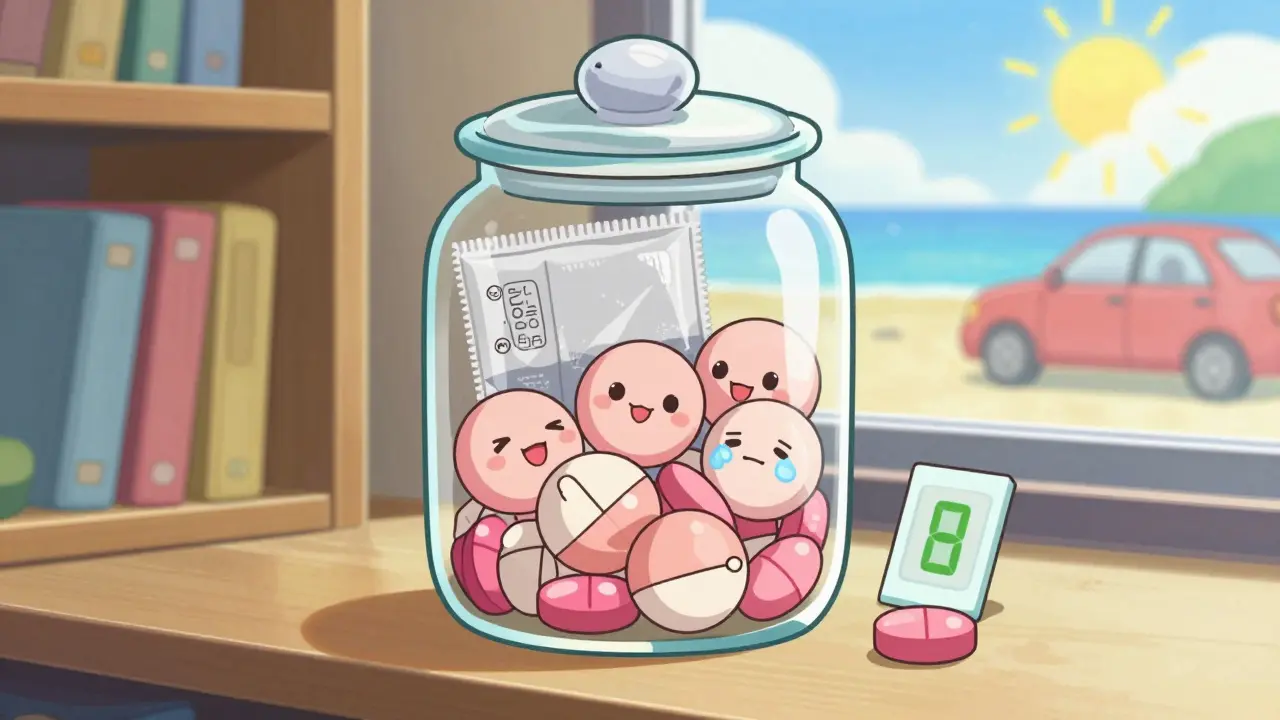
You don’t need fancy gear to keep your meds safe. Here’s what works, based on real-world testing and WHO guidelines:- Use airtight containers. Transfer pills from their original bottles into small, sealable plastic or glass containers with tight lids. Glass is better-it doesn’t breathe like plastic.
- Add silica gel desiccants. These little packets absorb moisture. Put one in every container. Replace them every 30 days in humid climates. You can buy them online or take them from new shoeboxes or electronics packaging.
- Use humidity indicator cards. These change color when moisture gets too high. Blue = safe. Pink = danger. Keep one in your storage container. It’s a cheap, visual alarm system.
- Avoid bathrooms and kitchens. These are the worst places in your home or hotel. Humidity from showers and cooking can hit 80-90%.
- Store meds in a cool, dry closet. Higher shelves are better-warm air rises. A closet in the middle of your room, away from windows, is ideal.
- Never leave meds in a hot car. Even in the shade, a car can hit 50°C inside. That’s enough to ruin insulin, thyroid meds, or seizure drugs in hours.
- Carry a small dry cabinet if you’re staying long-term. Portable dry boxes like SMT DryBoxes can maintain 5-15% RH. They’re pricey ($250-$1,500), but if you’re on chronic meds, they’re worth it.
For travelers, a simple trick: Keep your meds in your carry-on, not checked luggage. Checked bags sit in hot, humid cargo holds. Your carry-on stays with you in climate-controlled areas.
What About Packaging? Don’t Rely on the Bottle
The bottle your medicine came in? It’s not enough. Most plastic bottles let moisture in over time. Even foil blister packs can fail in prolonged humidity.Look for aluminum blister packs. These block 99.9% of moisture. If your meds come in them, leave them in until you’re ready to take them. Don’t dump them into a pill organizer unless the organizer is sealed and has desiccants.
Some newer packaging uses Activ-Polymer™ technology-advanced moisture-scavenging materials built into the cap or foil. These can keep humidity below 20% RH for over two years. They’re used in WHO-backed programs across Africa and Southeast Asia. If your meds are part of a global health initiative, they likely have this. But if you bought them locally or online? Don’t assume.
What If You’re in a Resource-Limited Area?
Not everyone has access to dry cabinets or imported desiccants. But there are low-cost, proven solutions:- Desiccant closets: A metal cabinet with a 5kg silica gel canister inside. Costs under $120. Maintains 35-45% RH for months. Used successfully in Ugandan clinics.
- PharmaSeal system: Reusable desiccant canisters that last 6 months. Costs $0.85 per unit. Deployed in 32 tropical countries.
- The 30-30 Rule: Replace desiccants every 30 days if the temperature is above 30°C. Tested in the Philippines with 15,000 patients-reduced spoilage by 47%.
These aren’t theoretical. They’re used by community health workers and clinics in places where refrigeration is unreliable. You can replicate them at home.
How to Know If Your Medicine Is Damaged
Trust your eyes and nose.- Color changes: Yellowing, dark spots, or fading? Stop using it.
- Texture changes: Pills that crumble, capsules that stick together, powders that form hard lumps? Don’t take them.
- Odor: A musty, sour, or chemical smell? That’s mold or breakdown products.
- Disintegration time: If an ODT takes more than a minute to dissolve on your tongue, it’s compromised.
- Humidity card turned pink? That’s your signal to replace the meds or the desiccant.
Never guess. If you’re unsure, get a new supply. The risk of taking degraded medicine-especially antibiotics or heart meds-is far greater than the cost of replacing it.
What’s Changing in the Industry?
The world is waking up to this problem. Since 2021, the Gates Foundation has distributed 500 million desiccant-integrated blister packs across Africa. In 2023, MIT published research on graphene oxide coatings that block 99.7% of moisture-far better than aluminum foil. The ICH is finalizing new guidelines (Q1H) expected in 2025 that will require all new drugs targeting tropical markets to prove stability under 30°C/75% RH.But for now, the burden is still on you. No one else is checking your medicine cabinet. No pharmacist is calling to ask if your pills are still good. You have to be the guardian of your own health.
Final Rule: When in Doubt, Replace It
Medication isn’t like bread. You can’t eat it a day past its date and be fine. Once humidity breaks down the chemistry, you’re not getting the dose you paid for. You might think, "It still looks fine." But you can’t see the molecular damage.For essential drugs-antibiotics, insulin, blood pressure pills, seizure meds-don’t risk it. If you’ve been in a humid environment for more than a week and didn’t use proper storage, get a new supply. It’s cheaper than a hospital visit.
Protecting your medicine isn’t about being paranoid. It’s about being smart. Tropical humidity doesn’t care if you’re a tourist, a long-term resident, or a healthcare worker. It’s always working. You just need to work harder than it does.
Eileen Reilly
January 12, 2026 AT 05:17bro i just threw my amoxicillin in my carry-on after a trip to Bali and now my skin is breaking out like i’m in a horror movie. no idea if it was the heat or just bad luck but i’m never trusting a plastic bottle again. silica gel FTW.
Cecelia Alta
January 13, 2026 AT 13:39oh wow so now i’m supposed to buy a $1500 dry box just to keep my blood pressure pills from turning into a science experiment? lol. i live in florida. the humidity here makes my socks sweat. if your meds are falling apart, maybe you shouldn’t be taking them in the first place. also who the hell stores meds in the bathroom? that’s not a mistake, that’s a personality disorder.
Monica Puglia
January 13, 2026 AT 15:00i love how this post is basically a love letter to silica gel packets 🫶 i’ve been saving them from every new pair of shoes and electronics i buy for years. now i put one in every pill bottle i own. it’s wild how such a tiny thing can save your life. also, pink humidity cards are the unsung heroes of tropical living. i keep one taped to my fridge like a mood ring for my meds 😅
Faith Wright
January 15, 2026 AT 12:59so let me get this straight - you’re telling me that people in the tropics are dying because they didn’t buy fancy desiccant cabinets? wow. what a luxury problem. my cousin in Lagos takes her meds out of the plastic bag they came in and puts them in a tin box next to the stove. she’s 72 and still dancing at weddings. maybe the real issue is overmedicating and underliving.
steve ker
January 16, 2026 AT 06:34why are you even talking about this like it’s news. everyone in the global south knows this. we’ve been using shoeboxes with charcoal and cloth since the 90s. your fancy silica gel is just capitalism repackaging common sense. also aluminum blister packs? we don’t even have running water half the time. stop acting like you discovered fire.
George Bridges
January 17, 2026 AT 03:55as someone who’s lived in both Minnesota and Manila, i can say this: the difference isn’t just climate - it’s access. the advice here is solid, but it assumes you have a carry-on, a closet, and money for dry boxes. what about the single mom in Cebu who buys meds from the street vendor because the clinic is 3 hours away? we need systems, not just personal hacks.
Rebekah Cobbson
January 18, 2026 AT 07:52thank you for writing this. i have a chronic condition and moved to Puerto Rico last year. i had no idea my insulin was in danger just sitting on the counter. i started using a small dry cabinet and it changed everything. i even bought extra desiccants for my mom back in Ohio - she thought i was being dramatic until she saw the humidity card turn pink. now she’s obsessed. you’re not paranoid, you’re prepared. keep sharing this.
Audu ikhlas
January 19, 2026 AT 20:55usa thinks it owns medicine now. you think your desiccants are better than african wisdom? we use dried plant leaves and clay pots. your tech is trash. your meds are overpriced. your fear is manufactured. i dont need a card to tell me when my pills are bad. i know when i feel better or worse. your post is just another way to sell stuff to gullible people
Abner San Diego
January 21, 2026 AT 15:59so basically you’re saying if i don’t spend $2000 on a dry box, i’m gonna die from a pill? i’m out.
Sonal Guha
January 23, 2026 AT 05:19the real issue is pharmaceutical companies designing meds for temperate climates and then selling them in the tropics without proper packaging. this isn’t about user error. it’s corporate negligence. but sure, blame the person holding the pill bottle.