 by
by How to Store Antibiotic Suspensions for Children Properly: A Clear Guide for Parents
27 Jan, 2026When your child is prescribed an antibiotic suspension, it’s not just about giving the right dose - it’s about storing it the right way. A bottle left on the counter or shoved into a hot bathroom cabinet might seem harmless, but it could make the medicine less effective - or even dangerous. Every year, thousands of kids face treatment failures because antibiotics weren’t stored properly. This isn’t about being perfect. It’s about knowing the basics so your child gets the full benefit of the medicine.
Not All Liquid Antibiotics Are the Same
There’s no one-size-fits-all rule for storing children’s antibiotic suspensions. The instructions change depending on the drug. The most common one, amoxicillin, can be kept either in the fridge or at room temperature (between 68°F and 77°F). It stays strong for 14 days after you mix it with water, no matter where you store it. But here’s the catch: many parents think that means they can leave it anywhere. That’s not true. If your house gets hotter than 80°F - like near a window or above the stove - it’s better to refrigerate it.
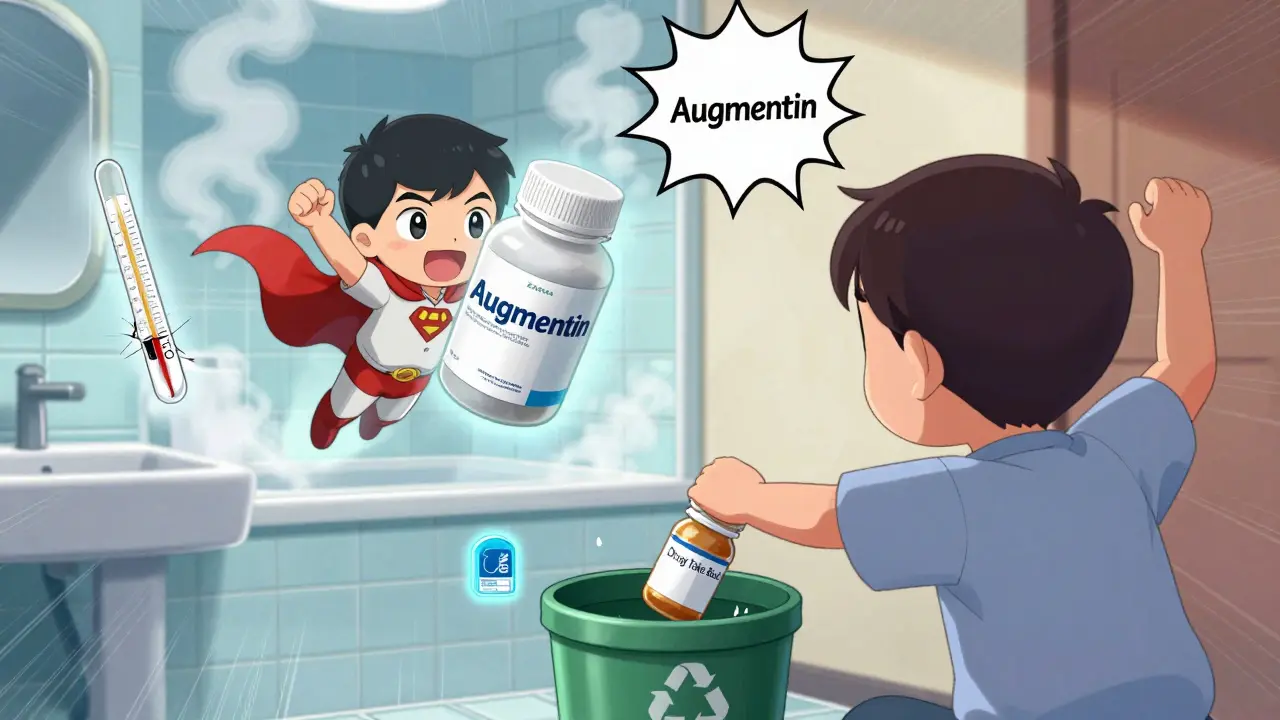
Then there’s amoxicillin/clavulanate (brand name Augmentin). This one is different. It must be refrigerated. Left at room temperature, it loses potency fast. After just 5 days in warm conditions, it can drop by nearly 10% in effectiveness. Even when refrigerated, it only lasts 10 days. After that, the clavulanate part breaks down and won’t fight resistant bacteria anymore.
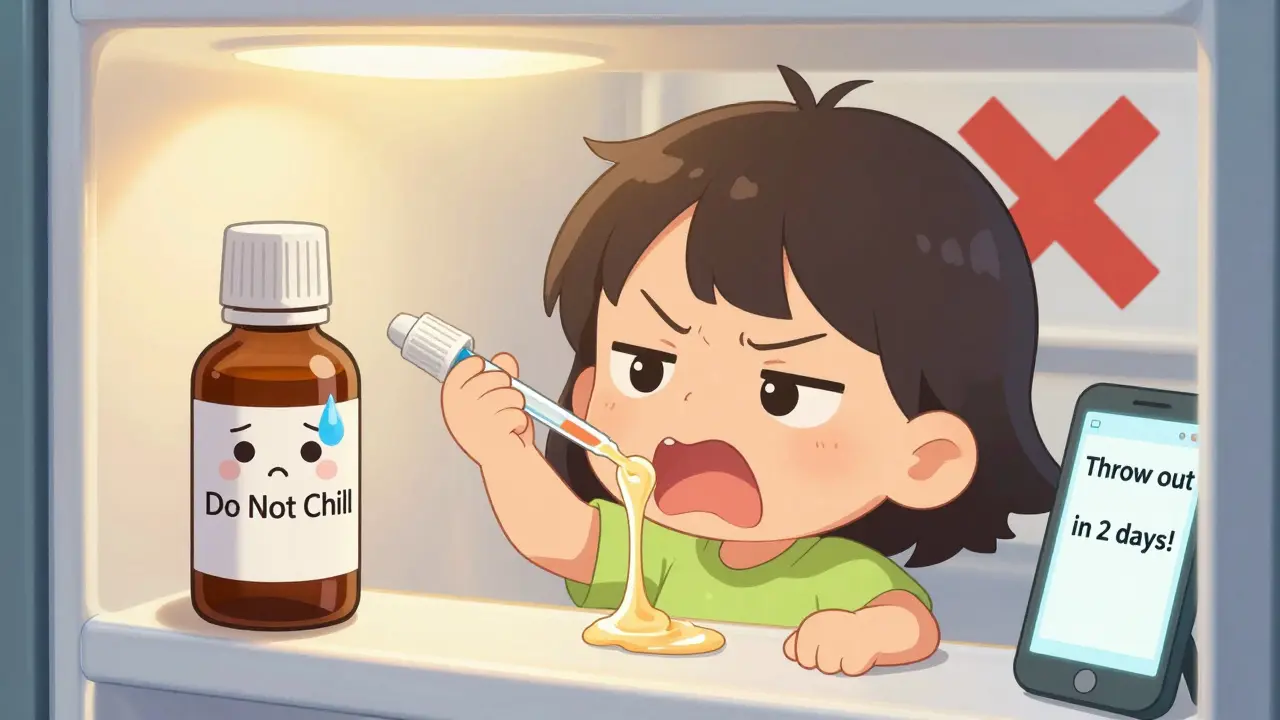
Don’t refrigerate azithromycin (Zithromax). Cold temperatures make it thick and gloopy. Kids hate it. Studies show it becomes 37% less palatable when chilled. Keep it at room temperature, and use it within 10 days. The same goes for clarithromycin, clindamycin, sulfamethoxazole/trimethoprim, and cefdinir. Refrigerating these makes them harder to swallow and doesn’t help their shelf life.
Discard Dates Matter More Than You Think
The biggest mistake parents make? Using antibiotics past their discard date. A 2023 CDC survey found that 37% of caregivers keep using liquid antibiotics after the expiration date on the bottle. That’s dangerous. Even if the medicine looks fine, it’s losing strength.
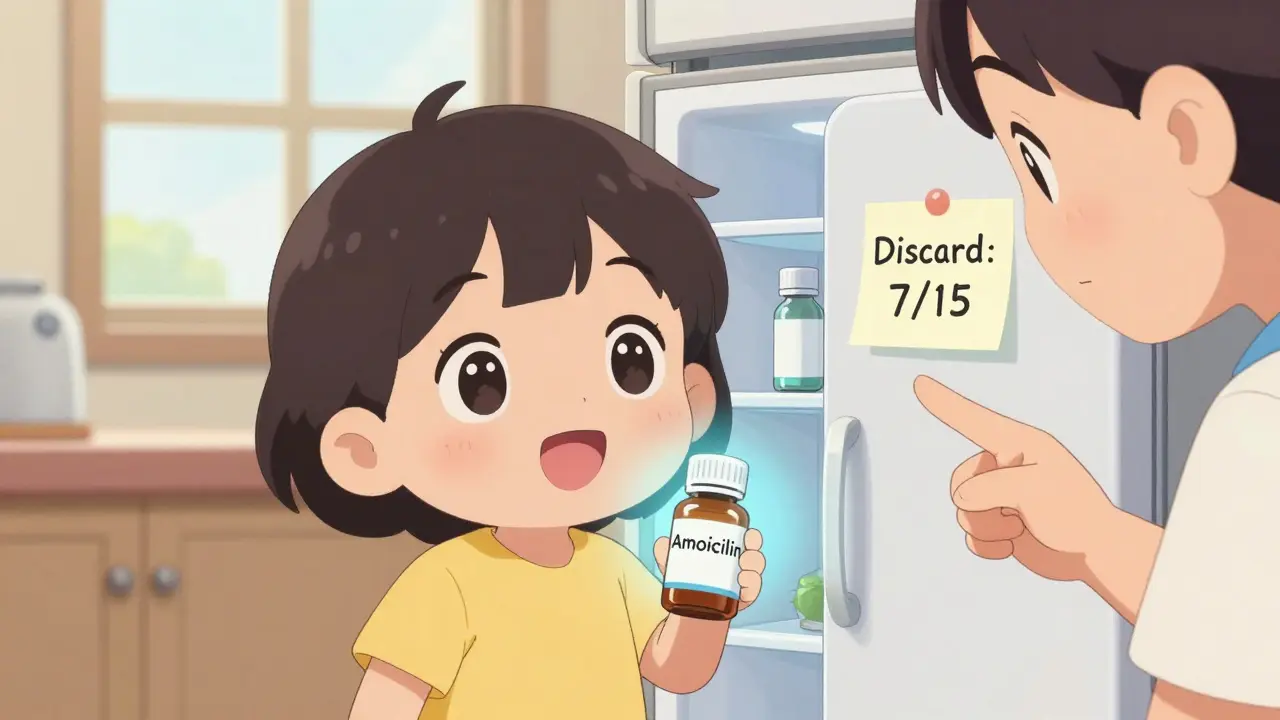
Amoxicillin lasts 14 days after mixing. Augmentin lasts 10. Azithromycin lasts 10. If the pharmacist didn’t write the discard date on the label, ask them. Then write it yourself with a permanent marker. Use a sticky note on the fridge or set a phone reminder. Don’t rely on memory. In a study of 2,500 parents, 78% forgot the date by day 5.
Some pharmacies now include a discard date sticker. If yours doesn’t, ask for one. The CDC recommends these stickers - and says they reduce improper use by 42%.
What Happens If You Store It Wrong?
Improper storage doesn’t just make the medicine weaker. It can lead to treatment failure. That means your child’s infection doesn’t clear up. They might need another round of antibiotics - or worse, end up in the hospital.
Research from the CDC shows that 15% of pediatric antibiotic treatment failures are directly tied to storage errors. For example, if amoxicillin/clavulanate is left out for 12 days instead of being thrown out after 10, the clavulanate component degrades by over 12%. That means the antibiotic can’t fight the bacteria that resist regular amoxicillin. The infection comes back - stronger.
Also, refrigerating azithromycin doesn’t help. It makes it thicker, harder to draw into a syringe, and unpleasant for kids. That leads to missed doses - another path to treatment failure.
Signs Your Antibiotic Has Gone Bad
You don’t need a lab to tell if the medicine is spoiled. Look for these signs:
- Discoloration: If the liquid turns darker, cloudy, or has unusual specks, toss it.
- Change in smell or taste: If it tastes sour, bitter, or smells off - even slightly - don’t give it.
- Excessive sediment: Some settling is normal. But if you shake it and it doesn’t mix back in smoothly, it’s degraded.
- Separation that won’t blend: If the powder doesn’t dissolve after shaking, the formulation is broken.
One parent on Reddit said, “I gave my son the azithromycin after two weeks. He threw up right after. I didn’t know it was expired.” That’s not an isolated case. Spoilage signs are obvious - if you know what to look for.
Where to Store It - and Where Not To
Don’t store antibiotics in the bathroom. Heat and moisture from showers ruin medicines. Don’t leave them on the kitchen counter near the stove or in direct sunlight. Even a windowsill can get too hot.
Best place? The back of the fridge - not the door. The door opens and closes, so temperature swings. The back stays steady at 36-46°F. If you don’t have a fridge, find the coolest, darkest spot in your home - a closet shelf away from heat sources.
For amoxicillin, refrigeration isn’t required, but it can help with taste. Many kids prefer the cold version. If your child likes it cold, keep it refrigerated. If they gag on cold medicine, keep it at room temperature. Either way, stick to the 14-day limit.
For azithromycin or clindamycin, room temperature is the only option. Pick a spot that stays under 77°F. If your home gets above 85°F in summer, consider buying a small, dedicated medicine cooler - even a mini-fridge used only for meds can help.
How to Avoid Confusion
There’s conflicting advice out there. Cleveland Clinic says amoxicillin can be stored at room temperature. MedlinePlus says it’s “preferable” to refrigerate. The pharmacy label might say one thing, your pediatrician another. That’s why the IDSA says: “When in doubt, check the pharmacy label.”
Always read the sticker on the bottle. If it says “Refrigerate,” do it. If it says “Store at room temperature,” don’t chill it. If there’s no label, call the pharmacy. Ask: “Does this need to be refrigerated? How long is it good for?”
Write the discard date on the bottle. Use a Sharpie. Put it where you can see it. Make it part of your routine. After you give the dose, glance at the date. If it’s past, throw it out - no exceptions.
What to Do With Expired Antibiotics
Never flush them down the toilet or toss them in the trash where kids or pets can get to them. The FDA recommends taking unused medicines to a drug take-back program. Many pharmacies offer this for free. If that’s not available, mix the liquid with kitty litter or coffee grounds in a sealed container, then throw it in the trash.
Also, keep all medicines up and away from children. Every year, over 60,000 kids under 5 end up in emergency rooms from accidental medicine poisoning. That’s preventable.
Tools That Help
There are simple tools that make this easier:
- Discard date stickers: Ask your pharmacist for one. If they don’t offer it, print one from the CDC’s website and tape it on.
- Phone reminders: Set a daily alert for the last day of use. Name it “Throw out amoxicillin.”
- MedSafe app (CDC): This free app sends automatic discard reminders based on the medicine you enter.
- Mini-fridge for meds: A small, portable one costs under $50. Great for families without reliable fridge space.
One parent on a parenting forum said, “I bought a tiny fridge just for my daughter’s meds. I stopped worrying. No more treatment failures.” It’s not expensive. It’s not complicated. It’s just smart.
Final Rule: When in Doubt, Throw It Out
Antibiotics aren’t like milk. You can’t smell them and know they’re bad. But you can know if they’re past their date. And if you’re unsure whether you stored it right - or if it looks, smells, or tastes odd - don’t risk it.
Throw it out. Get a new prescription. Your child’s health isn’t worth guessing. The cost of a new bottle is less than the cost of another doctor visit, another round of antibiotics, or a hospital stay.
Proper storage isn’t about being perfect. It’s about being consistent. Write the date. Know the rules. Check the label. When in doubt - throw it out.
Mindee Coulter
January 28, 2026 AT 14:08Just threw out a bottle of amoxicillin yesterday because I forgot the date. Learned the hard way after my kid got sick again. So simple to write the date on the bottle with a Sharpie-why don’t more people do this?
John Rose
January 30, 2026 AT 12:04This is exactly the kind of practical info parents need but rarely get. I used to keep everything in the bathroom-shameful, I know. Now I’ve got a little shelf in the back of the fridge just for meds. Game changer.
doug b
January 31, 2026 AT 15:46Don’t overthink it. If the label says refrigerate, refrigerate. If it says room temp, leave it out. If you’re unsure, call the pharmacy. Done. Your kid won’t die from a little extra effort.
Ambrose Curtis
February 2, 2026 AT 08:28amoxicillin/clavulanate is the real villain here. I had a friend whose kid got a resistant staph infection because they left Augmentin on the counter for 2 weeks. The kid ended up in the PICU. Don’t be that parent. Write the damn date.
Anna Lou Chen
February 3, 2026 AT 03:31It’s not merely storage-it’s epistemological accountability. The pharmaceutical temporality of pediatric suspensions reveals a deeper rupture in the caregiver’s ontological relationship to medical authority. Refrigeration is not a recommendation; it’s a hermeneutic act of trust in pharmacological temporality.
Yet we reduce this to sticky notes and phone alarms. We commodify vigilance. We fetishize the Sharpie. We mistake procedural compliance for moral responsibility.
Perhaps the real crisis isn’t degraded clavulanate-it’s our collective surrender to bureaucratic medicine.
Robert Cardoso
February 4, 2026 AT 00:3215% treatment failure from storage errors? Where’s the peer-reviewed source? CDC survey says 37% use expired meds-fine. But conflating that with storage is sloppy. Also, 37% less palatable for azithromycin? Who measured that? Kids’ taste buds aren’t calibrated lab instruments. This post feels like fearmongering dressed as public health.
matthew martin
February 4, 2026 AT 06:16I used to think refrigerating azithromycin was ‘being safe’-turns out I was just making my kid gag for no reason. Now I keep it in a dark drawer next to the coffee maker. Room temp, 10 days max. No drama. No vomiting. Just good vibes and antibiotics that don’t taste like regret.
Also, mini-fridge for meds? Genius. I got one for $35 on Amazon. My kid calls it ‘the medicine dragon.’ We both sleep better.
SRI GUNTORO
February 5, 2026 AT 08:46Parents are so careless. You wouldn’t leave baby food out for days, but you’ll let antibiotics sit in 90-degree heat? This isn’t negligence-it’s arrogance. You think your child is immune to consequences? They’re not. And you’re not the exception.
Mel MJPS
February 6, 2026 AT 05:28My daughter used to cry every time I gave her amoxicillin cold. I switched to room temp and now she takes it like candy. I didn’t know it was okay until I read this. Thank you for saying it plainly.
Bryan Fracchia
February 6, 2026 AT 06:41There’s something beautiful about how such a small thing-writing a date on a bottle-can protect a child’s future. We don’t need fancy gadgets. We just need to remember that care isn’t about perfection. It’s about showing up. Even when you’re tired. Even when you forget. Even when you’re overwhelmed.
Write the date. Check the label. Throw it out if you’re unsure. That’s all. That’s enough.
Howard Esakov
February 6, 2026 AT 11:59Only people who don’t understand pharmacokinetics think a mini-fridge is ‘smart.’ It’s performative parenting. You’re not protecting your child-you’re performing virtue. The real solution is better labeling by pharmacies. Not your $50 fridge obsession.
Lance Long
February 6, 2026 AT 21:32You got this. Seriously. Most of us are winging it. You read the label? You wrote the date? You didn’t keep it in the bathroom? You’re already ahead of 80% of parents. Don’t beat yourself up. Just keep going.
Katie Mccreary
February 7, 2026 AT 07:32So you’re telling me I’m a bad mom because I didn’t know azithromycin shouldn’t be refrigerated? Wow. Thanks for the guilt trip. My kid’s fine. Your post is just another way to make parents feel worthless.
Jeffrey Carroll
February 8, 2026 AT 07:19Thank you for compiling this with such clarity. The CDC’s discard date sticker recommendation is underutilized. I’ve begun requesting them at every pharmacy visit. It’s a small change, but it’s one that scales. More pharmacies should adopt this as standard practice.