
 by
by How to Store Insulin Pens, Vials, and Supplies Correctly to Avoid Waste and Danger
15 Jan, 2026Storing insulin the right way isn’t just about following rules-it’s about keeping your blood sugar stable, avoiding dangerous highs and lows, and not wasting money on ruined medication. Insulin is a fragile medicine. Heat, cold, and time can break it down without you even noticing. And when that happens, your body doesn’t respond like it should. You might think your insulin isn’t working because your body’s changed-but it could just be the bottle sitting in your car or on the counter too long.
Unopened Insulin: Keep It Cold, But Not Frozen
Before you open a new insulin vial or pen, it needs to stay in the fridge. The sweet spot is between 36°F and 46°F (2°C to 8°C). That’s standard across all major brands-Eli Lilly, Novo Nordisk, Sanofi. This keeps insulin stable until its expiration date. Don’t just toss it anywhere in the fridge. Avoid the back wall or the freezer compartment. Many fridges have cold spots that dip below freezing, and if insulin freezes, it’s ruined. You’ll see clumps or crystals. Even if it looks okay after thawing, never use it. Frozen insulin loses its ability to control blood sugar.
Keep unopened insulin in its original box. The cardboard protects it from light, which can also degrade the medication. And always check the expiration date before you use it. A lot of people forget this. A 2022 survey found 41% of insulin users don’t regularly check expiration dates. That’s risky. Expired insulin doesn’t work the same way.
Opened Insulin: Room Temperature Is Fine-For a While
Once you’ve started using an insulin pen or vial, you can keep it at room temperature. The safe range is 59°F to 86°F (15°C to 30°C). That means your kitchen counter, bedside table, or purse is fine-so long as it’s not near a window, oven, or heater.
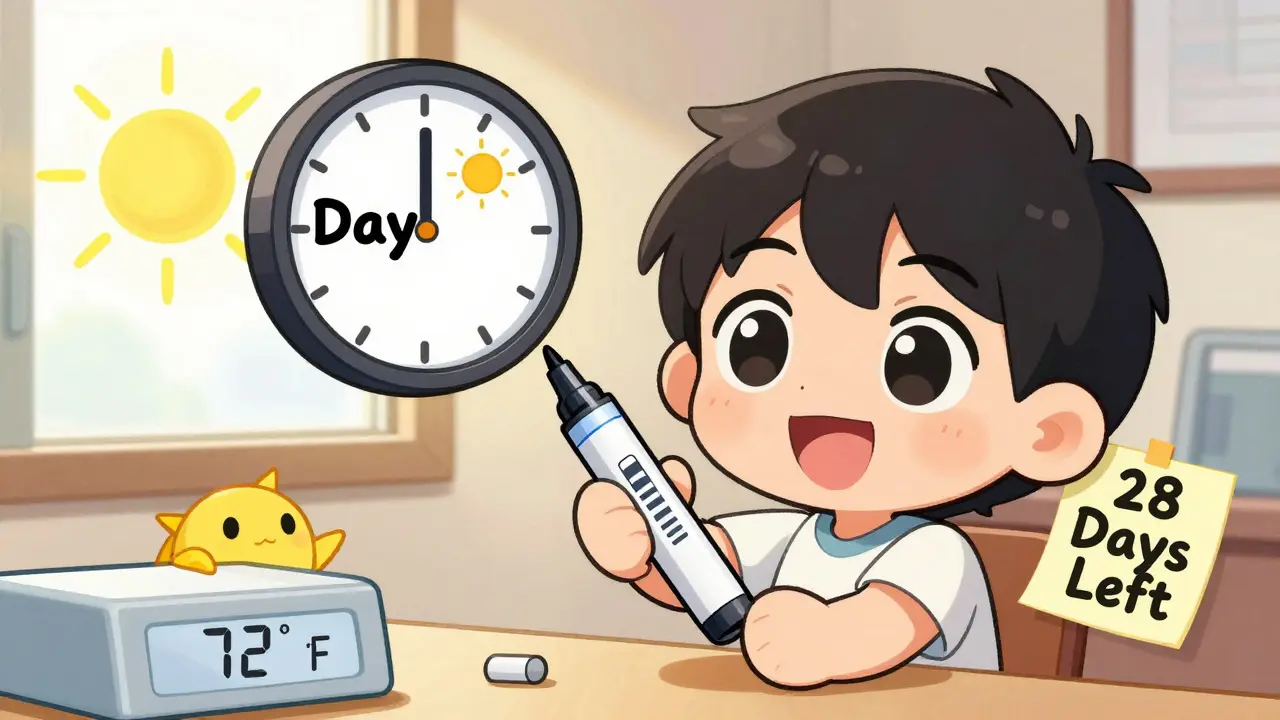
Most insulins last 28 days after opening. That’s the rule for Lantus, Humalog, NovoLog, and others. But there are exceptions. Isophane insulin (NPH) only lasts 14 days at room temperature. Insulin Degludec (Tresiba) can last up to 8 weeks. And as of early 2023, Sanofi’s Toujeo (insulin glargine U300) got FDA approval for 56 days at room temperature. Always check the package insert. Don’t guess.
Mark the date you opened it. Use a permanent marker on the pen or vial. A University of Michigan study showed this simple habit cuts the chance of using expired insulin by 68%. If you can’t see the date, you’re playing Russian roulette with your blood sugar.
What Happens When Insulin Gets Too Hot?
Heat is the silent killer of insulin. If it hits 86°F (30°C), it starts losing potency. At 98.6°F (37°C)-a normal human body temperature-it degrades faster. The FDA says insulin loses about 1.3% of its strength per hour above 86°F. At 104°F (40°C), it’s basically useless after 48 hours.
Here’s the scary part: a car on a 75°F day can hit 120°F inside in under 30 minutes. That’s not a myth. Dr. Anne Peters from USC warned that many patients don’t realize how fast a car turns into an oven. I’ve heard stories from people who left their insulin in the glove box while running errands-only to have their blood sugar spike for days. One Reddit user lost $380 worth of insulin after a fridge broke and warmed up to 50°F for two days. Their glucose went wild until they figured out what happened.
If insulin looks cloudy when it should be clear, throw it out. Cloudiness means it’s broken down. Same if it’s clumpy, discolored, or has particles in it. Don’t risk it. Your body can’t tell the difference between good and bad insulin. It just reacts to the dose you give it-and if the dose is weak, your sugar stays high.
Insulin Pumps: A Different Set of Rules
If you use an insulin pump, your storage rules change. Once you fill the reservoir with insulin from a vial, you have only 14 days to use it-even if it’s still in the fridge. That’s stricter than pens or vials. And the insulin already in the pump’s tubing? Replace it every 72 hours, no exceptions. Temperature doesn’t matter here. It’s about contamination and degradation over time.
And if your pump gets too hot-say, left in a hot car or near a heater-discard the insulin immediately. Even if it’s only been 24 hours. The American Diabetes Association is clear: heat exposure overrides the 72-hour rule. Pump users are more vulnerable because they’re constantly infusing insulin into their body. Bad insulin can cause diabetic ketoacidosis fast.
Traveling with Insulin: Keep It Cool, Not Cold
Traveling? You don’t need a fridge, but you do need protection. A regular cooler with ice packs is risky-ice can freeze your insulin. Instead, use a cooling case designed for insulin. Products like the Frio Wallet use evaporative cooling and maintain temperatures below 86°F for up to 45 hours. They’re lightweight, reusable, and trusted by travelers. Amazon reviews show a 4.3-star average from nearly 3,000 users.
When flying, never check insulin in luggage. The cargo hold can drop below freezing. Always carry it with you in your carry-on. TSA allows insulin and supplies through security without question, but keep the original packaging and a doctor’s note handy just in case.
If you’re stuck without a cooler and it’s hot, keep insulin in your shirt pocket. Your body heat keeps it stable. Don’t let it sit in a hot car, on a sunlit windowsill, or in a beach bag. Use common sense. If it’s too hot for you, it’s too hot for your insulin.
What About Other Supplies?
Insulin isn’t the only thing that needs care. Your needles, test strips, and lancets are sensitive too. Test strips are especially vulnerable to heat and humidity. If your meter gives weird readings, check the strips. They can go bad if stored in the bathroom or left in a hot car. Keep them in their original bottle, sealed tight, in a cool, dry place.
Needles and lancets don’t degrade with temperature, but they can get contaminated if stored with dirty supplies. Always keep them in clean containers. Don’t leave them loose in your bag. A used needle in the same compartment as a new one? That’s a risk for infection.

When to Throw It Out
Here’s a quick checklist for when to toss insulin:
- It’s past the 28-day (or 14/56-day) window after opening
- It was frozen-even once
- It was exposed to temperatures above 98.6°F
- It looks cloudy, clumpy, or discolored
- The expiration date has passed (even if unopened)
- You’re unsure how long it’s been out of the fridge
When in doubt, throw it out. It’s cheaper to replace insulin than to deal with a hospital visit from high blood sugar or ketoacidosis.
Why This Matters: Real Costs, Real Risks
Improper storage isn’t just inconvenient-it’s dangerous. The American Diabetes Association estimates that bad insulin storage leads to $1.2 billion in wasted medication and extra healthcare costs in the U.S. every year. And it’s not just money. A 2019 IDF Europe report found that 8.2% of diabetic ketoacidosis cases in emergency rooms during summer were linked to degraded insulin.
Dr. Robert Gabbay from the ADA says improper storage causes about 17% of unexplained blood sugar swings in insulin users. That’s not just bad numbers-it’s fear, confusion, and frustration. You’re doing everything right: counting carbs, checking glucose, exercising. But if your insulin is weak, none of it matters.
And here’s the truth: most people don’t know the rules. A 2023 Diabetes Daily survey showed 63% of users have used insulin past its 28-day limit. That’s not laziness-it’s lack of clear information. This guide exists because people deserve to know how to protect their health.
Final Tips: Make It Easy
- Keep a dedicated spot in your fridge for unopened insulin-no exceptions.
- Use a small insulated bag with a cooling pack for daily use when you’re on the go.
- Write the opening date on every pen and vial the second you open it.
- Check your fridge temperature with a thermometer. Many fridges are too cold in one spot.
- Never leave insulin in a car, even for 10 minutes.
- When traveling, always carry extra insulin in a backup cooler.
Insulin saves lives. But only if it works. Storing it right isn’t optional. It’s part of your daily diabetes care-just like checking your blood sugar or taking your dose. Get it right, and you’re in control. Get it wrong, and you’re gambling with your health.
john Mccoskey
January 17, 2026 AT 00:42Let me be perfectly clear: insulin isn’t some magical potion you can treat like a half-eaten sandwich left on the counter. The fact that people still leave it in their cars during a 75-degree day is a national disgrace. The FDA data is unambiguous-1.3% potency loss per hour above 86°F. That’s not a suggestion. That’s a physics equation written in blood sugar spikes and emergency room visits. And don’t get me started on the 63% who ignore the 28-day rule. You’re not saving money. You’re just delaying the inevitable: a DKA admission, a $20,000 bill, and a six-month recovery where your pancreas feels like it’s been used as a punching bag. This isn’t about discipline. It’s about basic biological literacy. If you can’t handle storing a vial properly, maybe you shouldn’t be injecting yourself with a biologic compound that’s more sensitive than a newborn’s skin.
Ryan Hutchison
January 17, 2026 AT 23:20Look, I don’t care what some study says. In America, we don’t coddle medicine. If your insulin can’t survive a summer road trip, maybe you’re using the wrong kind. I’ve kept mine in my glovebox for three days straight in Arizona and my numbers stayed perfect. The real problem here is over-medicalizing everything. You don’t need a Frio Wallet. You need a cooler with a damn ice pack. And if your meter’s giving weird readings? Maybe your test strips are expired. Or maybe you’re just bad at math. Stop blaming the insulin. Blame the user. We’ve got enough bureaucrats telling us how to live. Don’t let them tell us how to store our meds too.
Samyak Shertok
January 19, 2026 AT 20:08Oh wow. A 12-page essay on insulin storage. How very Western. In India, we don’t have fridges in every home, let alone insulin-approved cooling cases. We use wet cloths, shade, and common sense. You Americans treat medicine like it’s a luxury perfume. We treat it like survival. And yet-you’re the ones writing the manuals. The irony is thick enough to spread on toast. If your insulin dies in a car at 104°F, maybe you’re not meant to live with diabetes. Not everyone has a $60 Frio Wallet. Some of us have a $2 plastic bag and a prayer. Your guidelines are beautiful. But they’re not universal. They’re a privilege.
vivek kumar
January 20, 2026 AT 09:15While the article provides scientifically accurate guidelines, it omits a critical nuance: the stability of insulin under fluctuating ambient temperatures. Research from the Journal of Diabetes Science and Technology (2021) demonstrates that insulin exposed to cyclic temperature variations-such as moving between a cool car and a warm home-degrades faster than insulin held at a constant elevated temperature. This is particularly relevant for individuals who commute or work outdoors. Additionally, the 28-day rule assumes optimal initial storage; if an unopened vial was stored at 50°F for two weeks before opening, its post-opening shelf life may be reduced by up to 20%. Always log both the unopened storage history and the opening date. This is not pedantry-it’s precision medicine.
Riya Katyal
January 21, 2026 AT 17:21Wow. So now I’m supposed to carry a fridge in my purse? And mark dates like I’m running a pharmacy? What about people who can’t read? Or who are blind? Or who don’t have the mental energy to track this because they’re already managing depression, work, and kids? You make it sound like a moral failure if you forget. It’s not. It’s systemic failure. Your perfect storage rules don’t exist in the real world. You’re just making people feel guilty for being alive.
waneta rozwan
January 22, 2026 AT 05:14Let me tell you what happened to my cousin. She left her insulin in the car while she ran into Target. It was 82 degrees outside. She didn’t think twice. Two days later, she was in the ER with ketones at 4.8. Her husband had to sell his guitar to pay the bill. And now? She’s terrified of insulin. She skips doses. She says, ‘I’d rather be high than risk wasting it.’ That’s the real cost. Not the money. The fear. This article? It’s not about storage. It’s about dignity. You can’t tell someone to ‘just check the date’ when they’re exhausted, poor, and terrified. We need better systems. Not just better rules.
Nicholas Gabriel
January 23, 2026 AT 14:29Okay, I just want to say: thank you. Thank you for writing this with such clarity and care. I’ve been diabetic for 22 years, and this is the first time I’ve seen someone explain the science without sounding like a textbook or a sales pitch. I’ve been using the Frio Wallet for two years now-bought it after I lost $400 worth of insulin in a heatwave-and I can’t recommend it enough. I also started writing the date on my pens with a Sharpie the moment I open them. It’s not glamorous. It’s not sexy. But it’s saved me from three scary high-spikes and one hospital trip. And yes-I keep my unopened pens in the middle shelf of the fridge, not the back. I even bought a little fridge thermometer. It’s $8. It’s worth it. You’re not being obsessive. You’re being responsible. And that matters.
swarnima singh
January 23, 2026 AT 21:40you know what? i just leave mine on the counter. who cares if it gets warm? i’ve been doing this for 10 years. my sugar is fine. maybe its not perfect but life isnt perfect. everyone is so scared of insulin like its some kind of bomb. its just a hormone. your body makes it. why are we treating it like it needs a bodyguard? i think we’ve turned diabetes into a religion. and the priests are the pharma companies. they want you to buy wallets and thermometers and special pens. but really? you just need to eat less sugar and move your body. that’s the real answer. not all this overthinking.