 by
by Meniere’s Diet: How Sodium Restriction and Fluid Balance Reduce Vertigo and Hearing Loss
20 Dec, 2025If you have Meniere’s disease, you know how sudden vertigo attacks can turn your world upside down. One moment you’re fine, the next you’re gripping the wall, nauseous, with your ears ringing and your hearing muffled. It’s terrifying. And while medications can help, many people find real relief not from pills-but from what they eat and drink.
Why Salt Matters in Meniere’s Disease
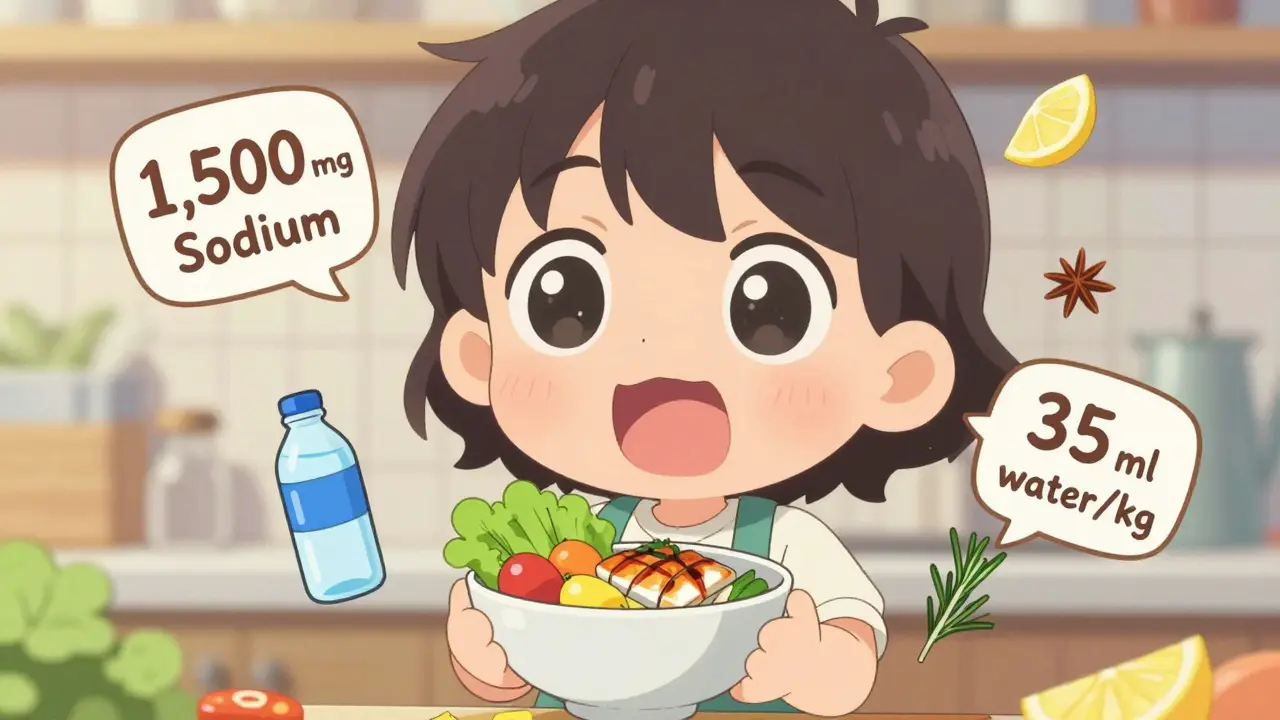
Meniere’s isn’t caused by an infection or a tumor. It’s a fluid problem in your inner ear. Too much fluid builds up in the endolymphatic sac, creating pressure that messes with your balance and hearing. That fluid isn’t just water-it’s loaded with salt. And when your body holds onto extra sodium, your inner ear holds onto extra fluid too. That’s why doctors worldwide recommend cutting back on sodium. It’s not a guess. It’s backed by decades of clinical observation and, as of February 2024, solid research. A study of 50 people with stage-3 Meniere’s showed that sticking to 1,500 mg of sodium per day, along with drinking 35 ml of water per kilogram of body weight, led to major improvements: hearing got clearer, vertigo attacks dropped by nearly half, and tinnitus became less intense. The numbers don’t lie. Pure tone audiometry scores improved by an average of 12.3 dB. Dizziness scores dropped from 62.3 to 28.9. Tinnitus scores fell from 58.7 to 32.4. These aren’t minor changes. These are life-altering improvements.How Much Sodium Should You Really Limit?
You’ve probably heard “eat less salt.” But how much is enough? The answer isn’t one-size-fits-all, but most experts agree on a range. - The ideal target for most people with Meniere’s: 1,500 mg per day. This is the level shown to work best in the 2024 Acta Otolaryngologica study. - The upper limit most guidelines accept: 2,000 mg per day. This is the cutoff used by the NIH, Mayo Clinic, and the American Heart Association. - Some researchers, like Dr. Richard Miyashita in Tokyo, suggest staying under 3,000 mg-but only if you’re just starting out. Even he says 1,500-2,000 mg is the sweet spot for real symptom control. That’s less than a teaspoon of salt. A single teaspoon holds about 2,300 mg. So if you’re adding salt to your food, you’re already over the limit before you even start eating.Fluid Balance: Drink More, Not Less
Here’s the twist: you’re not supposed to drink less water. In fact, you need to drink more-smartly. Old advice told people to restrict fluids. But that backfires. When you’re dehydrated, your body clings to every drop of water-and salt-leading to worse fluid buildup in your inner ear. The 2024 study used a precise formula: 35 milliliters of water per kilogram of body weight per day. For a 70 kg person (about 154 lbs), that’s 2.45 liters-or roughly 10 cups of water daily. Spread it out. Don’t chug it all at once. Sip steadily through the day. Avoid big gulps before bed. Keep a water bottle handy. And skip sugary drinks, energy drinks, and alcohol-they make fluid imbalance worse.What to Avoid: The Hidden Sodium Trap
You think you’re eating clean? You might be surprised. About 77% of sodium in the average diet comes from packaged, processed, and restaurant foods-not the salt shaker. Here’s what to watch out for:- Condiments: Soy sauce, ketchup, mustard, relish, Worcestershire sauce-just one tablespoon can have 300-900 mg of sodium.
- Processed meats: Deli ham, bacon, sausage, hot dogs-these are loaded with salt for preservation.
- Canned soups and vegetables: Even “low sodium” versions can have 400-600 mg per serving. Always check the label.
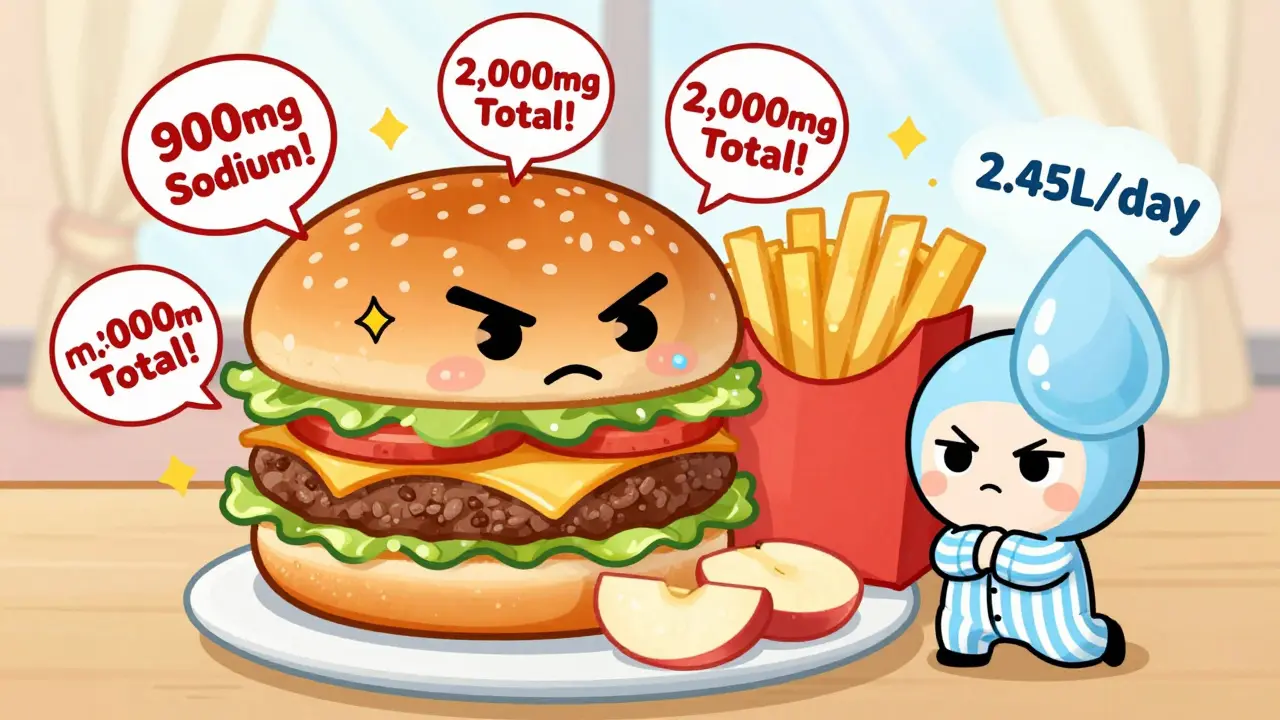
- Fast food: A single burger with fries can hit 2,000 mg of sodium before you even add ketchup.
- Bread and baked goods: One slice of white bread can have 200-300 mg. You eat multiple slices a day? That’s half your daily limit right there.
What to Eat: Simple, Real Food
The best diet for Meniere’s is the simplest one: whole, unprocessed foods.- Fresh vegetables and fruits: Naturally low in sodium, high in potassium (which helps balance fluids).
- Lean proteins: Chicken, fish, tofu, eggs-cook them without salt.
- Whole grains: Brown rice, quinoa, oats-choose plain, unsalted versions.
- Dairy: Opt for unsalted butter and low-sodium cheeses like fresh mozzarella or goat cheese.
- Snacks: Raw nuts (unsalted), apple slices, plain popcorn, rice cakes.
What About Caffeine and Alcohol?
They’re not direct sodium sources, but they make things worse. Caffeine (coffee, tea, energy drinks, chocolate) constricts blood vessels in the inner ear. That reduces blood flow, making fluid regulation harder. One cup of coffee might not trigger an attack-but daily consumption? It adds up. Alcohol dehydrates you and disrupts your inner ear’s ability to maintain fluid balance. Even moderate drinking can worsen vertigo and tinnitus. Cut back. Not necessarily quit-but aim for no more than one drink every few days, and avoid caffeine after noon.How Long Until You See Results?
Don’t expect miracles in a week. This isn’t a quick fix. Most people notice small improvements in ear fullness and tinnitus within 2-4 weeks. Vertigo attacks often drop in frequency after 6-8 weeks. The 2024 study showed clear results at the 6-month mark. Track your symptoms. Keep a simple journal: date, sodium intake (use a free app like MyFitnessPal), water intake, and any vertigo or hearing changes. You’ll start to see patterns.
Why Diet Beats Pills-Most of the Time
Doctors often prescribe diuretics like hydrochlorothiazide to flush out fluid. But these come with risks: dizziness, low potassium, kidney stones, and dehydration. Dietary changes? No side effects. No prescriptions. No pharmacy trips. Just food. One study found 68% of patients improved with strict sodium restriction-without any medication. Compare that to diuretics, which help only 50-70% of people-and come with side effects. And unlike surgery or steroid injections, diet doesn’t cost thousands. It just takes awareness.The Hard Part: Sticking With It
This is where most people struggle. Eating out? Avoid fast food. Ask restaurants to prepare your food without salt. Order grilled chicken or fish with steamed veggies. Skip the sauce. Traveling? Pack your own snacks. Bring rice cakes, nuts, dried fruit. Don’t rely on airport or hotel food. Family dinners? Explain your needs. Most people understand once you tell them it’s not a fad-it’s medical. One study found 22% of patients gave up because the food tasted bland. That’s fixable. Use more flavor-citrus, vinegar, herbs, spices. Your taste buds will thank you.What If It Doesn’t Work?
Diet isn’t a cure. But for most people, it’s the most effective first step. If you’ve stuck to 1,500 mg of sodium and proper hydration for 6 months with no improvement, talk to your doctor about other options:- Intratympanic steroid injections: Dexamethasone injected into the ear-helps 60-75% of people.
- Gentamicin injections: More aggressive. Stops vertigo in 80-90% of cases but can damage hearing.
- Inner ear surgery: Last resort for severe, uncontrolled cases.
Erika Putri Aldana
December 21, 2025 AT 07:24This is literally the most basic thing ever and people still act like it’s magic? 😒
Grace Rehman
December 21, 2025 AT 13:12So we’re telling people to eat like it’s 1950 and avoid anything that came in a box… and somehow that’s revolutionary? 🤔
Maybe the real issue is that we’ve turned food into a chemical experiment and then act shocked when our bodies rebel.
But hey, at least now we have a study that confirms what grandmas knew before they had Wi-Fi.
Also, 35ml per kg? That’s just math dressed up as medicine.
My cat drinks more than that and she’s fine.
Still… I’ll try it.
Because if I’m gonna be dizzy, I’d rather be dizzy on home-cooked food than a burrito from a gas station.
Also, no one talks about how much harder this is if you’re poor.
Fresh veggies cost more than a bag of chips.
And if you work two jobs? You don’t have time to cook.
So yeah. Science is cool.
But capitalism? Still winning.
Meina Taiwo
December 21, 2025 AT 17:00Stick to 1500mg sodium. Drink water evenly. Avoid processed stuff. Simple. Effective.
Track it. Be consistent.
Results come in 6-8 weeks.
No magic. Just math.
Dan Adkins
December 22, 2025 AT 23:19While the referenced 2024 Acta Otolaryngologica study does present compelling data, one must consider the limitations of sample size, potential confounding variables, and the absence of a double-blind control group. Furthermore, the physiological mechanism linking sodium intake to endolymphatic pressure remains theoretically inferred rather than empirically demonstrated at the cellular level. While dietary modification is certainly a low-risk intervention, its efficacy should be contextualized within a broader otoneurological management framework, particularly given the heterogeneity of Meniere’s presentations. I would caution against overgeneralizing these findings without replication in larger, multi-center cohorts.
John Hay
December 23, 2025 AT 09:50I’ve been doing this for 9 months. Vertigo attacks went from 3-4 a week to maybe one every 6 weeks.
My hearing’s clearer. The ringing? Down to a whisper.
It’s not perfect, but it’s the first thing that actually helped.
Don’t overthink it. Just cut the salt. Drink water. Cook your own food.
It’s not hard. It’s just not convenient.
And that’s the point.
Stacey Smith
December 23, 2025 AT 15:21Why is the government letting Big Salt keep poisoning us?
They know this works.
They don’t care.
They make money off your suffering.
Wake up.
They’re not your friends.
Southern NH Pagan Pride
December 24, 2025 AT 08:331500mg sodium? That’s a lie.
They’re hiding the truth.
The inner ear fluid thing? It’s all about the chemtrails and 5G messing with your endolymphatic sac.
They want you to think it’s salt so you don’t look at the real enemy.
And the water thing? That’s just a distraction.
They don’t want you to know the real cure is magnesium and raw apple cider vinegar.
But they’ll sell you ‘Mrs. Dash’ instead.
Wake up.
It’s all connected.
Jackie Be
December 25, 2025 AT 19:06I did this for 2 months and my ears stopped screaming at me
AND I DIDNT EVEN NEED A DRUG
MY LIFE IS A NEW MOVIE
THEY SAID I WOULD NEVER HEAR AGAIN
AND NOW I HEAR BIRDS
AND MY MOMS VOICE
AND THE SOUND OF MY OWN BREATH
THIS ISN’T A DIET
THIS IS A REBIRTH
JUST STOP EATING THE POISON
AND DRINK WATER LIKE YOUR LIFE DEPENDS ON IT
BECAUSE IT DOES
AND YES I CRIED WHEN I HEARD THE DOORBELL RING AGAIN
AND YES I TOLD MY BOSS TO TAKE HIS SALTY FRIES AND SHOVE THEM
AND YES I’M STILL EATING AVOCADO TOAST
JUST NO SALT ON IT
AND I’M HAPPY
AND I’M QUIET
AND I’M FREE
YOU CAN TOO
Jerry Peterson
December 25, 2025 AT 22:08As someone who grew up in Nigeria and now lives in the US, I’ve seen how food culture changes everything.
Back home, we eat fresh stuff because we can’t afford the processed stuff.
Turns out, that’s the secret.
It’s not about being perfect.
It’s about choosing the least bad option.
So if you’re eating rice and beans with grilled fish and no salt? You’re winning.
If you’re grabbing a sandwich from the corner store? You’re losing.
Don’t beat yourself up.
Just move the needle.
One meal at a time.
And hey - if you’re cooking with spices from home? That’s not just food.
That’s healing.
That’s culture.
That’s power.
Peggy Adams
December 26, 2025 AT 13:41Yeah right. Like I’m gonna read every label. Like I’m gonna weigh my water. Like I’m gonna give up my morning coffee and my Friday pizza.
Also, why do all these ‘medical diets’ sound like something a yoga instructor came up with after a juice cleanse?
It’s just… too much work.
And honestly? I’d rather just take the pill.
Even if it makes me dizzy.
At least I can still eat the fries.
Adrian Thompson
December 27, 2025 AT 17:091500mg? That’s a WHO lie.
They’re trying to make you weak.
Real men eat salt.
Real men don’t drink water like it’s a prescription.
They drink beer.
And if your ear gets dizzy? That’s your body saying you’re not American enough.
They want you to be a passive, sodium-shamed zombie.
But I’ll eat my bacon.
And I’ll eat my chips.
And I’ll yell at the sky when I fall over.
Because I’m not letting them take my freedom.
Or my salt.
Or my country.