
 by
by Peripheral Artery Disease: Symptoms, Diagnosis, and Treatment
3 Dec, 2025Peripheral artery disease isn't just about sore legs after walking. It's a warning sign your entire cardiovascular system is under stress. When arteries in your legs, arms, or stomach narrow due to plaque buildup, your body doesn't get enough blood-especially when you're active. This isn't normal aging. It's a serious condition that triples your risk of heart attack or stroke. Many people ignore the early signs, thinking it's just getting older or out of shape. But untreated PAD can lead to gangrene, amputation, or sudden death. The good news? If caught early, it's highly manageable.
What Does Peripheral Artery Disease Actually Feel Like?
The most common symptom is claudication-cramping, aching, or tiredness in your calves, thighs, or buttocks that shows up when you walk and disappears when you rest. It usually happens after the same distance each time, like after walking two city blocks. People often mistake this for arthritis or just being out of shape. But if you stop walking and the pain fades within five to ten minutes, it's likely PAD.
Not everyone has obvious symptoms. About half of people with PAD don't feel anything at all. That’s why it’s called a silent disease. But if you’re over 65, or over 50 and smoke or have diabetes, you’re at higher risk-even if you feel fine.
More advanced signs include:
- Cool or numb feet, especially one side
- Shiny, thin skin on your legs
- Loss of leg hair
- Toenails that grow slowly or become thick and brittle
- Sores on your toes, feet, or legs that won’t heal
- Pain in your feet or toes even when lying down-especially at night
- Erectile dysfunction in men, often appearing before heart symptoms
These aren’t just inconveniences. They mean your tissues aren’t getting enough oxygen. If you have non-healing wounds or pain at rest, you’re in a dangerous phase called critical limb ischemia. Without treatment, amputation risk jumps sharply.
How Is PAD Diagnosed?
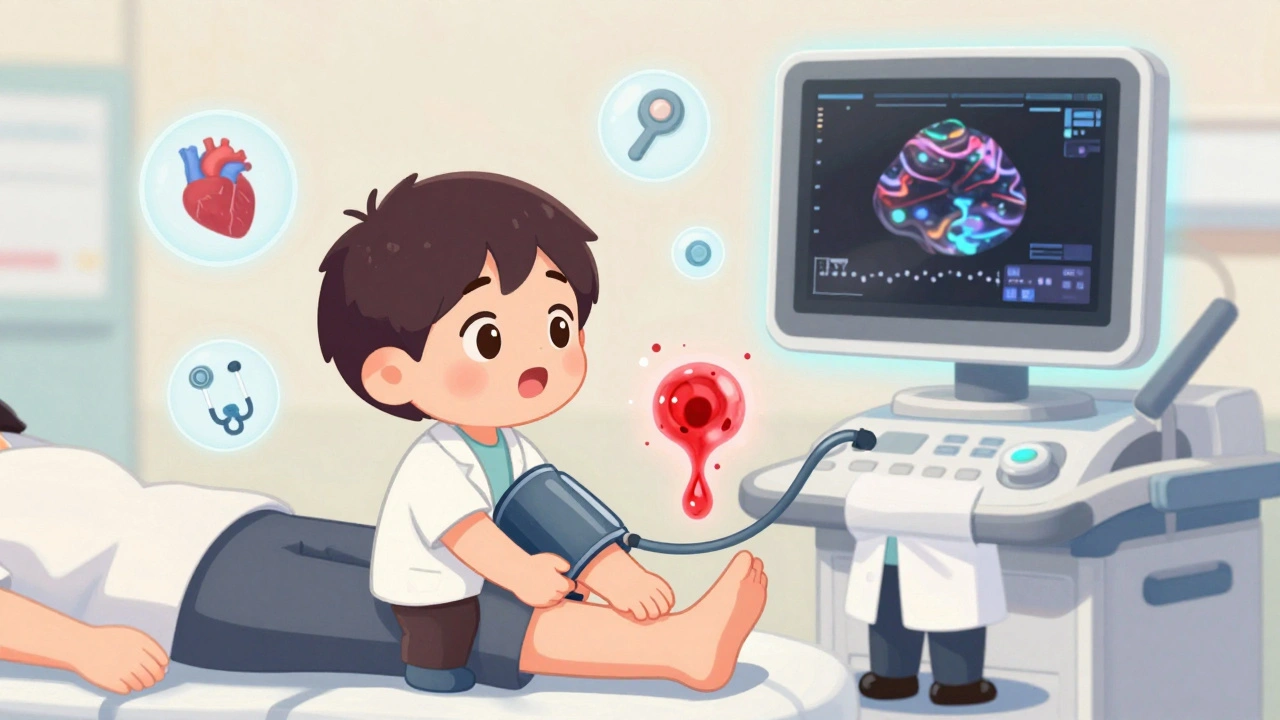
Doctors don’t guess. They test. The first step is the ankle-brachial index, or ABI. It’s simple, painless, and takes less than 15 minutes. Blood pressure cuffs are placed on your arms and ankles. The machine compares the pressure in your ankle to the pressure in your arm. If the ankle number is 90% or less of the arm number, you have PAD. An ABI below 0.9 confirms it in 95% of cases.
For people with diabetes or kidney disease, arteries can become stiff and hard to compress. In those cases, the toe-brachial index (TBI) is used instead. A TBI under 0.7 means PAD is present.
If the ABI shows something’s wrong, the next step is usually a Doppler ultrasound. This uses sound waves to see how fast blood is moving and where blockages are. It’s non-invasive and gives a clear picture of plaque buildup. For more detail, doctors may order a CT angiogram or MR angiogram. These create 3D images of your arteries and show exactly how narrow they are.
Catheter angiography-the gold standard-is only used if surgery is being considered. It involves injecting dye into your arteries and taking X-rays. It’s accurate, but carries small risks like kidney damage from the dye. Most people never need it.
The American Heart Association recommends ABI screening for:
- Everyone over 65
- Anyone over 50 who smokes or has diabetes
- Anyone over 40 with multiple heart disease risk factors (high blood pressure, high cholesterol, obesity)
Yet only about 20% of eligible people get tested. That’s a huge gap. If you fit the profile and have any leg discomfort, ask for an ABI test. It could save your leg-and your life.
Lifestyle Changes Are the First Line of Defense
Medication helps. But nothing beats changing how you live. The most effective treatment for PAD is a supervised walking program. Yes, walking-despite the pain.
Studies show that walking 30 to 45 minutes, three to five times a week, for 12 weeks, can increase how far you walk without pain by 150% to 200%. The key is to walk until you feel moderate discomfort, then rest until it goes away, then keep going. Over time, your muscles adapt. New blood vessels form. Your body learns to work around the blockage.
Quitting smoking is non-negotiable. Smokers with PAD are eight times more likely to need an amputation and three times more likely to die than those who quit. Smoking damages the lining of your arteries, speeds up plaque buildup, and makes your blood clot more easily. If you smoke, get help now. Nicotine patches, counseling, and medications like varenicline work.
Diet matters too. Eat less saturated fat, more vegetables, whole grains, and lean protein. Reduce salt to help control blood pressure. Stay hydrated. Avoid long periods of sitting. Move every hour.
Medications to Protect Your Heart and Legs
Even if you feel fine, you need medicine. PAD isn’t just a leg problem-it’s a sign your heart and brain are at risk.
Antiplatelet drugs keep your blood from clotting. You’ll likely take either aspirin (81 mg daily) or clopidogrel (75 mg daily). Clopidogrel is slightly more effective at preventing heart attacks and strokes in PAD patients.
Statins are mandatory. Even if your cholesterol is normal, you need a high-dose statin like atorvastatin or rosuvastatin to lower LDL to below 70 mg/dL. This reduces your risk of heart attack by 25% to 30%. Statins also stabilize plaque so it’s less likely to rupture and cause a clot.
Cilostazol can help if you have walking pain that limits your life. It increases blood flow to your legs and can improve walking distance by 50% to 100%. But it’s not for everyone. If you have heart failure, don’t take it.
Blood pressure control is essential. Aim for under 130/80. ACE inhibitors or ARBs are often preferred because they also protect your kidneys and heart.
Never skip these meds. PAD patients who stop their statins or antiplatelets have a much higher chance of losing a limb or having a heart attack.
When Procedures Are Needed
If lifestyle and meds aren’t enough, or if you have severe pain or wounds, you may need a procedure.
Balloon angioplasty is the most common. A tiny balloon is threaded into the blocked artery and inflated to push the plaque open. A stent-a small metal mesh tube-may be left behind to keep the artery open. It works well for short blockages and has a 90% success rate.
Atherectomy removes the plaque physically. A tiny rotating blade or laser shaves it away. It’s especially useful for hard, calcified blockages that don’t respond well to balloons.
Surgical bypass is for longer or more complex blockages. A vein from your leg or a synthetic tube is used to reroute blood around the blocked section. It’s more invasive but lasts longer-80% of vein bypasses stay open after five years.
For critical limb ischemia, time is critical. The WIfI classification system helps doctors decide urgency. Stage 4 patients-those with severe wounds and poor blood flow-have a 48% chance of amputation within a year if they don’t get revascularization.
Costs vary. A walking program costs about $1,200. Angioplasty runs $15,000-$25,000. Bypass surgery can hit $30,000-$40,000. But compared to the cost of amputation, long-term care, or a heart attack, these are investments in your future.

What’s New in PAD Treatment?
Research is moving fast. The VOYAGER PAD trial found that adding a blood thinner called rivaroxaban to aspirin reduced the risk of major limb events by 15% in patients after angioplasty or bypass. This combo is now recommended for high-risk patients.
Stem cell therapy is being tested in early trials. Injecting a patient’s own stem cells into the leg muscles has helped heal wounds in 65% of patients with severe PAD-compared to only 35% with standard care.
Advanced imaging like optical coherence tomography (OCT) lets doctors see plaque in incredible detail-down to the cellular level. This helps them choose the best treatment for each person.
In 2022, the U.S. passed the PAD Awareness Act, funding $5 million a year for screening programs targeting high-risk groups. It’s a step toward fixing the huge gap in diagnosis.
Why So Many People Miss the Signs
PAD is underdiagnosed because it’s invisible. You don’t feel chest pain. You don’t have a sudden collapse. The symptoms creep in slowly. People think leg pain is just aging. Doctors may overlook it if the patient doesn’t mention it.
There’s also a disparity in care. Black and Hispanic patients are 30% to 40% less likely to get revascularization-even when their disease is just as severe. Access to specialists, transportation, and insurance all play a role.
The bottom line? PAD kills. About 30% to 40% of people with PAD die within five years-mostly from heart attack or stroke. That’s worse than many cancers. But unlike cancer, PAD is preventable and treatable-if you act early.
What You Should Do Now
If you’re over 50 and smoke, have diabetes, or have high blood pressure or cholesterol:
- Ask your doctor for an ankle-brachial index test.
- If you get leg pain when walking, don’t ignore it. Track how far you walk before pain starts.
- Quit smoking-today. No delay.
- Start walking. Even 10 minutes a day, five days a week. Build up slowly.
- Take your meds as prescribed. Don’t stop because you feel fine.
- Check your feet daily for sores, color changes, or swelling.
PAD doesn’t have to be a death sentence. It’s a wake-up call. And if you listen, your body can recover.
Can peripheral artery disease be cured?
PAD can’t be completely reversed, but it can be effectively managed. With lifestyle changes, medication, and sometimes procedures, most people stop the progression, reduce symptoms, and avoid serious complications like amputation or heart attack. The goal isn’t to eliminate plaque entirely-it’s to stabilize it and improve blood flow enough to live without pain or disability.
Is walking good for PAD, even if it hurts?
Yes, walking is one of the best treatments. The pain you feel during walking is your muscles telling you they’re not getting enough oxygen. When you rest, the pain fades. By repeating this cycle-walk to discomfort, rest, then walk again-you train your body to use oxygen more efficiently. Over time, new tiny blood vessels form, improving circulation. Studies show this can increase walking distance by up to 200% in 12 weeks.
Does PAD only affect the legs?
While legs are most commonly affected, PAD can occur in arteries anywhere outside the heart. This includes the arms, kidneys, stomach, and brain. Blockages in the carotid arteries can lead to stroke. Blockages in the renal arteries can cause high blood pressure or kidney failure. PAD is a systemic disease-it means your arteries throughout your body are affected by atherosclerosis.
Can you have PAD without any symptoms?
Yes. About half of people with PAD have no noticeable symptoms. This is especially common in older adults and people with diabetes, who may have nerve damage that masks pain. That’s why screening with an ankle-brachial index is so important for high-risk groups. You can have serious artery blockage and feel perfectly fine-until it’s too late.
How often should you get checked for PAD?
If you’re over 65, or over 50 with diabetes or a smoking history, get an ABI test once. If it’s normal and you have no symptoms, repeat it every 5 years. If it’s abnormal, follow your doctor’s advice-usually every 6 to 12 months. If you’ve had a procedure like angioplasty, you’ll need regular follow-ups to monitor artery patency and adjust medications.
What happens if PAD is left untreated?
Untreated PAD leads to worsening symptoms and higher risks. You may develop pain at rest, non-healing sores, and eventually gangrene. Amputation becomes likely. More dangerously, the same plaque causing leg blockages is also in your heart and brain. Your risk of heart attack, stroke, or sudden death increases three to five times. The 5-year mortality rate for untreated PAD is 30% to 40%-higher than many cancers.
Can diet alone fix peripheral artery disease?
Diet helps, but it’s not enough on its own. A heart-healthy diet lowers cholesterol, reduces inflammation, and improves blood pressure, all of which slow PAD progression. But without exercise, smoking cessation, and medication, the disease will likely continue to worsen. Diet is a powerful tool, but it works best as part of a full treatment plan.
Is PAD more common in men or women?
PAD affects both genders equally, but symptoms often present differently. Men are more likely to report classic claudication. Women are more likely to have atypical symptoms like fatigue, weakness, or non-specific leg discomfort, which can lead to delayed diagnosis. Women with PAD also have higher rates of complications and worse outcomes after procedures, possibly due to later detection.
Peripheral artery disease is not a death sentence. It’s a signal. And if you act on it-quit smoking, walk regularly, take your meds, and get tested-you can live a full, active life for years to come.
Isabelle Bujold
December 4, 2025 AT 15:13I’ve been managing PAD for five years now, and the walking program was the game-changer. At first, I could only make it to the end of my driveway before my calves screamed. But after 12 weeks of walking to discomfort, resting, then pushing again? I’m now walking three miles without stopping. It’s not magic-it’s adaptation. Your muscles grow new capillaries. Your body learns to work with less. I didn’t believe it until I saw it. And yes, it hurts. But the pain is a signal, not a stop sign.
Also, don’t underestimate the power of compression socks. They don’t fix the blockage, but they help with swelling and circulation, especially if you’re on your feet a lot. And hydration. People forget that. Thick blood = worse flow. Drink water. Like, actually drink it.
Oh, and if you’re on cilostazol? Don’t take it with grapefruit juice. I learned that the hard way. Thought it was just a myth until I got dizzy and nauseous for three hours. Google drug interactions. It’s not optional.
And yes, I take my statin daily. Even on vacation. Even when I feel fine. Because PAD isn’t about your legs-it’s about your heart. And I’m not risking another trip to the ER.
My doctor told me if I kept this up, I’d likely outlive my 78-year-old dad. I’m 62. That’s motivation enough.
Don’t wait for a wound to open. Don’t wait for the pain to get worse. Start today. Even if it’s just 10 minutes. Consistency beats intensity every time.
And if you’re smoking? I get it. It’s hard. But every cigarette is like pouring concrete into your arteries. I quit cold turkey after my ABI was 0.72. No patches. No vaping. Just said ‘no’ to the habit. It’s been 4 years. My legs thank me.
You’re not too old. You’re not too tired. You’re not too busy. You’re just not ready yet. And that’s okay. But don’t lie to yourself. This isn’t aging. This is your body screaming for help. Listen.
And if you’re reading this and thinking ‘I’ll start next week’-I’m talking to you. Next week never comes. Today does.
I’m not a doctor. Just someone who didn’t want to lose a leg. And I won’t.
Augusta Barlow
December 6, 2025 AT 01:28Let’s be real-this whole PAD thing is just Big Pharma’s way to sell you statins and angioplasties. They don’t want you to know that walking is free and that your arteries can heal naturally with turmeric, magnesium, and sunlight. The ABI test? A scam. Blood pressure cuffs don’t measure real circulation-they measure what the machine wants you to believe.
My cousin had PAD and refused surgery. He started drinking apple cider vinegar every morning and walking barefoot on grass. Two years later? His ABI was normal. No meds. No stents. Just earth and vinegar.
And why is everyone so quiet about how the FDA is in bed with the vascular device companies? You think they want you to heal naturally? No. They want you dependent. On drugs. On procedures. On lifelong co-pays.
They’re lying about the 30% mortality rate too. That’s just fearmongering to keep you scared. People die of heart attacks because they’re stressed from worrying about PAD, not because of the PAD itself.
Don’t trust your doctor. They’re paid by the system. Ask for the raw trial data. You’ll see the numbers are rigged.
And if you’re taking aspirin? You’re bleeding out internally. I know someone who had a GI bleed from ‘low-dose’ aspirin. He’s in a wheelchair now. They never told him that.
Heal your body. Not your bank account.
Rebecca Braatz
December 8, 2025 AT 00:59Hey. I see you. I’ve been where you are. Legs heavy. Walking feels like dragging bricks. You think you’re just getting old. You’re not. You’re alive-and your body is begging you to listen.
I started walking 10 minutes a day. Five days a week. I didn’t care if I only made it to the mailbox. I did it. Every. Single. Day.
Week 3? I walked to the corner store. Got ice cream. Felt like a superhero.
Week 6? I walked the whole block without stopping. My neighbor said, ‘You look different.’ I said, ‘I am different.’
You don’t need a gym. You don’t need a trainer. You just need to show up. Even when you’re tired. Even when you’re mad. Even when you think it’s pointless.
And smoking? I quit. Not because I was scared. Because I wanted to hold my granddaughter without gasping. I did it. You can too.
Medications? Take them. Not because the doctor said so. Because you deserve to move. To feel. To live.
This isn’t about fixing your legs. It’s about reclaiming your life.
Start today. Not tomorrow. Today.
I’m rooting for you. Even if you don’t know me.
You got this.
Michael Feldstein
December 9, 2025 AT 11:05I’ve been reading up on PAD since my dad had a bypass last year. Super informative post. I didn’t realize how common silent PAD is-my dad had zero symptoms until he got a foot ulcer. Scary stuff.
I got my ABI test last month. Normal, thank god. But I’m 58 and smoked for 20 years, so I’m staying vigilant. Started walking 20 minutes after dinner. Feels weird at first, but it’s becoming a habit.
Also, I had no idea cilostazol existed. My doc never mentioned it. Maybe I’ll bring it up next visit. Wonder if it’s covered under my insurance.
And yeah, the statin thing makes sense. Even if your cholesterol’s fine, it’s not just about cholesterol-it’s about plaque stability. That’s a good point.
Anyone else use a fitness tracker to log walking sessions? I’ve got mine set to remind me every hour to stand and stretch. Small stuff, but it adds up.
Thanks for the breakdown. Really helpful.
Also, the part about women having atypical symptoms? That’s huge. My mom had fatigue and leg weakness for years. They called it ‘aging.’ Turns out it was PAD. She got diagnosed late. Don’t let that happen to you.
jagdish kumar
December 9, 2025 AT 13:11The arteries are the rivers of the soul. When they clog, the spirit dries. PAD is not disease-it is metaphor. The body speaks in silence, and we are too loud to hear.
They give you pills. They cut you open. But no one asks why you walk so little. Why you eat poison. Why you breathe smoke.
The cure is not in a machine. It is in stillness.
Listen.
Then move.
Not because you must.
But because you can.
michael booth
December 10, 2025 AT 10:23Just want to say thank you for this incredibly comprehensive overview. As someone who works in public health outreach, I’ve seen too many patients dismiss PAD as ‘just leg pain.’ This kind of clear, evidence-based breakdown is exactly what’s needed to shift public understanding.
I’ve distributed printed copies of this to our senior center and diabetic support group. The response has been overwhelming. People are asking for ABI screenings now. That’s huge.
Also, the walking program data is solid. We’ve started a community walking group-two mornings a week, led by a physical therapist. Attendance is up 300% since we started promoting it with this info.
Let’s keep pushing for screening access in underserved areas. This isn’t just individual health-it’s systemic change.
And yes, smoking cessation is non-negotiable. We’ve partnered with local clinics to offer free counseling. No one should have to quit alone.
Thank you again. This is the kind of content that saves lives.
Carolyn Ford
December 11, 2025 AT 09:12Oh please. ‘Walk through the pain’? That’s what they told my aunt before she lost her foot. They don’t tell you that walking with PAD can cause micro-tears in already-starved tissue. You’re not ‘training’-you’re damaging. And then they blame you for not ‘complying.’
And statins? They cause muscle atrophy, diabetes, and cognitive decline. The studies? Funded by Pfizer. Surprise.
And the ABI test? It’s inaccurate in diabetics and the elderly. My uncle had a 0.92 reading and still had a 90% blockage. The machine lied.
They want you to believe this is simple. It’s not. It’s a complex systemic failure caused by processed food, toxins, and corporate greed. And you’re being sold a Band-Aid while your arteries rot.
And why is everyone so obsessed with walking? What about rest? Recovery? Reducing inflammation with fasting? No one talks about that.
And don’t get me started on the ‘PAD Awareness Act.’ It’s a PR stunt. They’re not funding education-they’re funding more screenings so they can sell more stents.
You’re being manipulated. Wake up.
And if you’re taking cilostazol? You’re risking arrhythmias. Read the insert. It says ‘contraindicated in heart failure’-but they still prescribe it to 70-year-olds with hypertension. That’s malpractice.
Don’t trust the system. Trust yourself. And stop walking if it hurts. Rest. Eat clean. Sleep. That’s the real treatment.
They don’t want you to heal. They want you to pay.
Heidi Thomas
December 12, 2025 AT 21:53You’re all missing the point. PAD isn’t about walking or statins. It’s about endothelial dysfunction. You don’t fix blockages-you fix the lining of the arteries. That’s done with nitric oxide boosters like beetroot juice, L-arginine, and sunlight. No drugs. No surgery. Just biology.
And the ABI? Useless if you have calcified arteries. That’s why TBI exists. But no one mentions it because ultrasound machines don’t make money. The real diagnostic tool is pulse volume recording. But it’s expensive so they ignore it.
And the VOYAGER PAD trial? Rivaroxaban plus aspirin increases bleeding risk by 40%. They didn’t tell you that. You think that’s worth it for a 15% reduction in limb events? Maybe not.
And stem cells? Still experimental. Don’t fall for the hype. The only proven thing is smoking cessation and walking. Everything else is noise.
And yes, women get misdiagnosed because their symptoms are ‘atypical.’ But that’s because doctors are trained to look for male-presenting disease. Fix the system, not the patient.
And diet? You can’t eat your way out of atherosclerosis. It’s genetic. Stop blaming yourself.
So yes-walk. Quit smoking. Take statins. But understand the real science. Not the marketing. And stop listening to influencers who think turmeric cures PAD.