
 by
by Quality Control in Manufacturing: Safety Standards That Protect Patients
25 Dec, 2025Why Quality Control in Medical Manufacturing Isn’t Just Bureaucracy
Every time someone gets an insulin pump, a pacemaker, or a surgical stapler, they’re trusting that the device will work exactly as designed. No one thinks about the hundreds of checks, tests, and paper trails behind that device. But if even one step fails, it could mean infection, injury, or death. Quality control in medical manufacturing isn’t about filling out forms-it’s the last line of defense between a flawed product and a vulnerable patient.
The Rules That Keep Patients Safe
The U.S. Food and Drug Administration (FDA) set the foundation in 1996 with 21 CFR Part 820, also known as the Quality System Regulation. It forced manufacturers to track every part, every step, and every change. But the system was messy. Companies selling in Europe had to follow ISO 13485, a different set of rules. That meant double work, double costs, and double chances for mistakes.
That changed on January 31, 2024. The FDA dropped its final rule: ISO 13485:2016 would become the new standard. By February 2, 2026, every medical device maker in the U.S. must comply with this global benchmark. It’s not just a paperwork update-it’s a full system overhaul. ISO 13485:2016 doesn’t just say what to do; it forces you to think about why you’re doing it. Risk management is baked into every process, from design to delivery.
What’s Actually Checked Before a Device Leaves the Factory
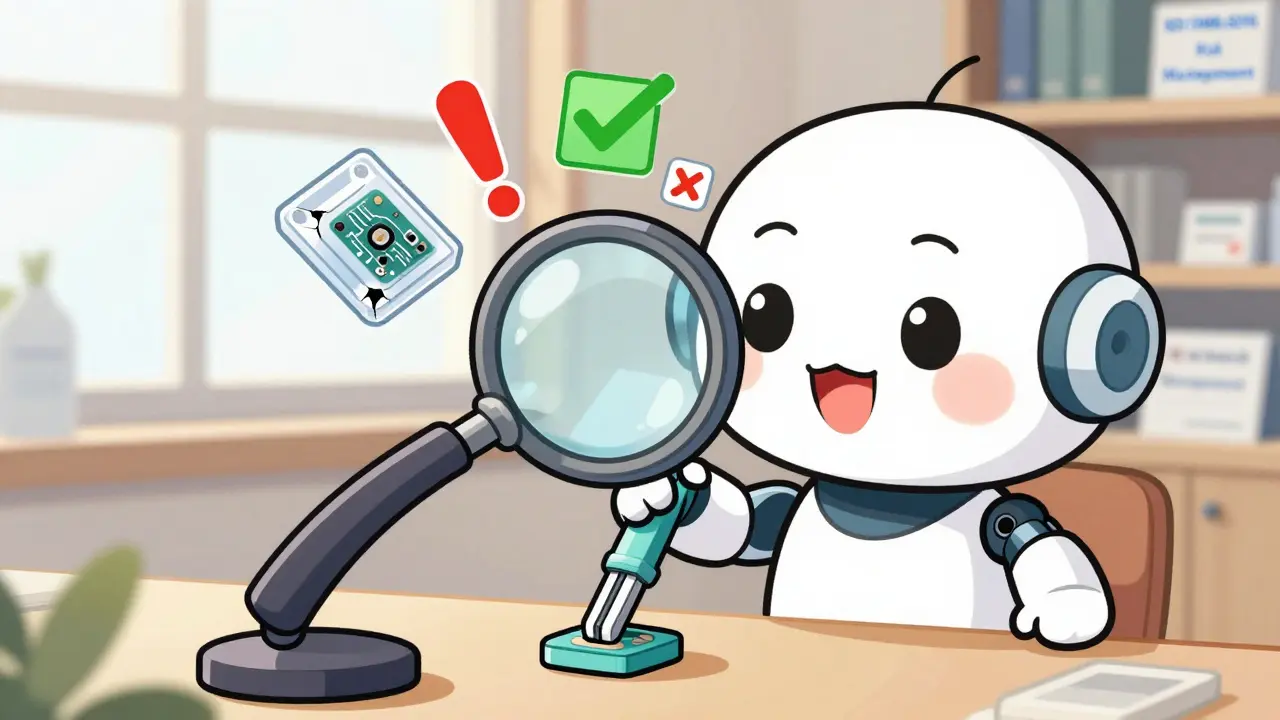
It’s not enough to say a device works. You have to prove it-over and over, under real-world conditions. Here’s what gets tested:
- Incoming materials: Every screw, wire, and plastic component is inspected. A single batch of contaminated polymer can ruin thousands of devices.
- In-process checks: At each stage of assembly, machines and technicians verify measurements. If a sensor’s voltage drifts by 0.5%, the whole batch gets quarantined.
- Final functional testing: Every device powers on, runs diagnostics, and meets performance specs. For electrical devices, that means passing IEC 60601-1: 1,500-volt dielectric tests, leakage currents under 100 microamperes.
- Traceability: Every serial number links back to the raw materials, the operator, the machine settings, and the test results. If a recall happens, you know exactly which 5,000 devices are affected-not 50,000.
Companies using statistical process control (SPC) cut defects by up to 45%. That’s not luck. That’s data-driven control.
How Risk Management Saves Lives
ISO 14971 is the standard for managing risk in medical devices. It’s not optional. It’s required. Manufacturers must identify every possible failure mode-even ones that seem unlikely. What if a battery overheats? What if software freezes during surgery? What if a supplier changes a material without telling you?
One company in Texas used this process to catch a software bug in an implanted glucose monitor. The flaw only showed up after 72 hours of continuous use. Without the risk matrix, it would’ve gone unnoticed until patients started getting false readings. Instead, they recalled 5,000 units before a single patient was harmed.
Dr. Jeffrey Shuren, head of the FDA’s device division, says robust quality systems prevent about 200,000 adverse events every year. That’s not a guess. That’s based on incident reports and root cause analysis across thousands of devices.
Real Problems, Real Consequences
Despite the rules, failures still happen. The FDA’s 2023 warning letters show a disturbing trend: 41% cited poor supplier oversight. One manufacturer used a new adhesive from a vendor that didn’t have proper certification. Six months later, 12,000 catheters started leaking. Patients got infections. The company lost $18 million and its reputation.
Another common issue? “Paper quality systems.” That’s when companies have perfect documentation but no real understanding of how their processes work. The FDA found that 23% of inspection findings involved complete paperwork-but failed process validation. Someone signed off on a procedure that never actually worked in production.
On Reddit, a senior quality engineer wrote: “We spent 18 months training everyone. Then we cut our corrective action time from 45 days to 17. That’s the difference between chaos and control.”
Technology Is Changing the Game
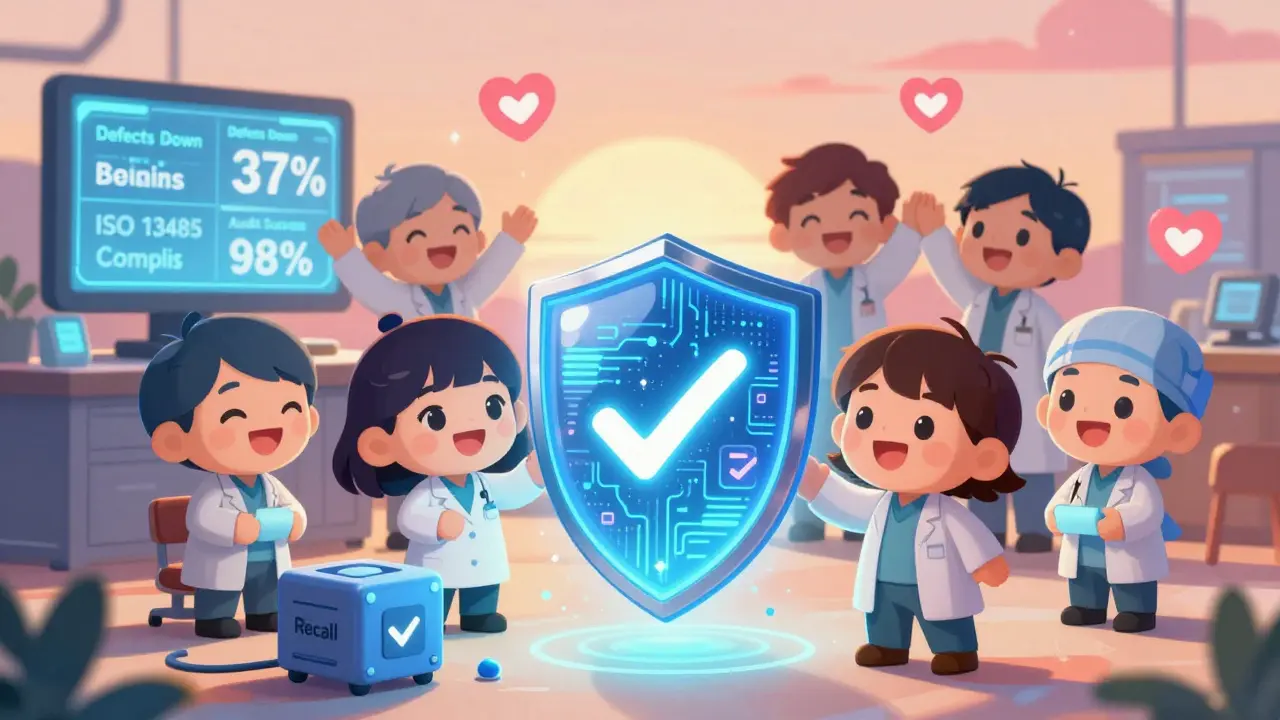
Old-school quality control meant clipboards, spreadsheets, and manual audits. Today, it’s digital. Quality management software like Greenlight Guru helps manufacturers stay compliant with built-in templates for FDA 21 CFR Part 820 and ISO 13485. Companies using these platforms report 32% higher audit success rates.
Even more powerful? Artificial intelligence. Early adopters are feeding production data into machine learning models to predict failures before they happen. One company saw defect rates drop 37% by flagging abnormal vibration patterns in their assembly robots. Another reduced inspection time by 60% by using computer vision to spot micro-cracks in plastic housings.
Gartner predicts that by 2027, 60% of medical device quality systems will use AI-driven analytics. That doesn’t mean humans are out of the loop-it means they’re freed up to focus on real problems, not paperwork.
The Cost of Getting It Wrong
Compliance isn’t cheap. Implementing a full quality system takes 12 to 24 months for Class II and III devices. Training alone can cost 200-400 hours per employee. Software licenses, audits, certifications-they add up.
But the cost of failure? Much higher. A single Class I recall can cost over $50 million. Legal fees, lost sales, damaged brand trust, and worst of all-patient harm. The FDA estimates that without strong quality controls, 1 in 20 device failures could lead to serious injury or death.
Meanwhile, manufacturers who get it right save money. The harmonization of ISO 13485:2016 with U.S. rules is expected to cut compliance costs by $400 million a year. Faster approvals. Fewer duplicate audits. Less redundancy.
What Manufacturers Need to Do Now
The clock is ticking. The deadline is February 2, 2026. Here’s what to do:
- Gap analysis: Compare your current system to ISO 13485:2016. Where are you falling short? Focus on risk management, supplier controls, and design traceability.
- Train your team: Quality staff need 6-12 months to master ISO 14971. Production staff need 40-80 hours of hands-on training.
- Upgrade your tech: If you’re still using Excel for traceability, you’re behind. Invest in a QMS platform built for medical devices.
- Test your suppliers: 41% of FDA warnings are about supplier failures. Audit them. Require certifications. Don’t assume.
- Don’t just document-understand: If your team can’t explain why a process exists, it’s not quality control. It’s paperwork.
There’s no shortcut. But there is a clear path: align with ISO 13485:2016, embrace risk-based thinking, and use technology to make systems smarter-not just more complex.
What’s Next for Medical Device Safety
The next version of ISO 13485, expected in late 2025, will include stronger cybersecurity requirements. With more devices connected to networks-like smart infusion pumps and remote monitoring implants-hacking isn’t science fiction anymore. Quality systems will need to protect data as much as they protect function.
One thing won’t change: the goal. Every procedure, every test, every audit is there for one reason-to keep patients safe. That’s not a regulatory box to check. It’s the reason this whole system exists.
What is ISO 13485:2016 and why does it matter for patient safety?
ISO 13485:2016 is the international standard for quality management systems in medical device manufacturing. It requires companies to systematically manage risk, ensure traceability of parts, validate every process, and maintain strict supplier controls. Unlike older standards, it’s built around real-world failure scenarios-not just paperwork. By aligning with this standard, manufacturers reduce the chance of defective devices reaching patients. The FDA now requires it for U.S. sales, making it the global baseline for safety.
How does the FDA’s new QMSR rule change things for manufacturers?
Before 2024, U.S. manufacturers had to follow FDA’s 21 CFR Part 820 for the American market and ISO 13485 for Europe and other countries. That meant duplicating processes, audits, and documentation. The new QMSR rule replaces most of the old FDA rules with ISO 13485:2016, eliminating 30% of redundant requirements. By February 2, 2026, all U.S. medical device makers must comply with ISO 13485:2016 alone. This reduces costs, speeds up approvals, and creates one global safety standard.
What’s the biggest mistake manufacturers make in quality control?
The biggest mistake is creating a “paper quality system.” That’s when companies have flawless documentation but no real understanding of how their processes work in practice. The FDA found that 23% of inspection findings involve complete records but failed process validation. For example, a procedure might say “inspect every circuit board,” but if no one actually checks them-or if the checklist isn’t tied to real test data-it’s useless. Quality isn’t about signing forms. It’s about knowing your process prevents failures.
How do supplier failures impact patient safety?
Suppliers provide 70-80% of components in most medical devices. If a supplier changes a plastic compound without notifying the manufacturer, it could make a catheter brittle. If they use unapproved adhesive, a pacemaker could detach. In 2023, 41% of FDA warning letters cited poor supplier oversight. Manufacturers must audit suppliers like they audit themselves-certifications, material testing, and change notifications are non-negotiable. A single weak link in the supply chain can lead to recalls, injuries, or deaths.
Can AI really improve medical device quality control?
Yes, and it already is. AI analyzes production data-vibration, temperature, electrical output-to spot patterns humans miss. One company reduced defects by 37% by predicting when a robotic arm was about to drift out of tolerance. Another used computer vision to find micro-cracks in plastic housings faster than any human inspector. AI doesn’t replace people-it gives them better information. Early adopters report 25-40% fewer defects and faster response times. By 2027, most leading manufacturers will use AI-driven analytics as part of their standard quality process.
Rajni Jain
December 27, 2025 AT 07:56Natasha Sandra
December 28, 2025 AT 03:15Erwin Asilom
December 30, 2025 AT 00:45Sumler Luu
December 31, 2025 AT 04:15sakshi nagpal
December 31, 2025 AT 10:43Sandeep Jain
January 2, 2026 AT 03:46roger dalomba
January 4, 2026 AT 02:14Brittany Fuhs
January 6, 2026 AT 00:59Sophia Daniels
January 6, 2026 AT 13:50Nikki Brown
January 8, 2026 AT 12:33Peter sullen
January 8, 2026 AT 14:16Steven Destiny
January 8, 2026 AT 17:24Fabio Raphael
January 9, 2026 AT 14:56