
 by
by Recent Advances in Bioequivalence Testing: Emerging Technologies
16 Feb, 2026For decades, proving that a generic drug works just like the brand-name version meant running expensive, time-consuming clinical trials on human volunteers. You’d measure blood levels, track how fast the drug entered the system, and compare it all to the original. It worked-but it was slow, costly, and sometimes unreliable. Now, in 2026, that’s changing. bioequivalence testing is no longer just about blood samples and lab results. It’s becoming smarter, faster, and more precise thanks to a wave of new technologies that are reshaping how regulators and manufacturers ensure drug safety and effectiveness.
AI Is Cutting Through the Data Noise
The biggest shift isn’t a new machine-it’s a new way of thinking about data. The FDA launched the Bioequivalence Assessment Mate (BEAM) system in mid-2024, and it’s already making a difference. BEAM isn’t a lab instrument. It’s a software tool that reads through mountains of test results, historical data, and regulatory filings to spot patterns humans might miss. Before BEAM, reviewers spent an average of 80 hours per generic drug application just sorting through reports. Now, that’s down to under 30 hours. How? The system flags inconsistencies, cross-checks dissolution profiles against known benchmarks, and even predicts whether a formulation will pass based on similar past cases. In pilot tests, BEAM reduced reviewer workload by 52 hours per application. That’s not just efficiency-it’s speed. And speed matters. The FDA’s goal is to review 90% of generic applications within 10 months by 2027. BEAM is helping them get there.
Machine learning doesn’t stop at review. It’s also being used to model how drugs behave in the body-known as PK/PD modeling. Instead of guessing how a drug will be absorbed based on a few data points, algorithms now use thousands of past studies to simulate real-world performance. This means fewer volunteers are needed in early testing. For complex drugs like those with delayed-release coatings or nanoparticles, this is a game-changer. One study showed AI-driven modeling improved prediction accuracy by 28% compared to traditional methods.
Seeing the Drug in Action-Beyond Blood Tests
Traditional bioequivalence testing relied on measuring drug concentration in the bloodstream. But what if the drug doesn’t enter the blood the same way every time? That’s where advanced imaging comes in. The FDA’s research labs now use tools like scanning electron microscopy (SEM), atomic force microscopy, and optical coherence tomography to examine drug particles at the micro level. These aren’t just pretty pictures. They show exactly how a tablet breaks down, how a cream spreads on skin, or how an inhaler delivers particles to the lungs. For example, a new formulation of an inhaled asthma drug might look identical to the original under a regular microscope-but SEM reveals subtle differences in particle shape and surface texture that affect how deep it goes into the airways.
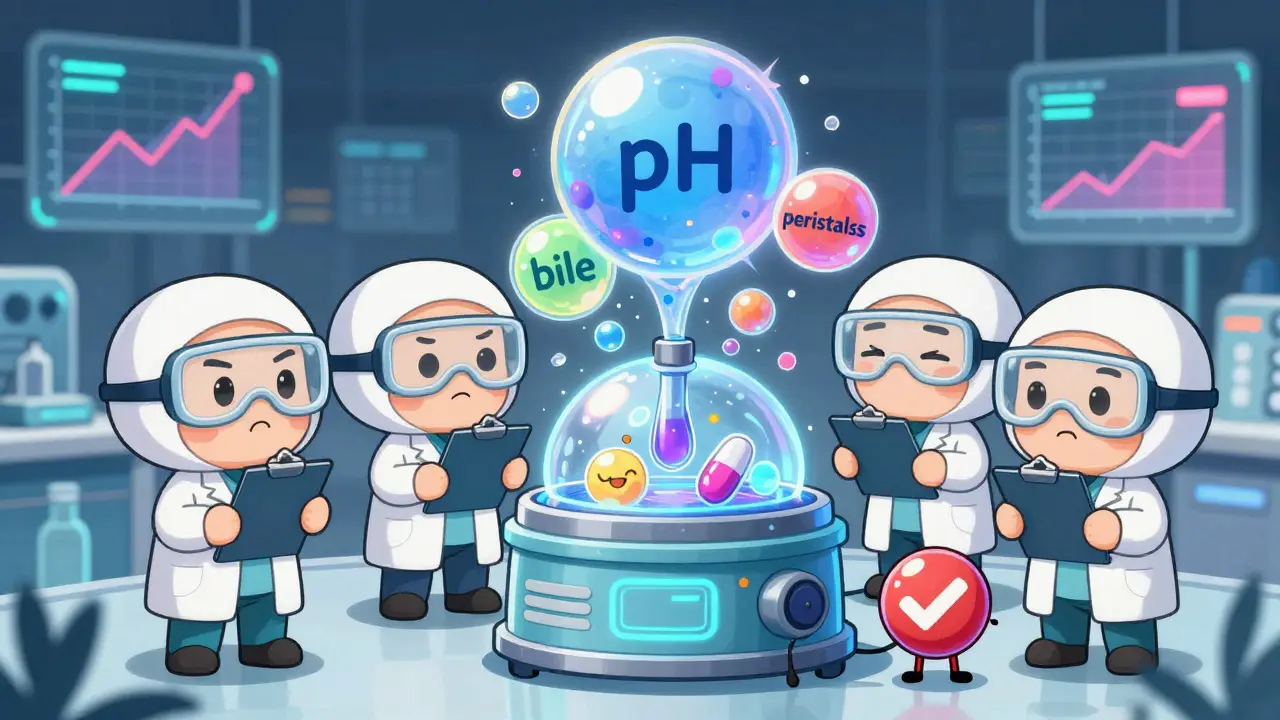
One standout innovation is the Dissolvit system. Unlike standard dissolution testers that use plain water or buffer solutions, Dissolvit mimics real digestive conditions. It adjusts pH, adds bile salts, and even simulates stomach movement. This matters because some drugs-especially those with poor solubility-only dissolve properly in a gut-like environment. If a generic tablet dissolves fine in water but not in a simulated intestine, it won’t work the same way in patients. Dissolvit helps catch those mismatches early. In March 2025, the FDA published findings showing Dissolvit could distinguish between formulations that traditional tests couldn’t tell apart.
Virtual Bioequivalence: Testing Without Humans
Imagine running a bioequivalence study without a single human volunteer. Sounds impossible? It’s not. The FDA has funded two major projects to make this real. The first is a virtual bioequivalence platform that uses computer models to simulate how a drug behaves in a population. It doesn’t replace all clinical trials-but for certain complex products like long-acting injectables or implants, it can reduce the need for human testing by up to 65%. The second is a mechanistic IVIVC (in vitro-in vivo correlation) model for PLGA implants, funded in April 2024. PLGA is a biodegradable polymer used in slow-release devices. Before, proving bioequivalence for these meant waiting weeks to collect blood samples from patients. Now, lab tests on the implant’s dissolution rate can predict how it will behave in the body with high accuracy. This cuts study time from months to days.
These aren’t just lab curiosities. They’re being adopted by manufacturers because they save money. A traditional bioequivalence study costs $1-2 million. Technology-enhanced studies? $2.5-4 million upfront. But they cut overall development time by 40-50%, and reduce the risk of late-stage failure. For biosimilars-complex biologic drugs that mimic biotech products like Humira or Enbrel-this is critical. The FDA approved 76 biosimilars by October 2025, and most of them relied on advanced modeling to get there.
Harmonization: One Rule for the World
Before 2024, bioanalytical testing rules were messy. The FDA had one set. Europe’s EMA had another. Companies had to run duplicate tests just to meet both. That changed when the ICH M10 guideline was adopted in June 2024. It unified standards for validating drug measurement methods across the U.S., EU, Japan, and other major markets. The result? A 62% drop in method validation discrepancies between regions. This means manufacturers can run one set of tests and submit to multiple agencies. It’s not just about convenience-it’s about faster global access to affordable drugs. Countries in the Middle East and Africa, especially Saudi Arabia and the UAE, are now building labs that follow ICH M10, thanks to government investments tied to Vision 2030 and WHO partnerships.

Where the Tech Still Falls Short
Not every drug can be handled by AI or imaging. Some formulations are still better tested the old way. For simple, small-molecule generics-like a basic 500mg acetaminophen tablet-traditional pharmacokinetic studies remain cheaper and more reliable. The cost of setting up advanced systems often outweighs the benefit for these straightforward cases.
Other areas remain tricky. Transdermal patches? Hard to test because skin absorption varies wildly between people. Orally inhaled products? The FDA still requires standardized charcoal block studies to block absorption and isolate lung delivery-but those methods are outdated and inconsistent. Topical creams and ointments? The challenge is proving that two products have the same composition at the molecular level, not just the same color or texture. The FDA’s 2025 workshop highlighted that current dissolution tests lack the power to detect subtle differences in semisolid formulations. That’s why they’re pushing for Q3 assessments-integrated modeling that looks at composition, particle size, and rheology together.
There’s also a risk. Dr. Michael Cohen from ISMP warned that over-reliance on in vitro models could be dangerous for drugs with a narrow therapeutic index-like warfarin or lithium. If a model predicts bioequivalence but misses a real-world variation, patients could be under- or overdosed. That’s why regulators still require at least one human study for these high-risk drugs.
The Road Ahead: What’s Next?
The FDA plans to roll out BEAM system-wide by Q2 2026. By 2030, experts predict AI-driven methods will handle 75% of standard generic applications. For complex products-peptides, oligonucleotides, advanced injectables-the future lies in virtual platforms and imaging-based assessments. The agency’s 2027 research agenda includes developing validated in vitro models for eye drops, ear drops, and nasal sprays. Meanwhile, a new pilot program unveiled in October 2025 requires all bioequivalence testing for accelerated ANDA reviews to be done in the U.S. using domestically sourced active ingredients. This isn’t just science-it’s policy. It’s meant to strengthen U.S. manufacturing, but it also adds complexity for global companies.
One thing is clear: bioequivalence testing is no longer a bottleneck. It’s becoming a precision tool. The goal isn’t just to prove two drugs are similar-it’s to prove they’ll behave the same way in every patient, every time. And with AI, advanced imaging, and virtual models, we’re getting closer than ever before.
What is bioequivalence testing and why does it matter?
Bioequivalence testing compares how quickly and completely a generic drug is absorbed into the bloodstream compared to the original brand-name version. It ensures that the generic works the same way in the body. Without this testing, there’s no guarantee that a cheaper drug will be just as safe and effective. For patients, this means reliable treatment. For manufacturers, it’s the legal pathway to bring generics to market.
How is AI changing bioequivalence testing?
AI is automating data review, predicting drug behavior using machine learning models, and reducing human error. The FDA’s BEAM system, for example, cuts review time by over 60% by analyzing past studies and flagging inconsistencies. AI also improves PK/PD modeling, meaning fewer clinical trials are needed for complex drugs. This speeds up approvals and lowers costs without sacrificing accuracy.
Can bioequivalence be proven without human trials?
For certain complex drug products-like long-acting injectables, implants, and some inhalers-yes. Virtual bioequivalence platforms and advanced in vitro models can now predict how a drug behaves in the body with high accuracy, reducing or even eliminating the need for human studies. But for simple generics and high-risk drugs (like blood thinners), human trials are still required to ensure safety.
What is the Dissolvit system and why is it important?
Dissolvit is a next-generation dissolution testing system that simulates real digestive conditions, not just lab solutions. It adds bile salts, adjusts pH, and mimics stomach movement to see how a drug actually breaks down in the body. This is crucial for drugs that don’t dissolve well in water. It helps catch formulation differences that traditional tests miss, ensuring generics truly match the original in performance.
Why are some bioequivalence studies still expensive?
While AI and virtual models reduce costs, advanced technologies like SEM, Dissolvit, and virtual platforms require specialized equipment, trained staff, and validation-adding $2.5-4 million to initial development costs. For simple generics, traditional PK studies ($1-2 million) are still more economical. The higher cost is justified for complex drugs where failure risks are high, but not always necessary for straightforward formulations.
Steph Carr
February 17, 2026 AT 12:46So let me get this straight-we’re replacing human trials with algorithms that don’t sleep, eat, or have existential dread? I’m not saying AI is wrong, but I am saying it doesn’t know what it’s like to have a 3 a.m. panic attack because your generic pill didn’t work and you’re stuck in a Walmart parking lot wondering if you’re dying or just hungry.
Still. I’ll admit it’s impressive. BEAM probably reads through data faster than my cat reads my mood. And if it cuts review time by 50 hours? That’s 50 hours someone else gets to spend not staring at spreadsheets. Maybe they’ll finally adopt a dog. Or take a nap. Either way, win.
But let’s not pretend this is magic. A model can’t feel the difference between a tablet that dissolves at 9 a.m. versus one that dissolves at 11 a.m. when you’re already late for work and your coffee’s cold. Some things still need flesh and blood to validate.
Also-Dissolvit? Sounds like a villain from a Marvel movie. ‘Behold, my pH-adjusted bile-salt simulator!’
…I’m kind of excited though. If this works, we might finally get affordable insulin without waiting 7 years. And that? That’s worth a little algorithmic weirdness.
Brenda K. Wolfgram Moore
February 17, 2026 AT 21:02The shift from manual review to AI-assisted analysis is a necessary evolution in regulatory science. The previous system was inherently bottlenecked by human cognitive limits and procedural inertia. BEAM doesn’t eliminate human oversight-it enhances it by freeing reviewers from repetitive tasks and allowing them to focus on outlier cases that demand nuanced judgment.
Similarly, the integration of physiologically relevant dissolution models like Dissolvit addresses a decades-old flaw in bioequivalence assessment: the assumption that lab conditions mirror in vivo environments. This is not just an improvement-it’s a paradigm shift toward predictive, mechanism-based science.
The reduction in clinical trial burden for complex formulations is ethically significant as well. Fewer volunteers exposed to experimental protocols without direct therapeutic benefit is a win for research ethics.
Regulatory harmonization under ICH M10 is perhaps the most underappreciated advancement. Global alignment reduces fragmentation, accelerates access, and prevents regulatory arbitrage. This isn’t just efficiency-it’s equity.
Carrie Schluckbier
February 18, 2026 AT 23:28AI is watching. Always watching. BEAM isn’t just reviewing applications-it’s learning. And what does it learn? Which companies cut corners? Which regulators look the other way? You think they’re just comparing dissolution profiles? No. It’s mapping connections. Who’s friends with whom. Who got promoted after approving a suspicious batch. It’s building a database of trustworthiness-and you don’t get to opt out.
And Dissolvit? That’s not a test. That’s a surveillance tool. They’re simulating your stomach. Why? So they can know exactly when you take your meds. And if you skip a dose? They’ll know. And then what? Your insurance gets flagged? Your prescription gets denied?
They say it’s for safety. But safety is just the word they use when they want control. You think the FDA cares if your generic works? No. They care if they can track you. If they can control you. If they can make you dependent on their system.
And don’t get me started on the ‘domestically sourced active ingredients’ requirement. That’s not about quality. That’s about isolation. About control. About making sure no one else can make the medicine but them.
They’re not fixing bioequivalence. They’re building a panopticon. And you’re all cheering for it.
Liam Earney
February 20, 2026 AT 04:02It’s all very impressive, isn’t it? The algorithms, the imaging, the simulations-so much technology, so much data, so many graphs and charts and predictive models… and yet, I can’t help but wonder: who’s really in charge here? Is it the scientists? The regulators? Or is it the corporations who fund the research, who design the software, who own the patents on the Dissolvit systems and the BEAM licenses? Because let’s be honest-the people who built this aren’t doing it out of altruism. They’re doing it because it’s profitable. And now, because it’s standardized, because it’s ‘harmonized,’ because it’s ‘efficient,’ the little guy-the independent generic manufacturer without a billion-dollar R&D budget-is being squeezed out of the room.
It’s not that the tech is bad. It’s that it’s being used as a gatekeeper. You need $4 million to even get in the door now? That’s not innovation. That’s exclusion dressed up as progress. And don’t tell me about ‘complex drugs’-because let’s face it, the simple ones-the ones that actually help millions of people every day-are being left behind, because they’re ‘not worth the investment.’
So yes, we’re getting faster approvals. But for whom? Not for the patient. Not for the pharmacist. Not even for the small lab in Iowa that just wants to make a decent tablet. No. For the shareholders. And that… that’s not progress. That’s a betrayal.
Sam Pearlman
February 21, 2026 AT 19:45Okay but honestly-how do we know the AI isn’t just biased? Like, what if BEAM was trained mostly on data from big pharma’s own trials? What if it’s like, ‘Oh, this formulation looks like the original? Cool, approve it.’ But what if the original was made in a factory in Germany and the generic is made in India and they use a different binder? The AI doesn’t care. It just sees numbers.
I’m not anti-tech. I love tech. But I’m pro-patient. And I’ve seen too many generics that ‘passed’ the test but didn’t work for people with IBS, or diabetes, or just… weird metabolisms.
Also-Dissolvit? That’s a cool name. Sounds like a breakfast cereal. ‘Dissolvit: Now with 30% more bile salts!’
Anyway. I’m just saying-don’t trust the machine. Trust the person who’s actually taking the pill.
Haley DeWitt
February 23, 2026 AT 13:27YES!! I’ve been waiting for this!!
Dissolvit is a GAME CHANGER. I work in a pharmacy and I’ve had patients come in saying their generic didn’t work-and we had no way to explain why. Now we can point to real science, not just ‘maybe your body’s different.’
Also, I’m so glad they’re moving away from charcoal block studies for inhalers. Those were ridiculous. Like, ‘Let’s block all absorption so we can measure… something?’ No. Just no.
AI isn’t perfect, but it’s way better than a tired FDA reviewer at 3 p.m. on a Friday who’s had three cups of coffee and is just trying to get through 27 applications before quitting time.
Also-can we please make this global? I have friends in Nigeria who can’t get affordable meds because their country doesn’t have the tech. If ICH M10 is working, let’s help them get it. Not just for profit-for people.
Thank you to everyone who made this happen. You’re doing good work.
John Haberstroh
February 24, 2026 AT 05:05It’s wild how we went from ‘let’s throw a bunch of people in a room and take blood every hour’ to ‘let’s simulate a human gut with AI and a robot stomach.’
I mean, we’re basically building a digital twin of the human body just to check if a pill dissolves right. And honestly? That’s beautiful. Like, sci-fi beautiful. We’re not just testing drugs anymore-we’re reverse-engineering physiology.
And yeah, I get the skepticism. ‘What if the model’s wrong?’ Fair. But here’s the thing: the old system was wrong more often than not. We just didn’t know it because we didn’t have the tools to see it.
Now we can see the difference between a tablet that dissolves like a snowflake in warm water versus one that dissolves like a rock in a blender. That’s not just better science. That’s poetry.
Also-Dissolvit. I want one. I’d name it Gerald. Gerald the Gut Simulator. Gerald, please dissolve this ibuprofen. Thank you, Gerald. You’re a good robot.
guy greenfeld
February 24, 2026 AT 11:09They’re calling it ‘precision medicine.’ But what they’re really doing is turning the human body into a dataset. Every absorption curve. Every dissolution profile. Every blood concentration. It’s all being fed into a black box that no one fully understands-not even the people who built it.
And then they say, ‘Trust the algorithm.’
But what if the algorithm learns to favor one company’s formulation because it’s been paid to? What if the training data is poisoned with data from trials where patients were told, ‘This is the original, don’t say anything’? What if the ‘virtual patient’ models are built on data from wealthy, white, young men-and then applied to elderly women with kidney disease?
They say ‘efficiency.’ I say ‘dehumanization.’
And don’t get me started on the ‘domestically sourced ingredients’ mandate. That’s not about safety. That’s about nationalism. That’s about making sure Americans are dependent on American-made drugs, even if it means paying more. Even if it means slower access. Even if it means fewer people get treated.
This isn’t science. It’s control dressed in a lab coat.
Agnes Miller
February 24, 2026 AT 18:12Dennis Santarinala
February 25, 2026 AT 22:13It’s refreshing to see real progress for once. I’ve spent years watching generics get stuck in regulatory limbo while patients go without. The fact that we’re moving toward predictive, mechanism-based testing instead of just throwing darts at a board of blood samples? That’s not just innovation-that’s compassion.
Yes, there are risks. Yes, the cost is high. But the cost of doing nothing-of patients getting sick because a pill didn’t dissolve right, or a patch didn’t absorb-was always higher.
And I’m glad they’re pushing for global standards. Medicine shouldn’t be a geography game. If you’re diabetic in Lagos or Louisville, you deserve the same shot at stability.
BEAM, Dissolvit, virtual models-they’re not perfect. But they’re better. And better is enough to start with.
Keep going.