 by
by Regulatory Exclusivity: How Non-Patent Protections Delay Generic Drugs
6 Dec, 2025When a new drug hits the market, it doesn’t just rely on patents to keep competitors away. There’s another layer of protection-regulatory exclusivity-that can block generic versions even when patents have expired. This isn’t about who invented what. It’s about who got approved first, and the government giving them a head start. For pharmaceutical companies, this is often the most reliable shield they have. For patients and generic makers, it’s a major roadblock to cheaper medicine.
What Exactly Is Regulatory Exclusivity?
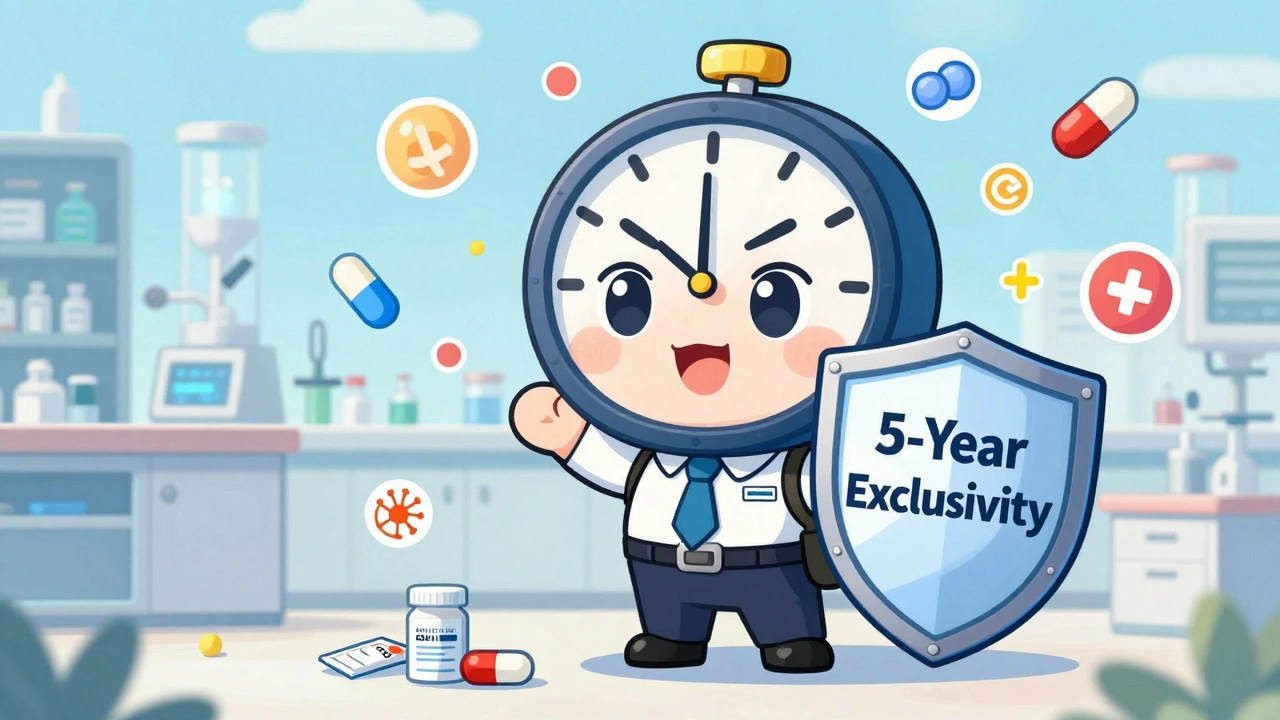
Regulatory exclusivity is a time-limited period granted by the FDA after a drug is approved. During this time, the agency can’t accept or approve applications for generic or biosimilar versions of that drug. Unlike patents, which are filed by companies and can be challenged in court, regulatory exclusivity kicks in automatically. No lawsuits. No filings. Just a clock that starts ticking the day the FDA says yes to the drug.
This system was created to balance two goals: encouraging companies to spend billions developing new drugs, while still allowing generics to enter the market eventually. The Hatch-Waxman Act of 1984 set the foundation. Before that, companies would spend 10-12 years getting a drug approved, and by the time it hit shelves, their 20-year patent was already half gone. Regulatory exclusivity fixes that gap. It starts at approval, not filing.
The Main Types of Exclusivity in the U.S.
Not all exclusivity is the same. The FDA grants different types based on the drug’s characteristics. Here’s what you’ll actually see in practice:
- New Chemical Entity (NCE) Exclusivity - 5 years. This is the gold standard for brand-new molecules. The FDA won’t even look at a generic application for the first 4 years. And even after that, they can’t approve it until the full 5 years are up. This applies to drugs like new antidepressants or cancer treatments with no prior chemical structure.
- Biologics Exclusivity - 12 years. Biologics are complex drugs made from living cells, like Humira or Enbrel. The BPCIA of 2009 gave them 12 years of protection. That’s longer than most patents last. AbbVie’s Humira, for example, didn’t face biosimilar competition in the U.S. until 2023-even though its main patent expired in 2016.
- Orphan Drug Exclusivity - 7 years. If a drug treats a rare disease affecting fewer than 200,000 Americans, it qualifies. This is why you see so many expensive drugs for tiny patient groups. In 2023, nearly half of all new FDA approvals were for orphan drugs.
- 3-Year Exclusivity - For new uses, new formulations, or new patient populations. If a drug gets approved for a new type of cancer or a new age group, the company gets 3 years of exclusivity for that specific use. It doesn’t block the original drug’s generics, just the new version.
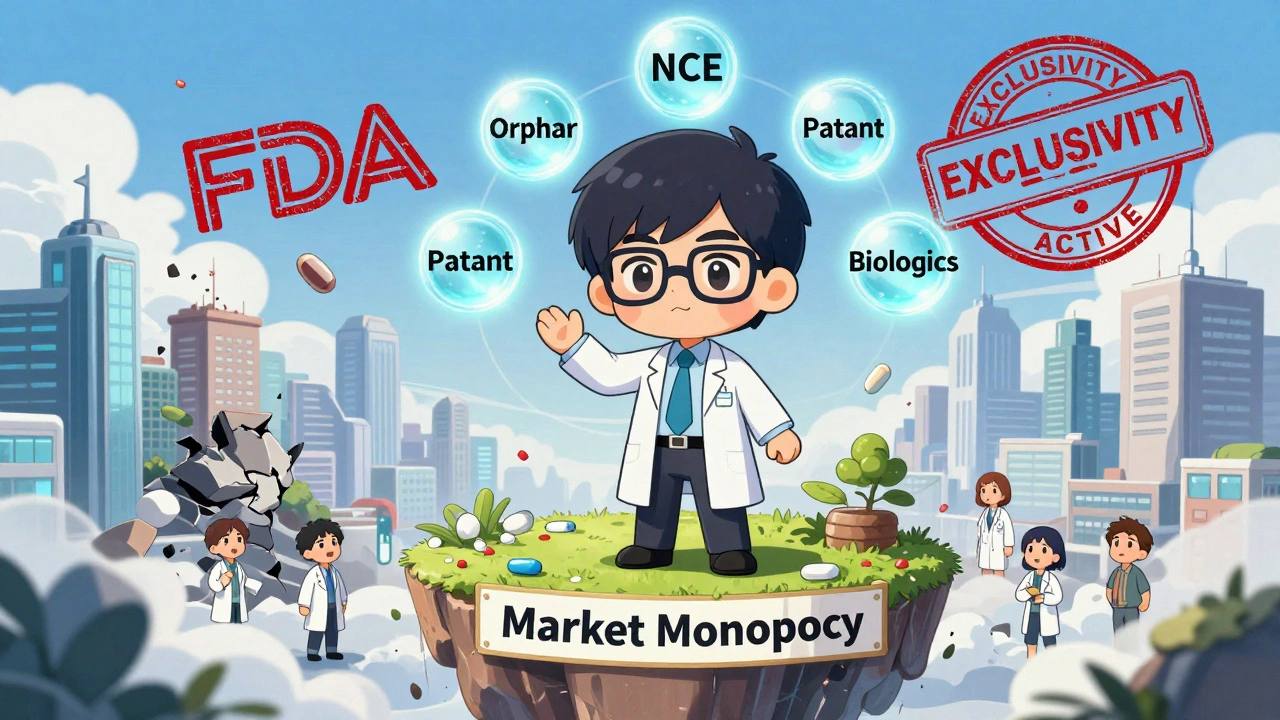
These periods can stack. A drug might have 5 years of NCE exclusivity, plus 7 years of orphan status, plus a patent that lasts 10 years. That’s 12+ years of market control before generics can even try.
How It Compares to Patents
People often confuse exclusivity with patents. Here’s the real difference:
| Feature | Regulatory Exclusivity | Patent Protection |
|---|---|---|
| Who grants it? | Food and Drug Administration (FDA) | United States Patent and Trademark Office (USPTO) |
| When does it start? | Upon FDA approval | Upon patent issuance (often years before approval) |
| Duration | Fixed: 5, 7, 12 years depending on type | 20 years from filing date |
| Can it be challenged? | No. Automatic and non-negotiable | Yes. Companies file lawsuits to invalidate them |
| What does it protect? | The drug product itself | A specific chemical structure, formula, or method |
| Does it block biosimilars? | Yes, for biologics | Only if the patent covers the biologic structure |
The key takeaway? Patents are about invention. Exclusivity is about approval. You can lose a patent fight and still have 12 years of exclusivity. That’s why companies fight hard to qualify for it.
What Happens in Other Countries?
The U.S. isn’t the only player. Other countries have their own rules:
- European Union - Uses an “8+2+1” system: 8 years of data protection, 2 years of market exclusivity, and an extra year if the drug gets a new indication.
- Japan - Grants 10 years of data exclusivity for new chemical entities.
- Canada - 8 years of data protection, but no market exclusivity.
These differences matter. A drug approved in the U.S. with 12 years of exclusivity might face competition in Europe after 10 years. That’s why big pharma companies plan global launches around these timelines.
Why It Matters for Drug Prices
Regulatory exclusivity directly affects how much you pay for medicine. IQVIA found that drugs under exclusivity sell for 3.2 times more than their generic equivalents. In 2023, Pfizer made $52.3 billion from exclusivity-protected drugs. That’s more than most countries spend on healthcare annually.
It’s not just about profit. It’s about access. When Humira had no competition for seven years after its patent expired, it brought in nearly $20 billion in U.S. sales in 2022 alone. Patients paid hundreds of dollars per injection. Once biosimilars arrived, prices dropped by 30-50% within months.
But here’s the debate: Is 12 years too long for biologics? The average development time for these drugs is 10-15 years. Critics say the 12-year exclusivity period, combined with patent extensions, gives companies 20+ years of monopoly pricing. The Congressional Research Service and Public Citizen argue this delays affordable access. Industry groups say it’s necessary to recoup R&D costs-biologics cost up to $2.7 billion to develop.
How Companies Use Exclusivity Strategically
Pharma companies don’t just wait for exclusivity. They engineer for it.
Take orphan drug status. In 2010, only 18% of new drugs were orphan drugs. By 2023, that number jumped to 47%. Why? Because 7 years of exclusivity is easier to get than 5 years of NCE status. Some companies split a single drug into multiple indications, each qualifying for 3-year exclusivity. Others file for orphan status on a rare subset of a common disease-like using a diabetes drug for a rare form of kidney disease.
It’s legal. It’s common. And it works. A senior regulatory affairs manager at a major pharma company said on Reddit: “NCE exclusivity is our most reliable protection-unlike patents which get challenged in court, the FDA simply won’t approve generics during the 5-year window.”
But it’s not easy. Tracking exclusivity dates across global markets takes teams of specialists. Excelon IP says 73% of big pharma firms now have dedicated exclusivity managers. They use the FDA’s Purple Book to track status, but even that doesn’t cover international data. One mistake in filing can cost millions.
What’s Changing Now?
The system is under pressure. The FDA’s 2024 Drug Competition Action Plan says it wants to “modernize exclusivity frameworks.” Congress has tried to cut biologics exclusivity from 12 to 10 years multiple times. The European Union is proposing to reduce data exclusivity from 8 to 6 years.
At the same time, new therapies are making exclusivity harder to apply. Cell therapies, gene therapies, and personalized medicines can’t be copied like pills. One expert noted: “Cell therapy products are protected not by exclusivity, but by their inherent irreproducibility.” That means the old rules may not fit the future.
By 2030, experts predict the average combined patent and exclusivity period will drop from 12.3 years to 10.8 years. But biologics? They’ll likely stay at 12. The pressure to lower prices is real. But so is the need to fund innovation.
What This Means for You
If you’re a patient, regulatory exclusivity means waiting longer for cheaper versions of your medication. If you’re a generic manufacturer, it means planning years ahead with no guarantee you’ll get approval. If you’re an investor, it’s the backbone of profit margins for top pharma companies.
There’s no perfect answer. Exclusivity keeps companies investing in risky, expensive research. But it also keeps prices high for years after the science is done. The system was built for pills and simple biologics. Now it’s being stretched thin by new kinds of medicine-and by public demand for affordability.
For now, it’s here to stay. But how long? That’s the next big question.
Is regulatory exclusivity the same as a patent?
No. A patent protects a specific invention, like a chemical formula or manufacturing method. It’s filed by the company and can be challenged in court. Regulatory exclusivity is granted by the FDA after a drug is approved and blocks generic versions from being approved for a set number of years. It’s automatic, doesn’t require enforcement, and applies to the drug itself, not just its formula.
Can a drug have both patent and regulatory exclusivity?
Yes, and most do. A new drug might have a 20-year patent that started when it was first invented, but if it takes 10 years to get approved, the patent could expire before the drug even hits the market. Regulatory exclusivity (like 5 or 12 years) kicks in at approval, giving the company a guaranteed period of market control even after the patent runs out.
Why do biologics get 12 years of exclusivity but small-molecule drugs only get 5?
Biologics are made from living cells and are far more complex to produce than chemical pills. It’s harder to prove they’re identical to the original, so the FDA requires more data and longer review. The 12-year period was set by Congress in 2009 to reflect the higher cost and risk of developing biologics-often over $2 billion per drug. The goal was to encourage investment in these advanced therapies.
Does regulatory exclusivity prevent all generic competition?
No. It only blocks generic or biosimilar versions that rely on the original company’s clinical data. Competitors can still develop their own versions using their own studies-but that’s expensive and time-consuming. For most companies, waiting out exclusivity is cheaper than starting from scratch. That’s why exclusivity works so well as a barrier.
How do I find out if a drug has exclusivity?
The FDA’s Purple Book is the official database for biologics exclusivity. For small-molecule drugs, the Orange Book lists patents and exclusivity. Both are public and updated weekly. You can search by drug name on the FDA website. If a drug has exclusivity, it will show the expiration date and type.
Can exclusivity be extended?
Not directly. Unlike patents, which can be extended for delays in FDA review, regulatory exclusivity periods are fixed by law. But companies can qualify for multiple types of exclusivity at once. For example, a drug might get 5 years of NCE exclusivity and 7 years of orphan status, effectively giving it 7 years of full protection, even if the NCE period ends earlier.
Ernie Blevins
December 8, 2025 AT 07:40This system is just corporate greed in a lab coat. Five years? Twelve years? Come on. They got paid back ten times over before the first generic even hit the shelf.
Nicholas Heer
December 9, 2025 AT 23:07THEY KNOW WHAT THEY DOIN. FDA? Controlled by Big Pharma. You think the 12-year biologics thing is for patients? Nah. It’s a backdoor monopoly. Congress gets bribed. The Purple Book? A lie. They’re siphoning cash while you pay $800 for an injection. Wake up.
Sangram Lavte
December 11, 2025 AT 14:35Interesting breakdown. In India, we don’t have 12-year exclusivity. Generics arrive faster, and life-saving meds are affordable. But I understand the innovation argument. It’s a tightrope.
Oliver Damon
December 12, 2025 AT 10:22There’s a deeper tension here between incentivizing innovation and ensuring equity. Exclusivity was designed as a social contract: we give you a monopoly so you take the risk. But when that monopoly stretches beyond what’s necessary to recoup R&D, it becomes extraction, not investment. We need to recalibrate the terms - not eliminate them, but align them with actual societal need.
Stacy here
December 13, 2025 AT 10:22It’s all a scam. The FDA is just a puppet for Big Pharma. They don’t care about patients. They care about profits. And the worst part? They use orphan drugs as a loophole. One pill for 200 people? Sure. But then they market it to 2 million. And charge $100K a year. It’s criminal. Someone needs to burn it all down.
Helen Maples
December 14, 2025 AT 21:00Let’s be clear: this isn’t about whether innovation should be rewarded - it should. But when a single drug brings in $50B while patients ration pills, that’s not capitalism. That’s feudalism. We need caps on exclusivity tied to R&D cost recovery, not arbitrary time blocks.
Jennifer Anderson
December 16, 2025 AT 06:39so like… if a company makes a new version of a drug for a rare condition, they get 7 years? but what if that same drug could help people with diabetes or heart disease? is it fair they lock it away just because the FDA labeled it ‘orphan’? feels like a loophole they exploit on purpose. like… why not let others use it if it’s safe? just sayin’.
Sadie Nastor
December 18, 2025 AT 02:50It’s wild how we reward innovation but punish access 😔 I get the need for profit… but when someone’s kid needs a drug and it’s $12K a month… that’s not a market failure. That’s a moral one. 🙏 Maybe we need a global fund to help offset costs during exclusivity? Just a thought.
Wesley Phillips
December 19, 2025 AT 09:40Let me tell you something about regulatory exclusivity - it’s not about science, it’s about legal engineering. The real geniuses aren’t the chemists. They’re the lawyers who figured out how to stack orphan, NCE, and 3-year exclusivity like Legos. That’s the innovation. The drug? Just the vehicle.
Desmond Khoo
December 21, 2025 AT 04:09Big pharma isn’t evil - they’re just playing the game we gave them. We told them ‘make something new and we’ll protect you.’ Now we’re mad they took the deal? Maybe we should’ve written better rules. 🤷♂️ But hey, at least we got the meds. Right?
Kyle Flores
December 22, 2025 AT 19:29i think we’re missing the point. it’s not about whether exclusivity is good or bad. it’s about whether we’re asking the right questions. instead of fighting over 12 vs 10 years, maybe we should ask: why do we let corporations decide who gets medicine? what if the government funded the research and licensed it out? just saying… maybe there’s another way.
Ryan Sullivan
December 23, 2025 AT 17:13Regulatory exclusivity is the ultimate tax on the sick. You want innovation? Fine. But let’s not pretend this isn’t a legalized racket. The FDA doesn’t protect patients - it protects profit margins. And the fact that Congress won’t touch this? That’s the real scandal.
David Brooks
December 24, 2025 AT 19:11Imagine if your car had a 12-year lock on replacement parts - no one could make a cheaper brake pad. That’s what’s happening with drugs. And we’re supposed to be okay with it because some guy in a lab ‘invented’ it? Nah. We need to break the chain.
Kyle Oksten
December 25, 2025 AT 13:09Exclusivity was meant to be a bridge - not a wall. The original intent was to balance public good and private incentive. But now the bridge is a fortress. And the people who built it? They’re still inside, laughing while the rest of us pay the toll.
Sam Mathew Cheriyan
December 26, 2025 AT 00:12wait a sec… what if the whole exclusivity thing is a distraction? what if the real issue is that the FDA approves drugs too fast and then acts like they’re sacred? maybe the problem isn’t exclusivity - it’s that we trust the system too much. they approve junk all the time. why are we giving them this much power?