 by
by Salt Substitutes and ACE Inhibitors or ARBs: The Hidden Potassium Danger
18 Jan, 2026Potassium Risk Calculator
Is This Salt Substitute Safe For You?
This tool helps assess your risk of dangerous potassium levels when using salt substitutes while taking ACE inhibitors or ARBs.
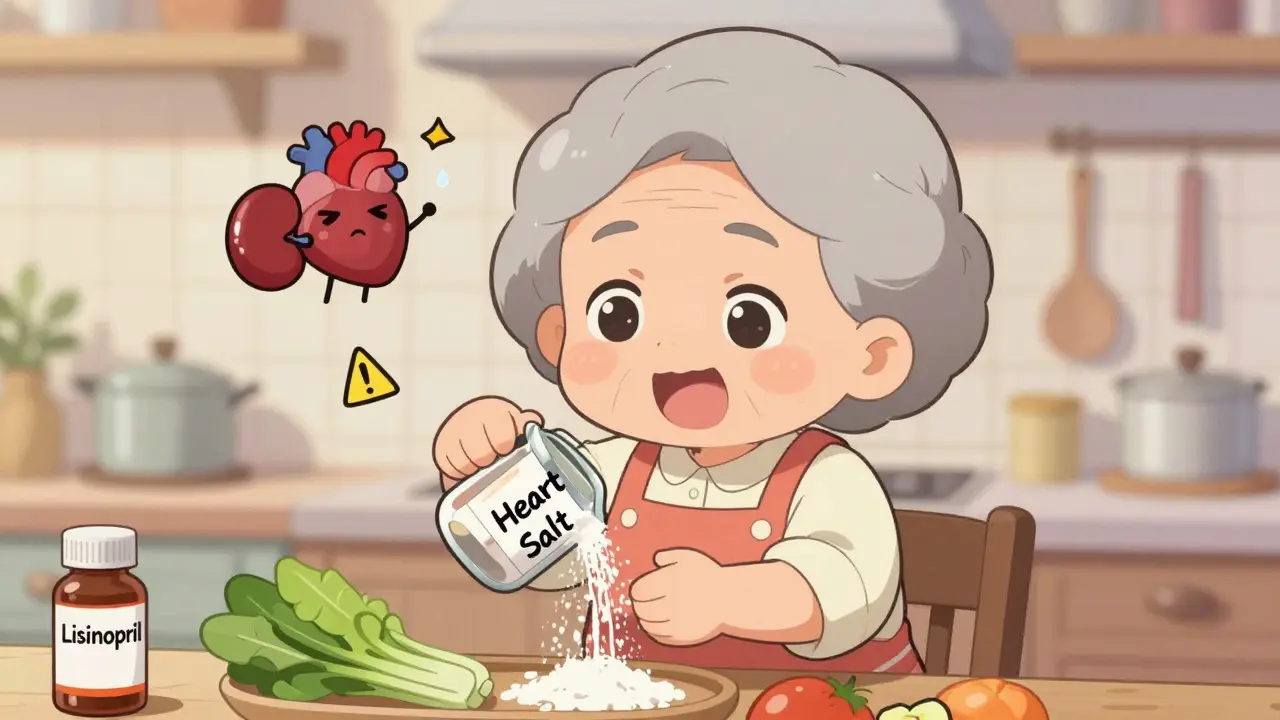
Many people switch to salt substitutes thinking they’re making a healthier choice-especially if they’re managing high blood pressure. But for those taking ACE inhibitors or ARBs, that swap could be life-threatening. It’s not just about cutting sodium. It’s about what’s replacing it: potassium chloride. And when that meets certain heart and kidney medications, the result can be dangerously high potassium levels in the blood-a condition called hyperkalemia.
What’s in Salt Substitutes?
Most salt substitutes don’t remove sodium. They replace part of it with potassium chloride. Common brands like LoSalt, NoSalt, and Heart Salt contain anywhere from 50% to 70% potassium chloride. That means every teaspoon you use adds 400-600 mg of potassium to your diet. For someone eating normally, that’s a big jump. The average adult gets about 2,800 mg of potassium daily from food. Add a salt substitute, and you’re suddenly pushing past 3,300 mg-sometimes even higher.That sounds fine until you realize your body doesn’t always know how to get rid of the extra potassium. And if you’re on an ACE inhibitor or ARB, your kidneys are already being told to hold onto more of it.
How ACE Inhibitors and ARBs Work-and Why They’re Risky With Potassium
ACE inhibitors (like lisinopril, enalapril) and ARBs (like losartan, valsartan) are common prescriptions for high blood pressure, heart failure, and kidney protection in diabetics. They work by blocking the renin-angiotensin-aldosterone system. That’s good for lowering blood pressure, but it also reduces aldosterone-a hormone that tells your kidneys to pee out potassium.Less aldosterone = less potassium excretion. That’s why these drugs are known to cause mild potassium increases in some people. Add a potassium-rich salt substitute, and the system gets overloaded. Your kidneys can’t keep up. Potassium builds up. And when it hits 5.0 mmol/L or higher, your heart starts to misfire.
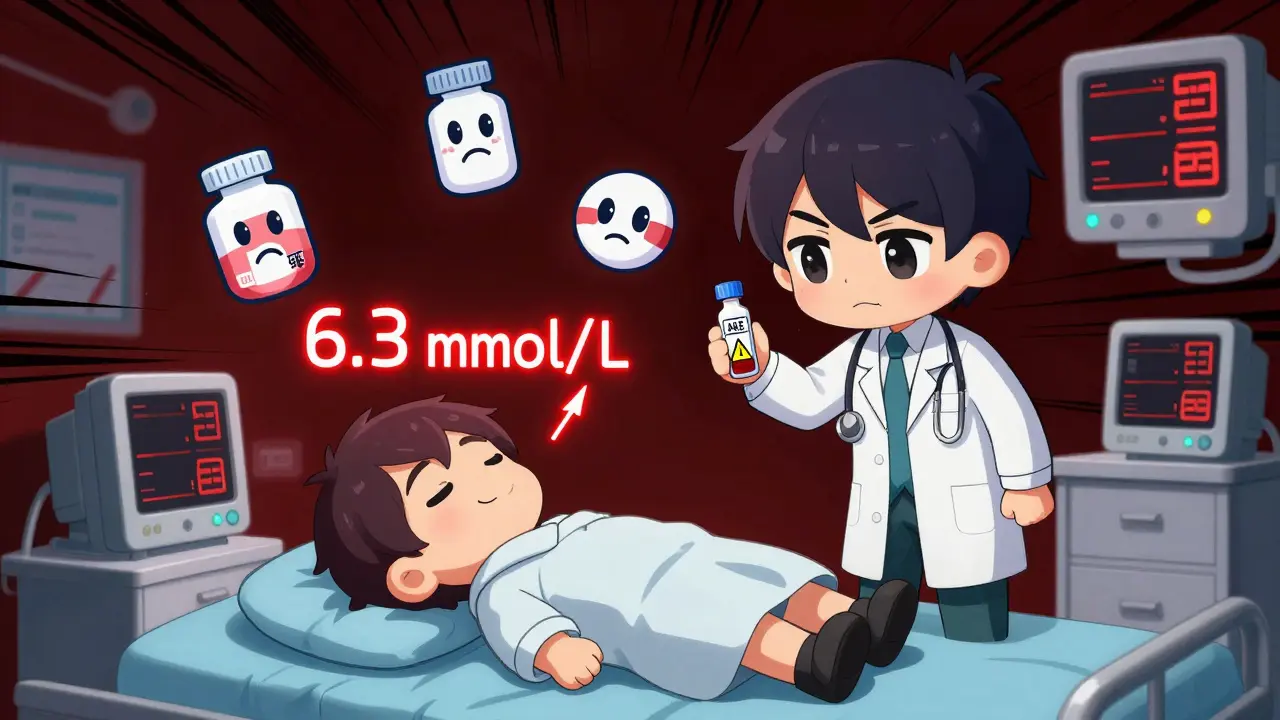
At 6.5 mmol/L or above, you’re at risk for cardiac arrest. That’s not theoretical. In 2004, a 72-year-old man on nabumetone and lisinopril used LoSalt for three weeks. His potassium hit 7.8 mmol/L. He went into cardiac arrest. He survived, but barely. That case was published in the Journal of the Royal Society of Medicine. It wasn’t rare. It was predictable.
Who’s Most at Risk?
Not everyone is equally vulnerable. The biggest danger is for people with:- Chronic kidney disease (CKD), especially stage 3 or worse (eGFR below 60)
- Diabetes with hyporeninemic hypoaldosteronism (affects 10-20% of diabetics with kidney issues)
- Age over 65
- Already high potassium levels (above 4.5 mmol/L)
One in seven U.S. adults has CKD. That’s 37 million people. And nearly half of them are on ACE inhibitors or ARBs. The numbers don’t lie: a 2019 analysis found that CKD patients on these drugs who used potassium salt substitutes had nearly 11 times the risk of hyperkalemia compared to others.
Even people who think they’re healthy might be at risk. Many don’t know they have early-stage kidney disease. A routine blood test might show normal creatinine, but eGFR could already be dropping. That’s why doctors need to ask-not assume.
What Do the Studies Say?
There’s a big divide in the research. On one side, a 2025 JAMA study followed 21,000 people for five years. Those using a salt substitute with 25% potassium chloride had a 14% lower risk of stroke. No increase in hyperkalemia. That’s why the American Heart Association is now considering recommending them for the general public.But here’s the catch: that study excluded people with advanced kidney disease or those on ACE inhibitors/ARBs. The benefits? Real. The risks? Hidden in the fine print.
Meanwhile, nephrologists like Dr. Mark S. Segal warn that these findings don’t apply to high-risk groups. A 2022 study in the Journal of the American Society of Nephrology showed that in patients with eGFR under 45, even small potassium increases from salt substitutes led to hospitalizations. The same 2025 study that showed stroke reduction found hyperkalemia rates jumped to 8.7 events per 100 person-years in CKD patients on ACE inhibitors. That’s not a small risk. That’s a red flag.
Real People, Real Consequences
Online forums are full of stories that don’t make it into journals.One Reddit user with 4,200 karma wrote: “Woke up in the ER with potassium at 6.3 after using ‘Heart Salt’ for three weeks while on lisinopril.”
A Drugs.com review from a 68-year-old in Michigan said: “Severe muscle weakness. Irregular heartbeat. My doctor said I was lucky I didn’t have a heart attack.”
On Amazon, 7% of reviews from users who self-reported kidney disease mentioned their doctor told them to stop the salt substitute after bloodwork showed high potassium.
These aren’t outliers. They’re symptoms of a system that doesn’t warn people.
Labeling Is a Mess
You’d think the package would say: “Don’t use if you’re on blood pressure meds.” But it doesn’t.In 2023, the FDA reviewed 12 major salt substitute brands. Only three had clear warnings about ACE inhibitors or ARBs. The rest? Silent. No bold text. No icons. No “Caution” box. Just a tiny footnote about “potassium content.”
Canada changed that in January 2024. All potassium salt substitutes sold there now must carry the label: “Contraindicated in patients taking ACE inhibitors or ARBs.”
The U.S. hasn’t. In September 2023, FDA official Dr. Lisa M. Wruck told Congress the current labeling is “inadequate for high-risk populations.” A proposed rule to fix this is expected in mid-2026. But until then? You’re on your own.
What Should You Do?
If you’re taking an ACE inhibitor or ARB:- Ask your doctor or pharmacist if you’re using a salt substitute. Many patients don’t even realize they’re using one.
- Get a blood test for potassium. If it’s above 4.5 mmol/L, stop using potassium-based substitutes immediately.
- Don’t assume you’re fine because you feel okay. Hyperkalemia often has no symptoms until it’s too late.
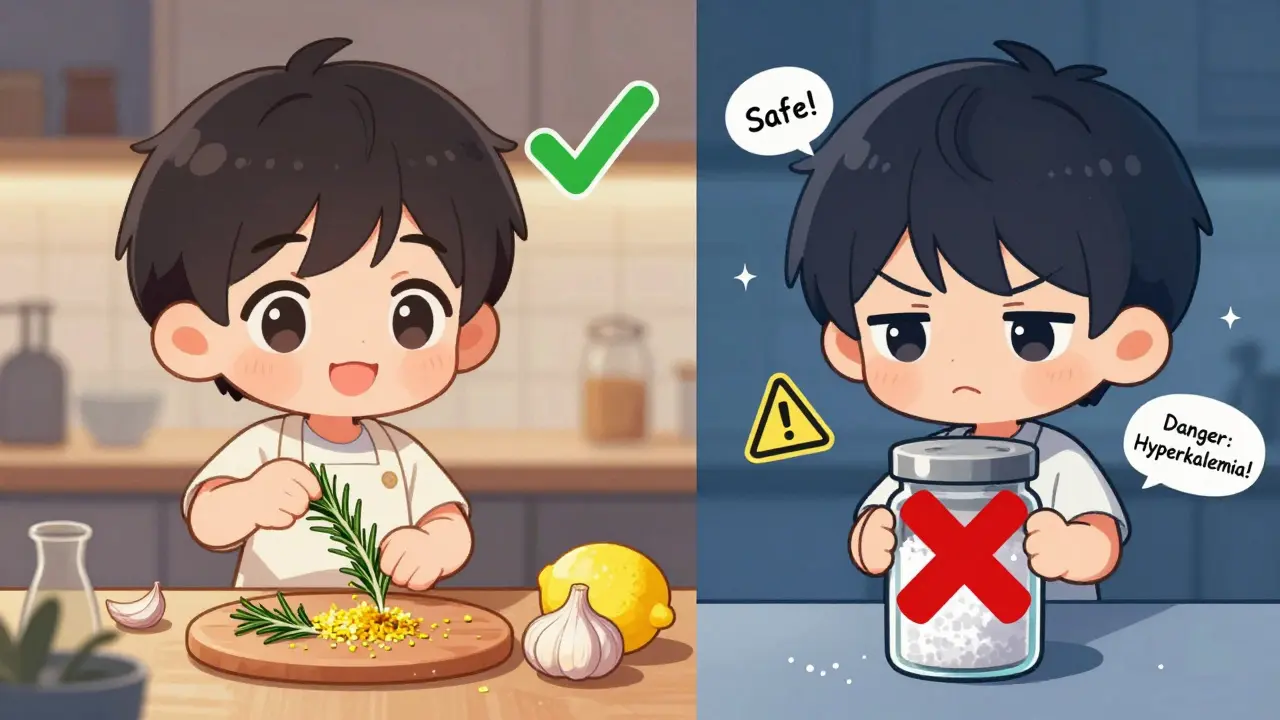
- Use herbs and spices instead. Rosemary, garlic, cumin, lemon zest, and Mrs. Dash can reduce sodium by 40-50% without touching potassium.
- Check your processed foods. Even if you stop using salt substitutes, you might still be getting too much potassium from low-sodium soups, canned beans, or protein shakes.
If you have CKD or diabetes, avoid potassium salt substitutes entirely unless your doctor gives you a clear green light-and even then, get your potassium checked every 3 months.
Alternatives That Actually Work
You don’t need potassium chloride to lower your blood pressure. You just need less sodium-and better flavor.Here’s what works:
- Herbs and spices: Use 2-3 tablespoons of dried herbs per pound of meat or vegetables. No potassium. No risk.
- Lemon or lime juice: Adds brightness. Reduces salt need by 20-30%.
- Vinegars: Apple cider, balsamic, rice wine vinegar-great for dressings and marinades.
- Low-sodium broths: Make your own with bones and veggies. Avoid store-bought unless labeled “no added salt.”
- Wait 10 minutes after cooking: Taste before adding salt. Often, you don’t need it.
These methods won’t cut sodium as much as potassium salt substitutes-but they’re safe. And if you’re on ACE inhibitors or ARBs, safety matters more than speed.
The Bottom Line
Salt substitutes aren’t inherently bad. For healthy people without kidney issues, they can help lower blood pressure and reduce stroke risk. But for the 10-15% of adults on ACE inhibitors or ARBs-especially those with kidney disease-they’re a ticking time bomb.The problem isn’t the salt substitute. It’s the lack of awareness. Patients don’t know. Doctors don’t ask. Labels don’t warn. And the consequences? They’re silent until it’s too late.
If you’re on one of these medications, don’t guess. Don’t assume. Ask. Test. Switch to herbs. Your heart will thank you.
Malikah Rajap
January 19, 2026 AT 20:30Wow, I had no idea my "healthy" salt substitute was basically a potassium bomb waiting to go off... I’ve been using LoSalt for years because I thought I was being so smart about my blood pressure. Now I’m terrified. My mom’s on lisinopril too. I’m gonna text her right now.
Jacob Hill
January 21, 2026 AT 12:51Same. I switched to NoSalt after my cardiologist told me to cut sodium, never once thinking about potassium. I just assumed all salt substitutes were created equal. My last blood test showed 5.1-I’m getting retested tomorrow. This post literally saved me.
Aman Kumar
January 21, 2026 AT 13:41Let me be blunt: this isn't a failure of labeling-it's a failure of medical literacy. Patients are passive recipients of pharmaceutical capitalism, swallowing convenience without interrogating the pharmacokinetics. Potassium chloride is not a substitute-it's a pharmacological Trojan horse, and the FDA's inaction is not negligence-it's institutional complicity. The system is designed to keep you docile, compliant, and quietly hyperkalemic.
Christi Steinbeck
January 21, 2026 AT 21:52STOP WHAT YOU’RE DOING RIGHT NOW. If you’re on an ACE inhibitor or ARB and using ANY salt substitute-stop. Immediately. Go check your last lab results. If potassium is above 4.5, you’re playing Russian roulette with your heart. I’m not being dramatic-I’ve seen two patients code because of this. You can flavor food with lemon, garlic, smoked paprika-no potassium needed. Your life is worth more than convenience.
Lewis Yeaple
January 23, 2026 AT 11:20While the clinical implications of potassium chloride ingestion in conjunction with renin-angiotensin-aldosterone system inhibitors are well-documented in peer-reviewed literature, the public health communication deficit remains alarming. The absence of mandated labeling constitutes a breach of the duty to inform, particularly given the prevalence of undiagnosed chronic kidney disease in the aging population. A regulatory intervention is not merely advisable-it is ethically imperative.
Jackson Doughart
January 25, 2026 AT 06:58I’ve been a nephrology nurse for 18 years. I’ve seen this exact scenario play out too many times. Patient comes in with palpitations, EKG shows peaked T-waves, potassium’s through the roof-and they say, "But I’m trying to eat healthy!" It breaks my heart. This isn’t about fear-mongering. It’s about making sure people know: "healthy" doesn’t always mean "safe for you."
sujit paul
January 26, 2026 AT 09:34This is all part of the Great Salt Conspiracy. Big Pharma doesn’t want you to know that herbs and spices are cheaper than pills. The FDA’s delay? A cover-up. They’re protecting the billion-dollar potassium chloride industry. Canada got it right-because they’re not bought. Meanwhile, Americans are being quietly poisoned by silent sodium substitutes. Wake up, sheeple. Your kidneys are the canaries in the coal mine.
Tracy Howard
January 27, 2026 AT 15:54Canada did what was right. Of course they did. We’ve always been more responsible. The U.S. still lets people buy poison with a tiny footnote. It’s embarrassing. If you’re using LoSalt in America, you’re not just taking a risk-you’re participating in a national failure of public health. Shame on you. Shame on the FDA.
Erwin Kodiat
January 27, 2026 AT 18:16My abuela used nothing but garlic, lime, and cumin. No salt, no substitutes. Her blood pressure was perfect. She lived to 94. Maybe we don’t need fancy chemicals-we just need to go back to the way food used to taste. Simple. Real. Safe.
Jake Rudin
January 29, 2026 AT 14:06There’s a deeper question here: why do we outsource our health to products? We don’t think about what’s in the salt substitute because we’ve been trained to believe that convenience is wisdom. But wisdom requires attention. Attention requires effort. And effort is uncomfortable. So we buy the bottle labeled "heart-healthy" and call it done. But health isn’t a product-it’s a practice. And practices require awareness.
Astha Jain
January 29, 2026 AT 23:41Valerie DeLoach
January 30, 2026 AT 19:24To everyone who just realized they’ve been using a potassium salt substitute: you’re not alone, and you’re not stupid. This is a systemic failure-not your fault. Now, take a breath. Call your doctor. Ask for a potassium test. Switch to herbs. You’re already doing the right thing by reading this. Keep going. You’ve got this. And if you’re reading this and you’re on an ACE inhibitor? Don’t wait for symptoms. Ask. Test. Protect yourself. You deserve to live well.