 by
by What Are Biosimilars? A Simple, Patient-Friendly Guide
16 Mar, 2026When you hear the word biosimilars, it might sound confusing - like a mix of science and jargon. But here’s the simple truth: biosimilars are not new or experimental. They’re proven, safe, and often more affordable versions of powerful biologic drugs you may already know.
What’s the Difference Between Biosimilars and Generics?
Most people know generics - like the generic version of ibuprofen or metformin. These are exact chemical copies of older, small-molecule drugs. They’re made in a lab using precise formulas, so every pill is nearly identical to the brand-name version.
Biosimilars? They’re not like that.
Biologic drugs - the ones biosimilars copy - are made from living things: human or animal cells, bacteria, or yeast. Think of them like a complex recipe made in a living kitchen. Even tiny changes in temperature, ingredients, or process can change the final product. That’s why a biosimilar can’t be an exact copy. It’s designed to be highly similar - with no meaningful difference in how it works, how safe it is, or what side effects it causes.
The FDA says it plainly: biosimilars must match the original biologic in safety, purity, and strength. That’s not a guess. It’s backed by years of lab tests, animal studies, and real patient trials.
How Are Biosimilars Made - And Why Does It Matter?
Biologics are made from living cells that have been genetically modified to produce specific proteins - like antibodies that target inflammation or cancer cells. These proteins are huge, complex molecules, often with sugars attached. The exact shape, folding, and structure of these molecules determine how well they work in your body.
Manufacturing a biosimilar means starting with a similar living cell line, using similar processes, and testing every step to prove it behaves just like the original. It’s not just about the final product. It’s about how it’s made - from the cell culture to the final injection.
That’s why biosimilars cost more to develop than generics. A generic drug might cost $1 million to bring to market. A biosimilar? Often over $100 million. But the payoff? Lower prices for patients.
Are Biosimilars Safe? Real Evidence, Real Results
Some patients worry: “If it’s not the same, is it safe?”
Here’s what the data says: since the first biosimilar was approved in the U.S. in 2015 (Zarxio, for chemotherapy patients), over 30 biosimilars have been approved and used by hundreds of thousands of people. In Europe, where biosimilars have been around since 2006, studies show no increase in side effects or loss of effectiveness compared to the original biologics.
Take Renflexis, a biosimilar for rheumatoid arthritis. Before approval, it was tested in 541 patients - and matched the original drug exactly in how well it reduced joint pain and swelling. Same dose. Same frequency. Same results.
The FDA doesn’t approve biosimilars unless they meet the same strict manufacturing standards as the original. And once approved, every biosimilar is tracked. If someone has a reaction, it’s reported, studied, and acted on - just like the original drug.
What Conditions Are Treated With Biosimilars?
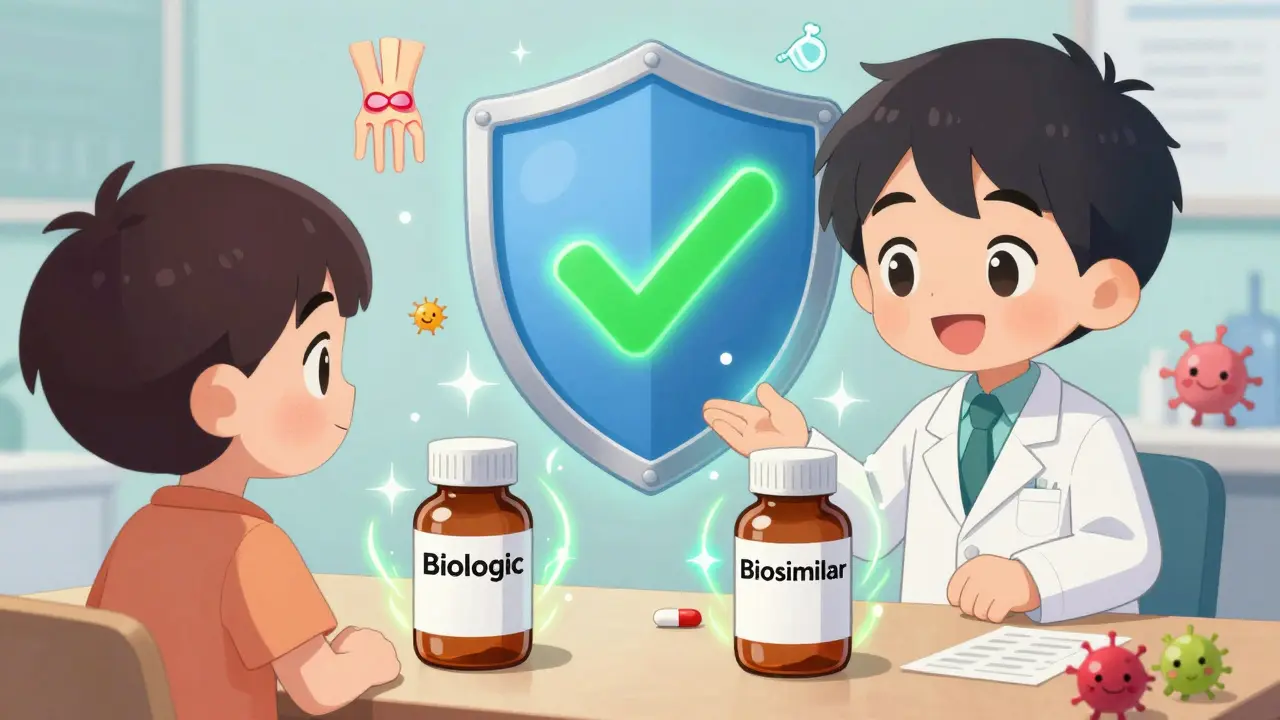
Biosimilars aren’t just for one disease. They’re used to treat serious, long-term conditions where biologics have changed lives:
- Autoimmune diseases like rheumatoid arthritis, psoriasis, and Crohn’s disease
- Cancer - especially breast cancer, colon cancer, and lymphoma
- Diabetes - biosimilar insulins help control blood sugar
- Chronic kidney disease
- Macular degeneration (a leading cause of vision loss)
For example, biosimilars for adalimumab (Humira) and infliximab (Remicade) are now widely used to treat inflammatory conditions. These drugs used to cost over $2,000 per dose. Biosimilars can cut that cost by 20-30% - and sometimes even more.
How Do You Know If You’re Getting a Biosimilar?
Biosimilars have names that look similar - but not identical - to the original.
Take infliximab - the original drug. Its biosimilar might be called infliximab-dyyb. The extra four letters at the end are not random. They’re a unique identifier, like a fingerprint, so doctors and pharmacists can track exactly which version you’re taking.
Your doctor will tell you if you’re being prescribed a biosimilar. Your insurance might also push you toward one because it’s cheaper - and that’s okay. Switching from the original biologic to a biosimilar has been studied extensively. Multiple trials show it’s safe and effective. You won’t lose effectiveness. You won’t suddenly have new side effects.
Cost Matters - Here’s What You Can Expect
Biologics are among the most expensive drugs in the world. A single dose of Humira can cost over $2,500. Without insurance, that’s $30,000 a year.
Biosimilars don’t always cut the price in half - but they do cut it significantly. Most cost 15-30% less. In some cases, when multiple biosimilars enter the market, prices drop even further. One study estimated that biosimilars could save the U.S. healthcare system over $54 billion between 2017 and 2026.
For patients, that means lower copays. Fewer refusals from insurance. More people getting the treatment they need.
What About “Interchangeable” Biosimilars?
There’s a special category called “interchangeable” biosimilars. These are biosimilars that the FDA says can be swapped for the original drug without the doctor’s approval - just like a generic.
The first one approved was Semglee, an insulin glargine biosimilar for diabetes. It’s now being used by many patients who need daily insulin. This is a big step forward - it means easier access and fewer barriers.
More interchangeable biosimilars are coming. The FDA is speeding up approvals to make sure patients get these savings as quickly as possible.
What Should You Do If Your Doctor Suggests a Biosimilar?
Ask questions. But don’t assume it’s a downgrade.
Here’s what to ask:
- Is this a biosimilar? If so, which one?
- Has it been tested in people like me?
- Will it work the same way as the original?
- Will my insurance cover it?
- What happens if I switch from the original?
Most patients who switch report no change in how they feel. No new side effects. No drop in effectiveness. In fact, many feel better because they’re finally able to afford their treatment.
Never stop or switch without talking to your doctor. But if your doctor says it’s a good option - trust the science. Biosimilars aren’t a compromise. They’re a smart, safe, and proven choice.
Final Thought: You’re Not Getting Second-Best
Biosimilars aren’t “cheap knockoffs.” They’re carefully built, rigorously tested, and medically identical in every way that matters.
They exist because biologics saved lives - but were too expensive for too many people. Biosimilars are the answer: bringing the same power, the same safety, and the same hope - at a price more people can afford.
If you’re on a biologic today - or thinking about starting one - ask your doctor: Is there a biosimilar option for me? You might be surprised by how much it could change your life.
Are biosimilars the same as generics?
No. Generics are exact chemical copies of small-molecule drugs - like aspirin or metformin. Biosimilars are highly similar to complex biologic drugs made from living cells. They can’t be exact copies because biologics are too complex. But they must prove they work the same way, with the same safety and effectiveness.
Are biosimilars safe?
Yes. The FDA requires extensive testing - including lab studies, animal tests, and clinical trials - before approving any biosimilar. Over 30 have been approved in the U.S., and millions of patients have used them. Studies in Europe, where they’ve been used for over 15 years, show no increase in side effects or loss of effectiveness.
Can I switch from a biologic to a biosimilar?
Yes. Multiple studies show that switching from a reference biologic to a biosimilar is safe and effective. Your body won’t react differently. Your condition won’t worsen. Many patients switch without even noticing a difference. Always talk to your doctor before switching, but there’s no reason to fear it.
Why are biosimilars cheaper than the original biologics?
Because they don’t need to repeat all the early research. The original biologic already proved it works. Biosimilar makers only need to prove their version is highly similar - which is expensive, but far less than developing a new drug from scratch. That savings gets passed on to patients and insurers.
Will my insurance require me to use a biosimilar?
Sometimes. Many insurance plans encourage or require biosimilars because they’re less expensive. This is called “step therapy.” If your plan does this, it’s legal and common. You can still ask your doctor if the original is medically necessary - but in most cases, biosimilars work just as well.
How do I know if I’m getting a biosimilar?
The name will be slightly different. For example, if your drug is infliximab, the biosimilar might be infliximab-dyyb. The four-letter ending is a unique identifier. Your doctor or pharmacist will tell you if you’re getting a biosimilar. You can also check your prescription label or ask your pharmacy.
Do biosimilars have the same side effects as the original?
Yes. Since biosimilars are designed to be highly similar, their side effect profiles are nearly identical. Clinical trials are specifically designed to detect any differences in safety. If a biosimilar had new or worse side effects, it wouldn’t be approved.
Are biosimilars used for cancer treatment?
Yes. Several biosimilars are approved for cancer, including versions of trastuzumab (Herceptin) for breast cancer, bevacizumab (Avastin) for colon cancer, and rituximab (Rituxan) for lymphoma. These biosimilars have been studied in thousands of cancer patients and are now standard options in oncology.
What’s the difference between a biosimilar and a bioidentical?
A bioidentical is made using the exact same production process as the original biologic - meaning it’s chemically identical. Biosimilars are made with a similar process and must be highly similar, but not identical. Bioidenticals are rare. Most approved products are biosimilars, not bioidenticals.
Is there a biosimilar for insulin?
Yes. Semglee is an interchangeable biosimilar to insulin glargine (Lantus). It’s been approved since 2021 and is now widely used. Other insulin biosimilars are also in development. These are helping people with diabetes save hundreds - even thousands - of dollars a year.
Melissa Starks
March 18, 2026 AT 03:22I've been on Humira for five years now, and when my insurance pushed me to switch to the biosimilar, I was terrified. I thought, 'This is going to be a disaster.' But honestly? Nothing changed. No new rashes, no flare-ups, no weird side effects. I even checked my bank account - my copay dropped from $450 to $120. I didn't realize how much stress I was under just from the cost until it was gone. If you're scared to switch, I get it. But trust me, the science isn't lying. You're not getting a downgrade. You're getting the same medicine, at a price that doesn't make you choose between rent and your next dose.
Linda Olsson
March 18, 2026 AT 22:01Let’s be real - biosimilars are just Big Pharma’s way of keeping the profit machine running while pretending to care about patients. They’re not 'highly similar' - they’re barely similar enough to slip through regulatory loopholes. I’ve read the clinical trials. The 'no meaningful difference' claim is a joke. They test on small groups, cherry-pick endpoints, and ignore long-term immune responses. And don’t even get me started on the 'interchangeable' label - that’s just a legal loophole so pharmacists can swap your drug without telling you. You think your doctor knows? Half of them don’t. This is corporate manipulation dressed up as progress.
Ayan Khan
March 20, 2026 AT 17:03In India, we’ve been using biosimilars for over a decade - for cancer, for arthritis, for diabetes. I’ve seen patients who couldn’t afford biologics suddenly live full lives because of them. The fear around biosimilars isn’t scientific - it’s cultural. We’ve been taught to equate 'expensive' with 'better.' But medicine isn’t luxury. It’s survival. A biosimilar isn’t a compromise - it’s justice. If a child in rural Bihar can get insulin because it costs $10 instead of $100, that’s not a compromise. That’s progress. Let’s stop romanticizing the original and start celebrating access.
Shameer Ahammad
March 22, 2026 AT 00:26It is absolutely imperative to clarify, with utmost precision, that the notion of biosimilars being 'equivalent' to original biologics is, in fact, a gross misrepresentation of the regulatory framework. The FDA's standards for 'highly similar' are not identical to 'identical' - and this distinction is not semantic; it is foundational. Furthermore, the absence of long-term, post-marketing surveillance data across diverse populations renders any claim of universal safety suspect. One must consider the pharmacokinetic variability introduced by manufacturing differences - particularly in glycosylation patterns - which may, in theory, influence immunogenicity over time. This is not alarmism; it is scientific rigor.
Alexander Pitt
March 22, 2026 AT 11:11Just as a refresher - biosimilars undergo head-to-head trials against the original drug, including immunogenicity studies, pharmacokinetic profiling, and clinical outcome comparisons. They’re not approved unless they meet the same batch-to-batch consistency standards as the original. The FDA even requires post-market monitoring. If a biosimilar had a different side effect profile, it would’ve been pulled years ago. We’ve had over 30 approved in the U.S. and millions of doses administered. The data is there. It’s not opinion. It’s evidence. Stop confusing 'not identical' with 'not safe.'
Manish Singh
March 23, 2026 AT 15:26My cousin in Delhi has psoriasis. She was paying $800 a month for Remicade. When the biosimilar came in at $200, she cried. Not because she was scared - because she finally felt like she could breathe again. I’ve seen people skip doses because they can’t afford it. Biosimilars don’t just lower costs - they restore dignity. The fear around them? It’s not about science. It’s about fear of change. But change saved her life. And if it can do that for her, why are we still arguing?
Nilesh Khedekar
March 25, 2026 AT 03:19wait so you're telling me the government let big pharma make a 'kinda same' version of a drug that costs 10x more?? like bro this is wild. i mean i get it they need to make money but like... why not just make the original cheaper? why do we need a whole new name and a 4 letter code?? feels like a scam. also i heard a guy on youtube who said biosimilars cause 'stealth autoimmunity' - idk if that's true but i'm not taking it. also my aunt took one and her knee started tingling?? maybe coincidence but i'm not risking it. #biosimilarfear
Emily Hager
March 26, 2026 AT 02:07While I appreciate the optimism expressed in this article, I must insist that the entire biosimilar paradigm is a dangerous erosion of therapeutic integrity. The notion that a molecule produced in a different cell line, under different environmental conditions, with potentially altered glycosylation profiles, can be deemed 'medically identical' is not merely scientifically questionable - it is ethically indefensible. To suggest that patients should 'trust the science' while being denied the right to choose the original, clinically validated product is a violation of patient autonomy. This is not affordability - this is coercion disguised as innovation. I refuse to be a participant in this experiment.
Robin Hall
March 26, 2026 AT 16:24Have you ever heard of the 'black box' effect? Biosimilars are tracked via those four-letter suffixes - but who’s monitoring the real-world outcomes? Who’s tracking if a patient switches back and forth between biosimilars and originals? Who’s checking for cumulative immune reactions? The FDA doesn’t require long-term studies beyond the initial approval. And let’s not forget - the original manufacturers still own the patents on the delivery systems, the auto-injectors, the packaging. The biosimilar is cheaper, but the whole system is still rigged. This isn’t progress. It’s a shell game.
Andrew Muchmore
March 27, 2026 AT 02:42My doctor switched me to a biosimilar last year. I was skeptical. But after six months? Same results. Same energy. Same no-flare days. The only difference? My wallet stopped bleeding. I didn’t need a lecture. I didn’t need a pamphlet. I just needed to be able to afford my life. If you’re scared - ask your doctor. But don’t let fear stop you from getting the treatment you need. You’re not taking a risk. You’re taking back control.
SNEHA GUPTA
March 28, 2026 AT 05:41It’s fascinating how we assign moral weight to cost. We call expensive drugs 'premium' and affordable ones 'compromises.' But medicine isn’t a status symbol - it’s a tool. The original biologic was revolutionary. The biosimilar is evolution. One didn’t erase the other. One made the other accessible. Perhaps the real question isn’t whether biosimilars work - but why we still believe that value must be measured in price tags rather than outcomes. If a life is saved, does it matter if the molecule was grown in a bioreactor in Ohio or Bangalore? Or does it matter that the person is alive?